Generally, drying (or dewatering) is a simple process of excess water (moisture) removal from a natural or an industrial product to preserve it (foodstuff) or to reach a specified moisture content. Drying is an energy-intensive process, especially when used for food products, as these generally have a water content which is much higher (about 25–80%) than is suitable for long preservation. Therefore the purpose of drying an agricultural product is to reduce its moisture content to a level that prevents its deterioration. It is essential to reduce the moisture content of foodstuff down to a certain level so as to slow down the action of enzymes, bacteria, yeasts and molds, this enables the food to be stored and preserved for long time without spoilage. Additionally, drying can be used for the total removal of moisture until the food has no moisture at all. When ready to use, the dehydrated food is re-watered and almost regains its initial conditions. Generally, crops are very sensitive to the drying conditions. Drying must be performed in a way that does not seriously affect their color, flavor, texture, or nutritional value. Thus the selection of drying conditions, especially temperature, is of major importance.
Solar drying is another very important application of solar energy. Solar dryers use air collectors to collect solar energy. The dryers are used primarily by the agricultural industry. In drying, two processes take place: one is a heat transfer to the product using energy from the heating source, and the other is a mass transfer of moisture from the interior of the product to its surface and from the surface to the surrounding air, in the form of water vapor.
Traditionally, farmers used the open-to-the-sun or natural drying technique, which achieves drying by using solar radiation, ambient temperature, relative humidity of ambient air, and natural wind.
This process has been used for millennia to preserve food. The technique involves the spread of the product to be dried in a thin layer on large outdoor threshing surfaces or concrete floors, where it is left until has been dried up to the desired moisture content. From time to time the material has to be turned over to accelerate drying by permitting trapped moisture to escape. Generally, the drying surface is made from concrete paved floors lined with polyethylene sheets; however sensitive food material is placed on perforated trays. Obviously the drying rate in the process is very slow, so the crops must remain outdoors for long periods of time, usually 10–30 days, depending on the product and the weather conditions of the site.
During drying, solar radiation is falling on the crop surface and simultaneously moisture is transferred from the material to the ambient air. A part of the solar radiation is lost to the atmosphere and to the surrounding soil. Heat and moisture transfer take place by natural convection and diffusion, respectively, and both depend on weather conditions and mostly on solar radiation intensity and wind velocity. According to Ramana (2009) more than 80% of food produced by small farmers in developing countries is dried by natural open-to-the-sun drying.
Capacity wise, and despite the very rudimentary nature of the process, natural drying remains the most common method of solar drying. This is because the energy requirements, which come from solar radiation and the air enthalpy, are readily available in the ambient environment and no capital investment in equipment is required. The process, however, has some serious limitations. Usually, the material must remain outdoors for a prolonged time-period. During this time, the farmer’s goods are subject to weather changes and natural attacks. The most obvious limitations are that the crops suffer the undesirable effects of dust, dirt, atmospheric pollution, and insect and rodent attacks. Because of these limitations, the quality of the resulting product can be degraded, sometimes beyond edibility. Cases exist also of complete or partial deterioration of crops due to sudden storms, heavy rains, or hail that can harm even the plastic cover, if used. Very sensitive crops are spread on trays covered with transparent material and are dried by the sun’s radiation and natural air circulation. All these disadvantages can be eliminated by using a solar dryer.
The technique of open-to-the-sun drying has changed very little since its early prehistoric uses. The sun’s free energy for drying is offset by a number of disadvantages, which reduce not only the quantity but also the quality of the final product. The main ones are that the whole procedure depends on the experience of unskilled personnel; the lack of any scientific control of the final quality and moisture content which depends only on observations and experience; the very slow rate operation which, depending on the nature of product and the prevailing weather conditions, can take place from a few days up to 1 month; the fact that the product is exposed directly to all kinds of weather changes, as rain, hail, and strong winds that can rot or destroy totally the material; and the very large qualitative and quantitative losses due to all weather and natural attack conditions closely related to the open-air procedure (Belessiotis and Delyannis, 2011).
Irrespective of all these disadvantages, open-to-the-sun drying is an economic procedure that needs little initial capital. With good weather and continuous observation of the drying progress, especially for foodstuff that dries quickly, the final product can be very good.
Solar radiation, in the form of solar thermal energy, is an alternative source of energy for drying, especially to dry fruits, vegetables, agricultural grains, and other kinds of materials, such as wood and timber. It is estimated that in developing countries significant post-harvest losses of agricultural products exist, due to the lack of other preservation means, which can be saved by using solar dryers. For solar drying, many products need pre-treatment to facilitate drying or to keep their flavor and texture. Fruit’s high sugar and acid content makes the direct sun drying safe. On the contrary, vegetables have low sugar and acid content which increases the risk of spoilage during open-air drying (Belessiotis and Delyannis, 2011).
The purpose of a dryer is to supply more heat to the product than that available naturally under ambient conditions, thus increasing sufficiently the vapor pressure of the crop moisture. Therefore, moisture migration from the crop is improved. The dryer also significantly decreases the relative humidity of the drying air, and by doing so, its moisture-carrying capability increases, thus ensuring a sufficiently low equilibrium moisture content.
There are two types of solar dryers: the ones that use solar energy as the only source of heat and the ones that use solar energy as a supplemental source. The airflow can be either natural convection or forced, generated by a fan. In the dryer, the product is heated by the flow of the heated air through the product, by directly exposing the product to solar radiation or a combination of both.
The transfer of heat to the moist product is by convection from the flowing air, which is at a temperature above that of the product, by direct radiation from the sun, and by conduction from heated surfaces in contact with the product.
Absorption of heat by the product supplies the energy necessary for vaporization of water from the product. From the surface of the product, the moisture is removed by evaporation. Moisture starts to vaporize from the surface of the product when the absorbed energy increases its temperature sufficiently and the vapor pressure of the crop moisture exceeds the vapor pressure of the surrounding air. Moisture replacement to the surface is by diffusion from the interior, and it depends on the nature of the product and its moisture content. If the diffusion rate is slow, it becomes the limiting factor in the drying process, but if it is fast enough, the controlling factor is the rate of evaporation from the surface, which occurs at the initiation of the drying process.
In direct radiation drying, part of the solar radiation penetrates the material, and it is absorbed within the product, thus generating heat both in the interior of the product and on its surface. Therefore, the solar absorptance of the product is an important factor in direct solar drying. Because of their color and texture, most agricultural materials have relatively high absorptance.
By considering product quality, the heat transfer and evaporation rates must be closely controlled to guarantee both optimum drying rates and product quality. The maximum drying rate is required so that drying is economically viable.
Solar energy dryers are generally considered as simple devices. They range from very primitive ones used in small, desert, or remote communities, up to more sophisticated industrial installations, although the latter are still very few and under development. Solar energy dryers are classified according to the heating mode employed, the way the solar heat is utilized, and their structural arrangement. With respect to the heating mode employed, the two main categories are active and passive dryers. In active systems, a fan is used to circulate air through the air collector to the product, whereas in passive or natural circulation solar energy dryers, solar-heated air is circulated through the crop by buoyancy forces as a result of wind pressure. Therefore, active systems require, in addition to solar energy, other non-renewable energy sources, usually electricity, for powering fans for forced air circulation or for auxiliary heating.
With respect to the mode of solar energy utilization and structural arrangements, the three major subclasses are distributed-, integral-, and mixed-mode-type dryers. These subclasses belong to both active and passive solar energy dryers. In a distributed-type solar energy dryer, the solar energy collector and the drying chamber are separate units. In an integral-type solar energy dryer, the same piece of equipment is used for both solar energy collection and drying, that is, the dryer is capable of collecting solar energy directly, and no solar collectors are required. In the mixed-mode type, the two systems are combined, that is, the dryer is able to absorb heat directly but the process is enhanced by the use of a solar collector. These types are explained in more detail in the following sections.
7.4.1 Active solar energy dryers
Active solar energy dryers are usually suitable for larger amounts of material and often they are hybrid units using auxiliary sources of energy as conventional fuels to operate during cloudy weather and/or nighttime. These are more complicated and more expensive than the passive systems as they require fans.
Distributed type
A typical distributed-type active solar dryer is shown in Figure 7.14. It comprises four components: a drying chamber, a solar energy air heater, a fan, and ducting to transfer the hot air from the collector to the dryer. In this design, the crop is located on trays or shelves inside an opaque drying chamber, which does not allow the solar radiation to reach the product directly. Air, which is heated during its passage through an air solar collector by the action of a fan, is ducted to the drying chamber to dry the product. The advantage of not allowing the solar radiation to reach the product directly is outlined in the passive section.
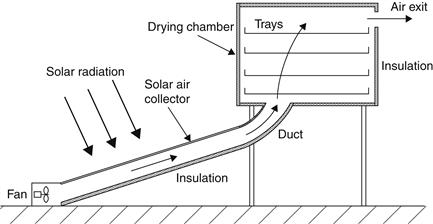
FIGURE 7.14 Schematic diagram of a distributed-type active solar dryer.
Integral type
Large-scale, commercial, forced-convection, greenhouse-type dryers are like transparent-roof solar barns and are used for solar timber drying kilns (see Figure 7.15). Small-scale forced dryers are often equipped with auxiliary heating.
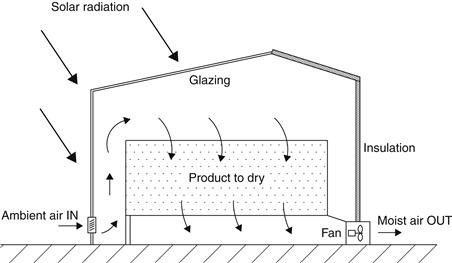
FIGURE 7.15 Schematic diagram of a forced-convection, transparent-roof solar barn.
A variation of the design shown in Figure 7.15 is the active greenhouse-type dryer built inside a semi-cylindrical outer shell. The semi-cylindrical structure acts as a solar heater. It consists of an exterior transparent cover, which acts as the collector glazing, and an inner semi-cylindrical black absorber sheet. A fan circulates the hot air through the air duct formed by the two semi-circular sheets to the material and the moist air is finally exhausted from the top of the transparent cover.
Another variation of this type of dryer is the solar collector–roof/wall, in which the solar heat collector forms an integral part of the roof and/or wall of the drying chamber. A solar–roof dryer is shown in Figure 7.16. A collector–wall system is like a Trombe wall, described in Chapter 6, where a black painted concrete block wall with outside glazing forms the solar collector and serves also as a thermal storage.
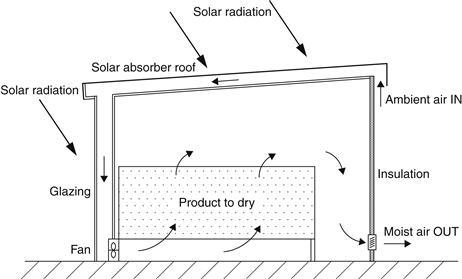
FIGURE 7.16 Schematic diagram of an active collector–roof solar energy storage dryer.
Mixed-mode type
The mixed-mode dryer is similar to the distributed type, with the difference that the walls and roof of the dryer are made from glass, to allow solar energy to warm the products directly, as shown in Figure 7.17.
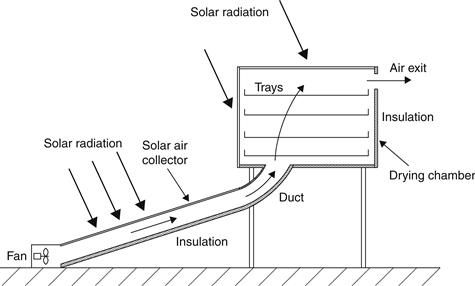
FIGURE 7.17 Schematic diagram of a mixed-mode-type active solar dryer.
It should be noted that, because drying efficiency increases with temperature, in conventional dryers the maximum possible drying temperature that would not deteriorate the product quality is used. In solar dryers, however, the maximum drying temperature is determined by the solar collectors, because their efficiency decreases with higher operating temperatures and this may not yield an optimal dryer design.
Most air heaters use metal or wood absorbers, although black polythene absorbers have been used in a few designs in an attempt to minimize cost.
7.4.2 Passive solar energy dryers
Passive or direct drying of crops is still in common practice in many Mediterranean, tropical, and subtropical regions, especially in Africa and Asia or in small agricultural communities. Passive solar dryers are “hot box” units where the product in the hot box is exposed to the solar radiation through a transparent cover. Heating takes place by natural convection, through the dryer transparent cover or in a solar air heater.
The passive-type solar dryers are primitive inexpensive constructions, easy to install and operate, especially at sites where no electrical grid exists. Passive or natural circulation solar energy dryers operate by using entirely renewable sources of energy, such as solar and wind.
Distributed type
Distributed, natural circulation solar energy dryers are also called indirect passive dryers. A typical distributed natural circulation solar energy dryer comprises an air heating solar energy collector, appropriate insulated ducting, a drying chamber, and a chimney, as shown in Figure 7.18. In this design, the crop is also located on trays or shelves inside an opaque drying chamber, which does not allow the solar radiation to reach the product directly. Air, which is heated during its passage through an air solar collector, is ducted to the drying chamber to dry the product. Because the crops do not receive direct sunshine, caramelization (formation of sugar crystals on the crop surface) and localized heat damage do not occur. Therefore, indirect dryers are usually used for some perishables and fruits, for which the vitamin content of the dried product is reduced by the direct exposure to sunlight. The color retention in some highly pigmented commodities is also very adversely affected when they are exposed directly to the sun (Norton, 1992).
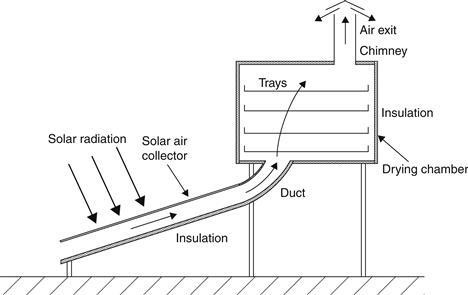
FIGURE 7.18 Schematic diagram of a distributed-type passive solar dryer.
Higher operating temperatures are generally obtained in distributed natural circulation dryers than in direct dryers. They can generally produce higher quality products and are recommended for deep layer drying. Their disadvantages are that the fluctuation in the temperature of the air leaving the solar air collector makes constant operating conditions within the drying chamber difficult to maintain; they are relatively elaborate structures, requiring more capital investment in equipment; and they have higher running costs for maintenance than integral types. The efficiency of distributed-type dryers can be easily increased, because the components of the unit can be designed for optimal efficiency of their functions.
Integral type
Integral-type, natural circulation solar energy dryers are also called direct passive solar energy dryers. In this system, the crop is placed in a drying chamber, which is made with transparent walls; therefore, the necessary heat is obtained by the direct absorption of solar radiation at the product, from the internal surfaces of the chamber, and by convection from the heated air mass within the chamber. The heat removes the moisture from the product and, at the same time, lowers the relative humidity of the resident air mass, thus increasing its moisture-carrying capacity. The air in the chamber is also expanded because the density of the hot air is lower than the cold, thus generating natural circulation, which also helps in the removal of moisture, along with the warm air. Because heat is transferred to the crop by both convection and radiation, the rate of drying for direct dryers is greater than that for indirect dryers.
Integral-type, natural circulation solar energy dryers can be of a very simple construction, as shown in Figure 7.19, which consists of a container insulated at its sides and covered with a single glazing or roof. The interior walls are blackened; therefore, solar radiation transmitted though the cover is absorbed by the blackened interior surfaces as well as by the product, thus raising the internal temperature of the container. At the front, special openings provide ventilation, with warm air leaving via the upper opening under the action of buoyant forces. The product to be dried is placed on perforated trays inside the container. This type of dryer has the advantage of easy construction from cheap locally available materials and is used commonly to preserve fruits, vegetables, fish, and meat. The disadvantage is the poor air circulation obtained, which results in poor moist air removal and drying at high air temperatures (70–100 °C), which is very high for most products, particularly perishables.
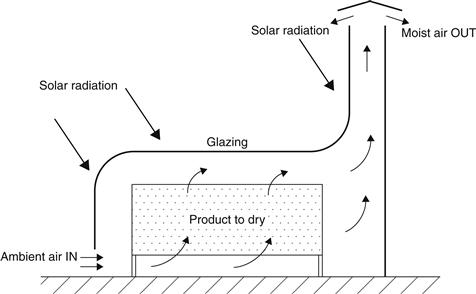
FIGURE 7.19 Schematic diagram of an integral-type passive solar dryer.
A variation of the dryer shown in Figure 7.19 is the cabin dryer, which resembles an asymmetric solar still unit (see Figure 8.1(b), Chapter 8, Section 8.3) oriented north–south. The material to be dried is spread on perforated plates, through which the air circulates by natural convection and finally leaves the drying chamber from the upper north side. Bottom and side walls are opaque and well insulated. Cabin dryers are simple and inexpensive. They are suitable for drying agricultural products. They are normally constructed with a drying area of 1–2 m2 and capacities of 10–20 kg.
Mixed-mode type
Mixed-mode, natural circulation solar energy dryers combine the features of the integral-type and the distributed-type natural circulation solar energy dryers. In this case, the combined action of solar radiation incident directly on the product to be dried and the air heated in a solar air collector provides the necessary heat required for the drying process. A mixed-mode, natural circulation solar energy dryer has the same structural characteristics as the distributed type, that is, a solar air heater, a separate drying chamber, and a chimney; in addition, the drying chamber walls are glazed so that the solar radiation can reach the product directly as in the integral-type dryers, as shown in Figure 7.20.
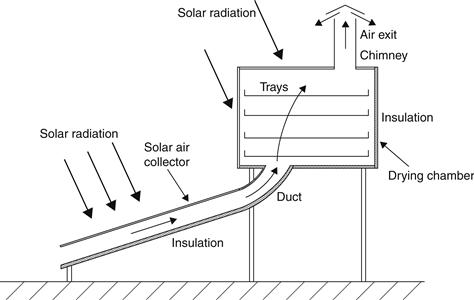
FIGURE 7.20 Schematic diagram of a natural circulation, mixed-mode solar energy dryer.
7.4.3 General remarks
The economics of solar dryers depend on the cost of the overall drying system and the gain from solar energy utilization, replacing conventional fuel. The main reasons for selecting solar energy for drying are the energy saving and the lack of availability of conventional energy sources to remote rural areas, or the high cost of transportation of fuel to those areas.
Another possibility considered recently is the use of mechanical dryers heated indirectly by solar energy. This is a rather new technique, not yet widely commercialized, which involves solar thermal energy collecting devices and off the shelf dryers, which are available in several types and sizes. The basic disadvantage of this indirect solar drying technique is the high initial capital cost for the dryer, solar collectors, auxiliary energy supply system, and the necessary supplementary equipment, such as ducts, pipes, pumps, blowers, control and measurement instruments. More skilled personnel are also required to operate the system. The advantages are many and include the high drying rate (15–30 h); the proper control of the drying process which ensures proper moisture content of the final product, so the dried product can be stored for longer times; the avoidance of losses as the product is not subject to any natural phenomena; the need for smaller surface areas for the same quantity of material as the trays can be accommodated in stacks inside the dryers; increased productivity, as dryers can be loaded again within few hours; and the flexibility of the dryer to accept similar seasonal crops, thus expanding operation of the system almost around the year (Belessiotis and Delyannis, 2011).
Energy storage is essential for places with either high or low radiation intensity and in cases where harvest products should be dried in continuous operation, immediately after harvest. Storage devices increase the initial capital cost as well as the operation costs, so to avoid unnecessary expenses storage must be applied in the following cases (Belessiotis and Delyannis, 2011):
• When solar intensity is high energy must be stored to avoid over-drying of the product at higher temperatures.
• When the agricultural product is very sensitive to temperature. By storing excess solar energy temperature can be easily regulated and controlled.
• When the drying operation has to be continued over night. This affects sensitive products that must be dried immediately after harvest.
Hybrid solar energy dryers were also developed in recent years, due to the significant increase in agricultural production. Hybrid solar energy dryers combine solar radiation energy with an auxiliary conventional source of energy. They can be operated solely by solar energy, solely by conventional energy sources, or by both. In most of the cases hybrid solar energy drying systems are medium to large capacity installations and operate by a solar fraction in the range of 50–60%. Thus the drying operation, especially for large amounts of material, is nowadays satisfied with large active hybrid solar energy drying systems.
All dryers employing solar energy collection employ air flat-plate solar collectors. For passive solar dryers, simple air heaters made of transparent plastic films are sufficient. These are inexpensive, easily constructed, and operated. The design of suitable air solar collectors for drying systems is one of the most important tasks that affect the economy of the system. For low-temperature applications, used in the case of most foodstuffs, single glazed collectors of the type presented in Chapter 3, Section 3.1.1, are sufficient and appropriate.
Agricultural products are organic substances and due to the dependence on several parameters, the drying process is very complicated. Even for the same product, drying depends not only on the type of the crop but also on its physical condition, the site of culture, and the initial moisture content. The two most crucial drying condition are the drying temperature and the pre-treatment procedure. To establish suitable drying conditions, related to the dryer in use, experimentation is often necessary.
The most important condition for agricultural products to keep the nutrient values, that is, vitamins sensitive to heat, and retain color and flavor is the drying temperature. The lower drying temperature starts from about 30 °C, but at these low temperatures drying rate is very slow and there is a risk of spoilage or molding. Generally, the majority of food can be dried at a mean temperature of 60 °C. Some products need lower drying temperatures at the beginning, and after being semi-dried the temperature can be raised up to a certain suitable point. This technique helps to keep the skin of the crop soft. In open-sun air drying, temperature depends on the intensity of solar radiation, is not easily controlled, and ranges from 40 to 80 °C. In active solar energy dryers, in the event of high radiation intensities the temperature can be regulated by mixing hot air with the necessary amount of fresh air from the atmosphere.
Many crops, fruits, and vegetables are grown near the soil and are susceptible to the activity of various microorganisms. So immediately after harvest, if possible, they must be treated and dried, irrespective of the drying method employed. Pre-treatment helps to slow down the activity of microorganisms and soften the skin. Generally every crop has its own optimum conditions of pre-treatment when drying and these are simple methods based on experience. The main steps for agricultural products are (Jayaraman and Das Gupta, 1998):
1. Selection of the best quality of crops after harvest. They must be ripe, firm, and without scratches.
2. The products must be washed thoroughly to decrease microorganisms to a minimum, as they grow quickly when exposed to the atmosphere.
3. Depending on the product type, it must be shelled, peeled, and/or sliced.
4. Blanch the products to destroy enzymes and help retain color. Blanching consists of dipping the crops in boiling water or treating them by steam.
5. Sulfur the crops which help to prevent losses in color, flavor, and nutrients (vitamins) and acts as a disinfectant. Sulfuring is an old method of treating the crops by sodium sulfite solution or solutions of sodium bisulfite or metabisulfite. An old method usually applied is to burn sulfur and use the fumes for sulfuring.
6. Treatment with ascorbic acid solution to prevent browning of fruit or fruit slices.
Useful guidelines for solar drying are given by the El-Paso Solar Energy Association (EPSEA, 2012) which include the above pre-treatment procedure and other practical guidelines, such as the necessity to allow the product to cool down after drying and before storing, and the recommended material of the trays which is stainless steel rack, wood slats with cheesecloth cover, teflon, teflon-coated fiberglass, nylon, and food-grade plastics.
Leave a Reply