
A way to increase the effectiveness of PVs is to concentrate sunlight on small, highly efficient photovoltaic cells using inexpensive reflective material, lenses, or mirrors. These are known as concentrating photovoltaics (CPVs). Today, the technology takes up a very small portion of the solar industry; however, it is expected that the CPV industry will grow as technology improves and cost comes down and further field tests and demonstrations are conducted.
The solar spectrum has photons ranging up to 4 eV. A single-material PV cell can convert only about 15% of the available energy to useful electrical power. To improve this performance, multiple cells with different band gaps, which are more complex and therefore more expensive, can be used. These are called multi-junction PVs. Particularly, a triple-junction PV produced recently achieved a remarkable 40% efficiency (Noun, 2007). This PV consists of three layers of PV material placed one atop the other. Each of the three materials captures a separate portion of the solar spectrum (see Figure 2.26) and the objective is to capture as much of the solar spectrum as possible. These are much more expensive than other silicon solar cells, but their efficiency offsets their high cost, and in concentrating systems, a small area of these cells is required.
The advantages of CPV systems are the following:
1. They replace expensive PV material with lower-cost mirrors or reflective materials.
2. Solar cells are more efficient at high-irradiation levels.
3. Due to tracking, production of energy starts earlier in the morning and extends later in the day.
4. They have high efficiencies of around 30–40% at the module level (RENI, 2012) and 25% at the system level (i.e., including losses from inverters and tracking).
5. Due to 2-axis tracking and high efficiency modules, they produce a large amount of energy from a given surface area.
Disadvantages of CPV systems include:
1. At high concentration, cells heat up and lose efficiency, so they must be cooled.
2. Concentrating systems use only direct solar radiation, “wasting” diffuse radiation.
3. The system must track the sun; higher concentration requires more accurate tracking.
4. Concentrating systems are more complex than flat-plate ones and less reliable, because they have moving parts.
5. Two-axis trackers require relatively wide spacing to avoid shading, which reduces CPV’s power output per area of land.
Compared to flat-plate PV, concentrating PV has a greater capital cost of $4–$6 per Watt and a higher conversion efficiency of direct irradiation. With this profile, CPV systems are suited to utility-scale power generation in locations with significant insolation and clear skies, such as deserts far from coasts. In such settings CPV is able to produce electricity at among the lowest cost per kWh of solar technologies.
Usually CPV uses lenses to concentrate sunlight onto small-size photovoltaic cells. Because a CPV module needs much less cell material than a traditional PV module, it is cost-effective to use higher-quality cells to increase efficiency. For CPVs, all concentrating systems presented in Chapter 3 can be used. The most popular system of CPV, however, is the Fresnel lens system. As in all concentrating systems, a tracking mechanism is required to follow the sun trajectory. Usually, a number of PVs are installed in a single box and atop each a Fresnel lens is installed. A CPV system can include a number of boxes, all put in a single tracking frame. For this type of system, two-axis tracking is required. A schematic diagram of a CPV Fresnel system is shown in Figure 9.22(a) and a photograph of an actual system is shown in Figure 9.22(b). It should be noted that, in CPVs, the distribution of solar radiation on cells has to be as uniform as possible to avoid hot spots.
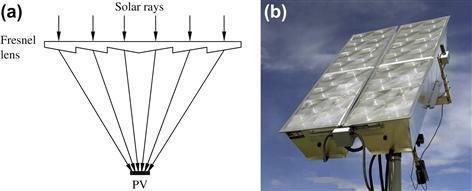
FIGURE 9.22 Schematic diagram and a photograph of a CPV Fresnel system. (a) Schematic diagram. (b) Photograph of an actual system.
Because the temperature developed in CPV systems is high, some means of removing the heat energy must be provided to avoid reduction in the PV efficiency and prolong the life of the PVs. In some systems, this extra heat is used to provide thermal energy input to other processes, as in the hybrid PV/Ts analyzed in the next section.
Leave a Reply