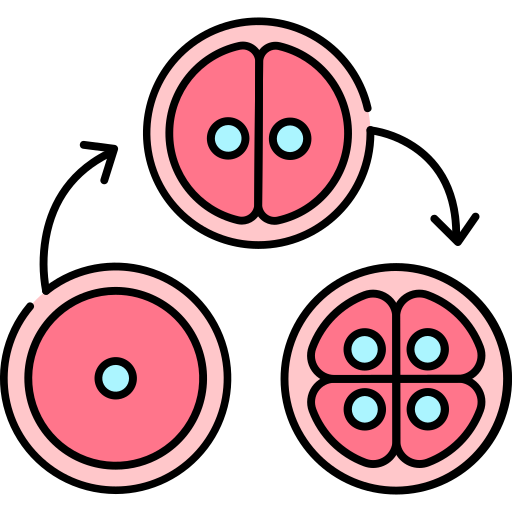
- Cell division Mitosis: Mitosis is a unique type of cell division that can be observed in both somatic (non-reproductive cells) as well as germinal cells (egg cells and sperms). It involves a series of tightly regulated and organized steps that lead to the formation of two daughter cells. These genetically identical daughter cells (genetically identical to the parent cell) contain an equal number of chromosomes. Mitosis is known to aid several processes like tissue growth, maintenance, and asexual reproduction.
- Cell division Meiosis: Meiosis is a specialized form of cell division that occurs in only germinal cells (egg and sperm cells) and not in somatic cells. This type of cell division is specifically designated for sexual reproduction in reproductive cells. It consists of two successive divisions that eventually result in the production of 4 daughter cells (or 4 gametes). These daughter cells are “genetically different” from the parent cell. Also, gametes don’t contain an equal number of chromosomes as the parent cell. Each daughter cell is composed of “half the number of chromosomes” when compared to the parent cell. Meiosis is primarily responsible for genetic variation through processes such as genetic recombination.
- Cell division Amitosis: Amitosis is a less common type of cell division that’s usually observed in some specific single-celled organisms or specific cells within multicellular organisms. It differs from mitosis and meiosis as it does not involve the characteristic formation of a mitotic spindle apparatus or the precise separation of chromosomes. (Read more here: A unique type of cell division called “Amitosis”)
Leave a Reply