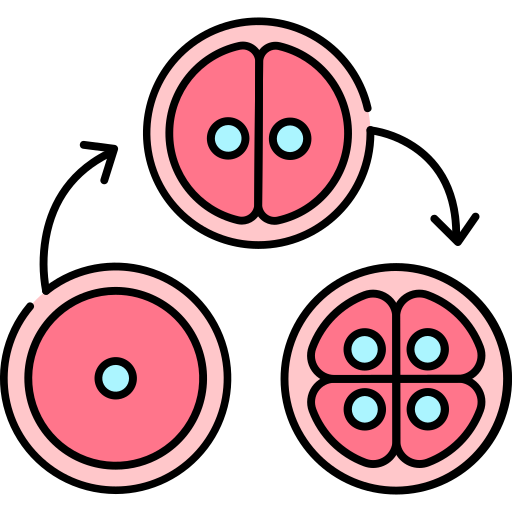
Some important points to note about prokaryotic cell division are:
- The process by which prokaryotes’ cell division occurs is very simple.
- The cell division process for prokaryotes is usually a means of reproduction for them.
- Since prokaryotes don’t have a very complex structure and are devoid of any cell organelles (organellar structures), cells divide by simple type of binary fission or budding, both of which are asexual methods of reproduction. They have got only 1 membrane as the structural constituent. This is why when prokaryotic cell division begins, it manifests as a simple DNA replication step followed by doubled DNA splitting into half (2 identical copies of the genetic material).
- Cell elongation: Following DNA replication, the prokaryotic cell elongates to accommodate the duplicated genetic material.
- Prokaryotic cell division also includes a step of septum formation wherein a septum (or a cell wall) begins to form at the midsection of the elongated cell which aids the final dividing step. The septum eventually grows inwards leading to the final separation of the 2 compartments and the formation of 2 distinct daughter cells. This results in the physical separation of the parent cell into 2 individual daughter cells.
- The newly formed daughter cells are capable of independent functioning and carrying out their cellular processes like metabolism, growth, and replication.
- Speed: Talking about speed, prokaryotic cell division is quite rapid. Under optimal conditions, prokaryotic cells can divide and generate multiple generations within a short span of time.
- Genetic stability: Talking about the genetic stability of offspring, as the replicated DNA is faithfully divided and distributed between the daughter cells, prokaryotic cell division ensures substantial genetic stability.
- Adaptability and evolution: Prokaryotic cell division plays an instrumental role in the adaptation and evolution of prokaryotic organisms by facilitating genetic variation and the accumulation of beneficial mutations.
- Since prokaryotic cells also have plasmids, the plasmid DNA also gets duplicated during binary fission.
- There is the presence of a divisome; it is an atypical protein complex that aids prokaryotic cell division in bacteria. It takes care of the cell division process by:
- Ensuring inner & outer membrane constriction during prokaryotic cell division process.
- Ensuring that correct peptidoglycan cell wall remodeling happens at the division site.
- There is also the presence of FtsZ, i.e., a tubulin-like protein that has an integral role in the contractile ring formation during prokaryotic cell division.
Leave a Reply