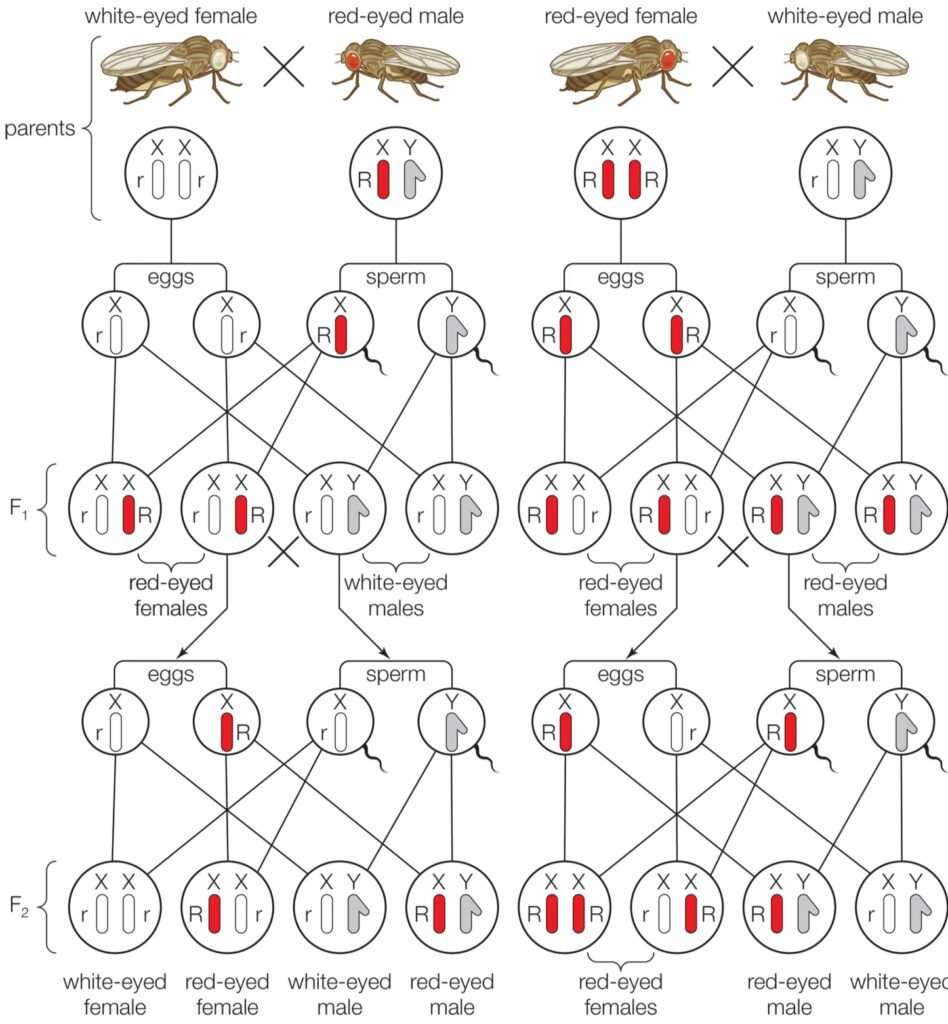
It seemed that genes were parts of chromosomes. In 1910 this idea was strengthened through the demonstration of parallel inheritance of certain Drosophila (a type of fruit fly) genes on sex-determining chromosomes by American zoologist and geneticist Thomas Hunt Morgan. Morgan and one of his students, Alfred Henry Sturtevant, showed not only that certain genes seemed to be linked on the same chromosome but that the distance between genes on the same chromosome could be calculated by measuring the frequency at which new chromosomal combinations arose (these were proposed to be caused by chromosomal breakage and reunion, also known as crossing over). In 1916 another student of Morgan’s, Calvin Bridges, used fruit flies with an extra chromosome to prove beyond reasonable doubt that the only way to explain the abnormal inheritance of certain genes was if they were part of the extra chromosome. American geneticist Hermann Joseph Müller showed that new alleles (called mutations) could be produced at high frequencies by treating cells with X-rays, the first demonstration of an environmental mutagenic agent (mutations can also arise spontaneously). In 1931 American botanist Harriet Creighton and American scientist Barbara McClintock demonstrated that new allelic combinations of linked genes were correlated with physically exchanged chromosome parts.
Leave a Reply