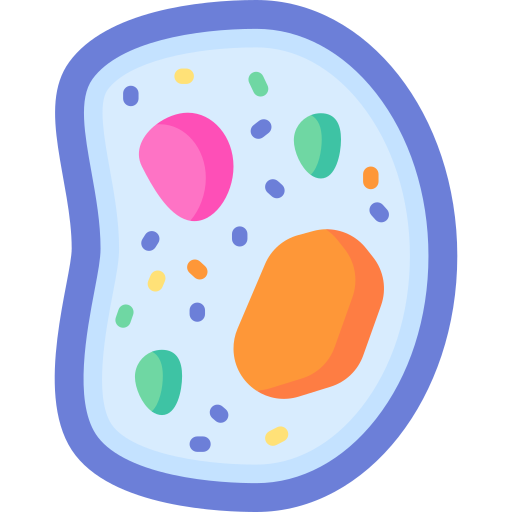
- As previously mentioned, the cytoplasm is the partially liquid, gel-like substance within the cell that holds the nucleus and other cytoplasmic organelles and is enclosed by the cell membrane. The cytoplasm can be easily observed by staining the cell and examining it under a microscope. The main components of the cytoplasm are cytosol, organelles, and cytoplasmic inclusions. Below in Figure 3 is a well-labeled diagram of the cytoplasm structure
Cytosol
- The cytosol is the part of the cytoplasm that is the liquid-like portion. It is mostly made up of water, dissolved minerals, and cytoskeleton filaments. It, however, does not contain any organelles but holds them within the cell as part of the entire cytoplasm. It consists of water, organic molecules, and dissolved ions. The highest percentage of cytosol component is water, i.e. about 70%. The typical ions in the mammalian cytosol are potassium, sodium, chloride, bicarbonate, amino acids in proteins, magnesium, and calcium. The cytosol serves as the site where many chemical reactions take place. In prokaryotes, it is where most metabolic reactions take place (others occur in the cell membrane). In eukaryotes, it is where the organelles and other cytoplasmic structures are suspended. Since the cytosol contains dissolved ions, it plays a role in osmoregulation and cell signaling. It is also involved in generating action potentials in cells, such as endocrine, nerve, and muscle cells.
Organelles
- Organelles are the membrane-bond, specialized structures within cells that carry out specific tasks for the cell. The term “organelles” is based on the organs, as the organs in animals and humans work similarly in carrying out a specific task for the body. See Figure 3 for the various organelles found in a plant cell and an animal cell. In eukaryotic cells, the nucleus, for instance, is the organelle that contains the genetic material, and therefore it controls cellular activities such as metabolism, growth, and reproduction by regulating gene expression. Chloroplasts are plastids containing green pigments essential for photosynthesis. Mitochondria are the organelles that synthesize energy for multifarious metabolic processes. The endoplasmic reticulum occurs as an interconnected network of flattened sacs or tubules involved in lipid synthesis, carbohydrate metabolism, drug detoxification, and attachment of receptors on cell membrane proteins. It is also involved in intracellular transport, such as the transport of the products (of the rough endoplasmic reticulum) to other cell parts like the Golgi apparatus. Golgi apparatus is made up of membrane-bound stacks. It is involved in glycosylation, packaging of molecules for secretion, transporting of lipids within the cell, and giving rise to lysosomes. Other cytoplasmic structures found in the cytoplasm are vacuoles and ribosomes. Ribosomes, the site of protein synthesis, are comprised of protein and RNA. Some ribosomes are unbound whereas the others are attached to the endoplasmic reticulum.
Cytoplasmic Inclusions
- Cytoplasmic inclusions are part of the cytosol but are not membrane-bound so they are not considered organelles. Instead, they are suspended in the cytosol as small, insoluble particles. Cytoplasmic inclusions depend on the type of cell they are in. For instance, an animal cell would neither have nor need starch, the glycogen of Polyhydroxybutyrate (PHB), because these are energy storage units that are needed by plant cells after they photosynthesize. On the other hand, there are cytoplasmic inclusions called lipid droplets. These are used by both plant and animals cells to store lipids like fatty acids. Lipid droplets are made of both lipids and proteins so that they don’t dissolve into the cytosol.
Leave a Reply