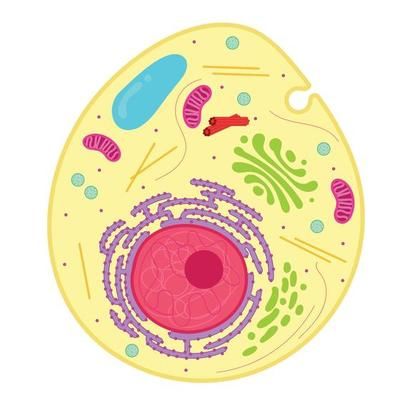
- Ribosomes perform vital functions inside cells. Ribosomes in plant cells and ribosomes in animal cells are organelles with huge responsibilities for the normal functioning of cells and life processes
Translation
The ribosomes are described as the site of protein synthesis. Protein synthesis is the process of creating protein molecules. In biological systems, the major steps are amino acid synthesis, transcription, and translation. The ribosomes, though, are involved in the translation step. During translation, the amino acids are added by tRNAs and then are linked together in a specific order as specified in the mRNA transcript. So, when asked, “Where does translation occur?”… the answer is ribosome!
- Ribosomes are the protein factories. The translation process of converting mRNA code into protein happens because of ribosomes.
- Ribosomes hold the ability to decode the mRNA code.
- The ribosome moves along the mRNA template and reads each codon (made up of 3 nucleotides) of the mRNA.
- Then the ribosome pairs it with a specific amino acid. Amino acids are provided by an aminoacyl-tRNA.
- Aminoacyl-tRNAs are in possession of 2 things: first, a complementary anticodon on one end, and secondly, a specific, appropriate amino acid on the other end.
- Ribosomes have a unique ability to rapidly and accurately recognize appropriate tRNAs by putting their conformational proofreading ability at work.
- Cotranslational folding
- Another important role that ribosomes play inside living cells is the folding of proteins. This folding endows functionality to many proteins, hence making ribosomes furthermore important inside the cell.
- Addition of translation-independent amino acids
- Although we have always studied that the process of translation can’t happen without the presence of a coding mRNA strand. But there are cases where translation happens even in absence of mRNA strands. This is known as mRNA-independent protein elongation. A specific type of ribosomal quality protein aids in this process, (Rqc2). In this type of amino acid addition, the C-terminal of stalled proteins is extended. Alanines and threonines are the most common additions in such elongations.
Ribosome Locations
Ribosomes can be distributed in the cytosol or can be bound to the membrane of the endoplasmic reticulum. And thus, ribosomes are sometimes classified as either free or bound. The two types of ribosomes have similar functions and structures and are interchangeable. In fact, the bound ribosomes are attached to the ER transiently. They may come and go. They attach to the endoplasmic reticulum (via the translocon) when a signal peptide is synthesized by protein translation at the ribosome, and then recognized by a signal recognition particle.
- Free ribosomes
In eukaryotes, the ribosomes may be classified as either ‘free’ or ‘bound’. Free ribosomes may be found suspended in the cytosol whereas bound ribosomes are attached to the endoplasmic reticulum (as such called rough endoplasmic reticulum). Free ribosomes’ function is for creating proteins, especially proteins that will function in the cytosol.
- Membrane-bound ribosomes
Ribosomes found attached to the outer membrane of the endoplasmic reticulum are referred to as membrane-bound ribosomes. Bound ribosomes are involved in the synthesis of proteins that are to be exported or used within the cell membrane.
Leave a Reply