Ribosomes are made up of two basic components as discussed earlier: ribosome RNA (rRNA) and ribosomal proteins (R-proteins). There are various different types of proteins and their numbers differ from species to species. These 2 components are arranged in different constitutions in 2 different ribosomal units.
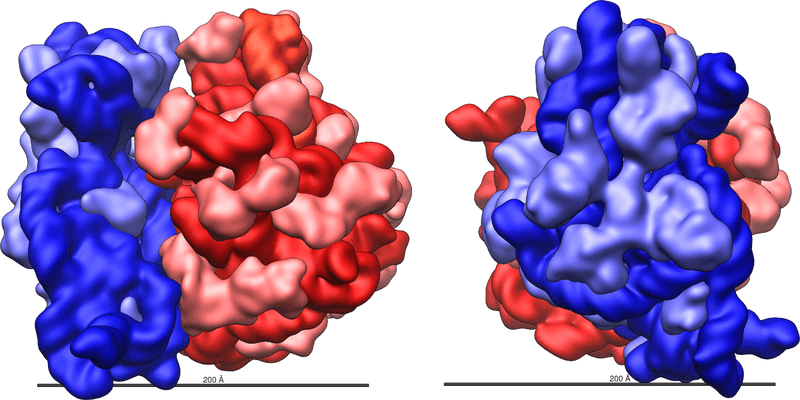
The two ribosomal subunits fit together and work as one to build proteins according to the genetic sequence held within the messenger RNA (mRNA). Ribosomes are typically composed of two subunits: the large and small subunits. They join as one during translation; together, they catalyze the translation of mRNA into a polypeptide chain during protein synthesis, and since their active sites are made of RNA, ribosomes are also referred to as “ribozymes.”
Bacterial ribosomes
Size: Smaller than most of the ribosomes of eukaryotes (e.g. plants and animals); nearly 20nm in diameter. (Kurland CG, 1960)
Composition: 65% rRNA + 35% ribosomal proteins
Formed in the cytoplasm of bacterial cells.
The prokaryotic ribosome (70S) is made up of 50S (large subunit) and 30S (small subunit).
In prokaryotes, the 30S ribosomal subunit contains the 16S rRNA whereas the 50S ribosomal subunit contains 5S rRNA and 23S rRNA.
The numbers of nucleotides in each rRNA unit are:
16S rRNA subunit consists of 1540 nucleotides and is bound to 21 proteins.
5S RNA subunit consists of 120 nucleotides.
23S RNA subunit consists of 2900 nucleotides.
5S and 23S rRNAs are bound to 31 proteins.
Archaeal ribosomes
The structure of archaeal ribosomes is structurally similar to bacterial ribosomes.
They are also 70S and possess 2 subunits- 50S and 30S like the bacterial ribosomes. But they are similar to the eukaryotic ribosomes when compared at the sequence level. (Cullen, Katherine E., 2009)
Eukaryotic ribosomes
Size: Bigger than prokaryotic ribosomes; nearly 25-30nm in diameter. (Wilson DN, 2012)
The production of ribosomes involves both the cytoplasm and the nucleolus.
The eukaryotic ribosome (80S) consists of 60S (large subunit) and 40S (small subunit).
In eukaryotic cells, the 40S ribosomal subunit contains the 18S rRNA whereas the 60S ribosomal subunit contains rRNAs: 5S, 5.8S, and 28S.
In eukaryotes, the semi-autonomous organelles like chloroplasts and mitochondria also have 70S ribosomes that resemble those of prokaryotes (e.g. bacteria). Because of this, it is suggested that these eukaryotic organelles have descended from their ancestral bacteria.
The numbers of nucleotides in each rRNA unit are:
18S RNA consists of 1900 nucleotides and is bound to 33 proteins.
5S RNA consists of 120 nucleotides.
28S RNA consists of 4700 nucleotides.
5.8S RNA consists of 160 nucleotides.
5S RNA, 28S RNA, and 5.8S RNA are bound to 46 proteins
Leave a Reply