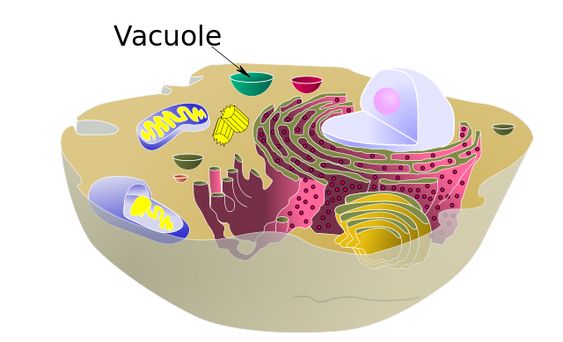
- Gas vacuoles
- Central vacuoles
- Contractile vacuoles
- Food vacuoles
Gas vacuoles
- Gas vacuoles are cell organelles that are freely permeable to atmospheric gases. Their presence has been noted in many species of Cyanobacteria and only in some other bacteria and archaea. The main role associated with gas vacuoles is allowing and controlling buoyancy.
Central vacuoles
- Central vacuole is terminology for the plant cell vacuoles as they have a large central vacuole occupying the majority of the cell’s volume. Cells exploit the proton gradient across the tonoplast of these central vacuoles in plant cells to transport essential nutrients into or out of the central vacuole.
- The main roles associated with central vacuoles are:
- Storage
- Maintenance of turgor pressure
- Keeping the chloroplasts of the plant cells “closer to the cell membrane” and thereby “closer to light”: This is ensured as the central vacuole swells up and pushes all the cellular content against the cellular membrane. See Figure 6.
- Precursors for herbivory: Plant vacuoles store a range of chemicals in their central vacuoles that are reactive on exposure to some cytosolic content. So, when a herbivore invades the plant and tries to consume it, the vacuoles are abruptly damaged and burst open. As soon as the vacuolar chemicals react with the cytosolic content, an offensive toxin against herbivory is released. Example: Garlic has alliin and alliinase (an enzyme)
Contractile vacuoles:
Contractile vacuoles are the specialized vacuoles of protist cells. They are associated with the function of osmoregulation. They carry out the removal of excessive water from the protist’s body as they tend to take in a lot of water. This is carried out by the process of contraction and expulsion.
There are 2 stages of this process. They are:
- When the contractile vacuole of protists takes in water, the vacuole swells up and increases in size. This is called the diastole stage.
- When the contractile vacuole of protists reaches saturation/threshold, the vacuole starts contracting and expelling the water out in pulses. This is called the systole stage.
Food vacuoles:
Food vacuoles are a type of vacuole that houses a number of digestive enzymes. They are therefore also referred to as digestive vacuoles. Their presence has been noted in ciliates and sporozoans. The malarial parasite, Plasmodium falciparum, also has these food vacuoles. They almost mimic lysosomes in their functioning. These vacuoles are the sites where the parasite digests the hemoglobin (Hb) of the erythrocytes. When anti-malarial drug development started, this was widely targeted and became the favorite target for scientists for such drugs
Leave a Reply