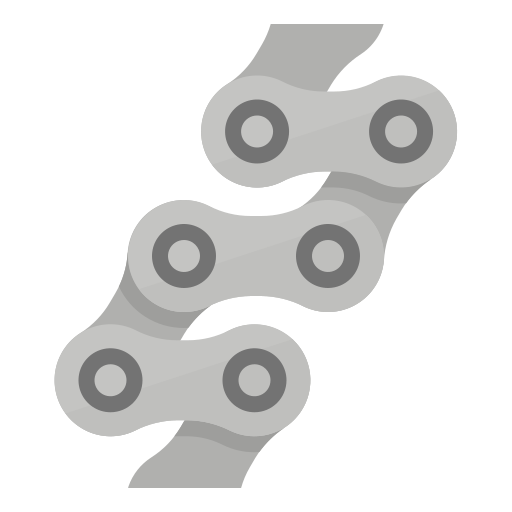
To overcome the problem of slip in belt drive or rope drive, chain drive is used. A schematic diagram of chain drive is shown in Figure 15.8. The velocity ratio in chain drive remains constant. But, chain drive is heavier than the belt drive and there is gradual stretching in its strength. Time to time some of its links have to be removed. Lubrication of its parts is also desired. The wheel over which chains are run, corresponding to the pulleys in a belt is known as sprocket having projected teeth that fit into the recess in the chain.

Figure 15.8 Chain Drive
Pitch: Distance between two consecutive roller centres is known as pitch, p.
Pitch Circle: The circle drawn through the roller centres of a wrapped chain round a sprocket is called the pitch circle.
Let T is number of teeth on a sprocket
ø is angle subtended by chord of link at the centre
r is radius of pitch circle

15.4.1 Chain Length
Let R and r are the radii of the pitch circle of two sprockets having teeth T and t, respectively.
L is length of the chain
C is centre distance between sprockets = K · p

Example 15.6: For reduction of speed from 250 to 100 rpm, a chain drive is used. Calculate the number of teeth on the driven sprocket if number of teeth on driven sprocket is 20. Pitch circle diameter of the driven sprocket is 650 mm and centre distance between sprockets is 100 mm. Also, determine the pitch and length of the chain.
Solution:

15.4.2 Types of Chain
Hosting Chain: This type of chain is used for lower speed. It consists of oval links as shown in Figure 15.9.

Figure 15.9 Hosting Chain
Conveyer Chain: Conveyer chain may be detachable/hook joint type/closed end pintle type as shown in Figure 15.10. The sprocket teeth are so shaped and spaced that the chain could run onto and off the sprockets smoothly and without interference. Such chains are used for low speed applications.

Figure 15.10 (a) Hook Joint Type Conveyer Chain and (b) Closed-end Pintle Type Conveyer Chain
Power Transmission Chains
Block Chain: This is used for power transmission at low speed such as bicycle, motor bike, etc. (Figure 15.11).

Figure 15.11 Block Chain
Roller Chain: A common form of roller chain is shown in Figure 15.12. A bush is fixed in inner link whereas the outer link has a pin fixed to it. There is only sliding motion between the pin and the bush. The roller is made of hardened steel and is free to turn on the bush. A good roller chain is quite and wears less in comparison to a block chain.

Figure 15.12 Roller Chain
Silent/Inverted Tooth Chain: Roller chains can run at very high speed. But when maximum quietness is required, inverted tooth chains are required. It has no roller; the links are so shaped as to engage directly with the sprocket teeth and included angle is either 60° or 75° (Figure 15.13).

Figure 15.13 Silent or Inverted Tooth Chain
Leave a Reply