
Let T1 is tension in tight side of the belt
T2 is tension in slack side of the belt
θ is angle of lap of belt over the pulley
μ is coefficient of friction between the belt and pulley
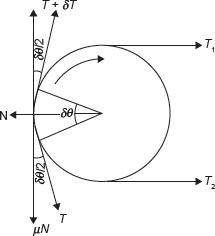
Figure 15.5 Tensions in Belt
Consider a short length of belt subtending an angle δθ at the centre of the pulley as shown in Figure 15.5.
Let N is a normal reaction between the element length of a belt and pulley
δT is increase in tension in tight side than that on slack side
T + δT is tension on the tight side of the element
Resolving the force in tangential direction,

Resolving the force in radial direction,
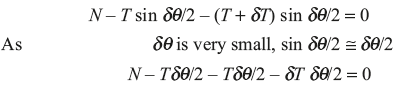
Neglecting the product of two small quantities

From Eqs (15.1) and (15.2), 
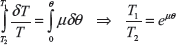
In V-belt,  , where α is the angle made by V-section of the belt.
Power Transmission in Belt Drive

Example 15.3: Two pulleys of diameters 500 and 200 mm are mounted on two parallel shafts 2 m apart. These shafts are connected by a cross belt. Find the angle of contact of belt and pulley. If larger pulley rotates at 250 rpm and maximum permissible tension in the belt is 1 kN, find the power transmitted by the belt. Assume coefficient of friction between belt and pulley is 0.25.
Solution:
For crossed belt (Refer Figure 15.4)

15.2.7 Effect of Centrifugal Force on Belt Drive
When velocity of the belt is more than 10 m/s, the centrifugal force becomes predominant. Analyse the various components of forces as shown in Figure 15.6.
Let ρ is the density of belt materials
Tc is centrifugal tension on the belt element in tight and slack side
r is radius of the pulley
t is thickness of the belt
b is width of the belt
σ is maximum allowable stress in the belt
m is mass per unit length of the belt
FC is the centrifugal force on the element
V is the velocity of the belt
Δθ is the angle of lap
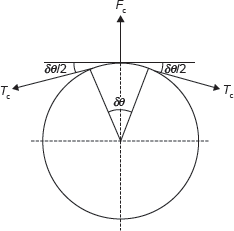
Figure 15.6 Centrifugal Force in Belt Drive
Now,
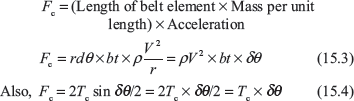
From Eqs. (15.3) and (15.4), we get
Tc = ρ (bt) V2
Total tension on tight side,
T = T1 + Tc,
where T is maximum allowable tension equal to σ × b × t
Total tension on slack side = T2 + Tc
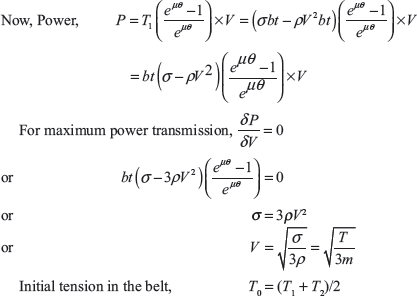
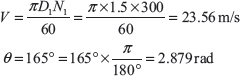
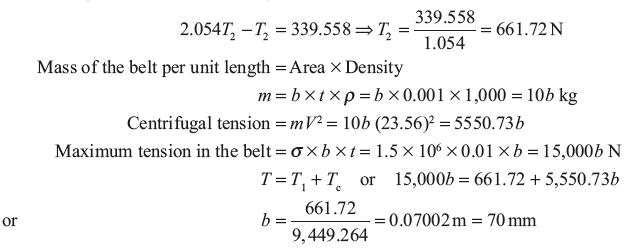
Example 15.4: A leather belt of density 1,000 kg/m3, thickness 10 mm is used to transmit a power of 8 kW from a pulley 1.5 m in diameter running at 300 rpm. Determine the width of the belt taking centrifugal tension into account. If angle of lap is 165° and coefficient of friction between belt and pulley is 0.25. Assuming allowable stress for leather belt is 1.5 MPa.
Solution:
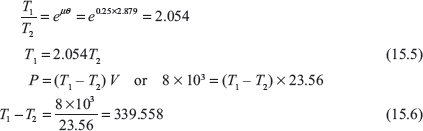
From Eqs (15.5) and (15.6), we get
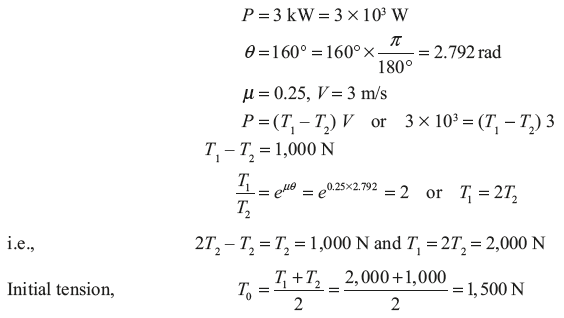
Example 15.5: An open-belt drive transmits a power of 3.0 kW. The linear velocity of the belt is 3 m/s. Angle of lap on smaller pulley is 160°. The coefficient of friction between belt and pulley is 0.25. Determine the effect on power transmission in the following cases:
- Initial tension in belt is increased by 10%.
- Angle of lap is increased by 10% using idler pulley for the same speed and tension in tight side.
- Coefficient of friction is increased by 10% for same initial tension.
Solution:


 T1 is the same as before whereas θ is increased by 10%
Leave a Reply