
By either moving the conductor and keeping the magnetic field system stationary, or moving the field system and keeping the conductor stationary so that flux is cut by the conductor, the emf thus induced in the conductor is called dynamically induced emf.
5.18.1 Mathematical Expression
Considering a conductor of length l m placed in the magnetic field of flux density B Wb/m2 is moving at right angle to the field at a velocity v m/s, as shown in Figure 5.29(a). Let the conductor be moved through a small distance dx m in time dt s, as shown in Figure 5.29 (b).
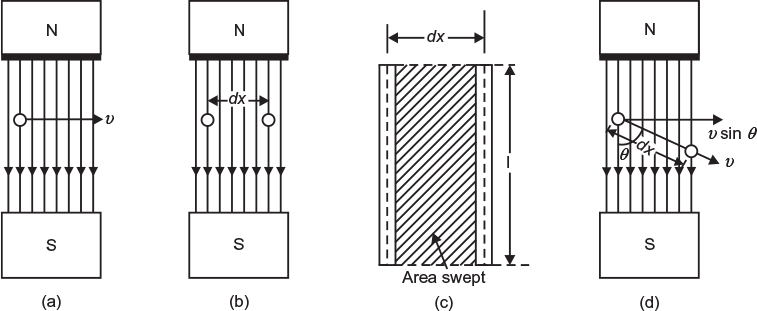
Fig. 5.29 Dynamically induced emf (a) Conductor moves perpendicular to the magnetic field (b) Distance covered (dx) (c) Area swept (d) Conductor moves at an angle θ with the direction of magnetic field
Area swept by the conductor, A = l × dx
Flux cut by the conductor, ɸ = B × A = Bldx
According to Faraday’s Law of electromagnetic induction;
Induced emf, 
Now, if the conductor is moved at an angle θ with the direction of magnetic field at a velocity υ m/s, as shown in Figure 5.29(d). A small distance covered by the conductor in that direction is dx in time dt s. Then, the component of distance perpendicular to the magnetic field, which produces emf, is dx sin θ.
Therefore, area swept by the conductor, A = l × dx sin θ
Flux cut by the conductor, ɸ = B × A = Bldxsin θ
Induced emf, 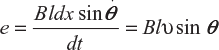
Example 5.21
A coil of 500 turns is linked with a flux of 2 mWb. If this flux is reversed in 4 ms, calculate the average emf induced in the coil.
Solution:
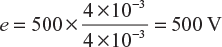
Average induced emf, 
where N = 500 turns; dɸ = 2 − (− 2) = 4 mWb; dt = 4 × 10³ s
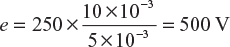
A coil of 250 turns is wound on a magnetic circuit of reluctance 100,000 AT/Wb. If a current of 2 A flowing in the coil is reversed in 5 ms, find the average emf induced in the coil.
Solution:
ɸ = mmf/reluctance, that is, ɸ = NI/S
where N = 250, I = 2 A, and S = 100,000 AT/Wb
∴
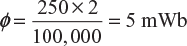
Average induced emf, 
where dɸ = 5 − (− 5) = 10 mWb (since current is reversed)
Leave a Reply