
Michael Faraday summed up conclusions of his experiments regarding electromagnetic induction into two laws, known as Faraday’s laws of electromagnetic induction.
5.15.1 First Law
This law states that ‘Whenever a conductor cuts across the magnetic field, an emf is induced in the conductor’.
or ‘Whenever the magnetic flux linking with any circuit (or coil) changes, an emf is induced in the circuit’.
Figure 5.27 shows a conductor placed in the magnetic field of a permanent magnet to which a galvanometer is connected. Whenever the conductor is moved upward or downward, that is across the field, there is deflection in the galvanometer needle that indicates that an emf is induced in the conductor. If the conductor is moved along (parallel) the field, there is no deflection in the needle that indicates that no emf is induced in the conductor.
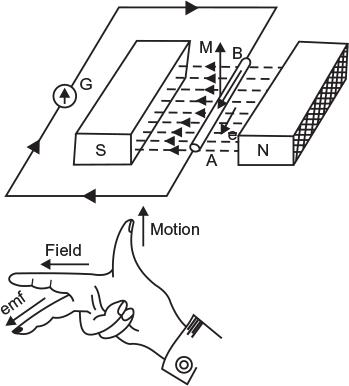
Fig. 5.27 Phenomenon for Faraday’s laws of electromagnetic induction
For the second statement, consider a coil placed near a bar magnet and a galvanometer connected across the coil, as shown in Figure 5.28. When the bar magnet (N-pole) is taken near to the coil (see Fig. 5.28 (a)), there is deflection in the needle of the galvanometer. Now, if the bar magnet (N-pole) is taken away from the coil (see Fig. 5.28 (b)), again there is deflection in the needle of galvanometer but in opposite direction. The deflection in the needle of galvanometer indicates that emf is induced in the coil.
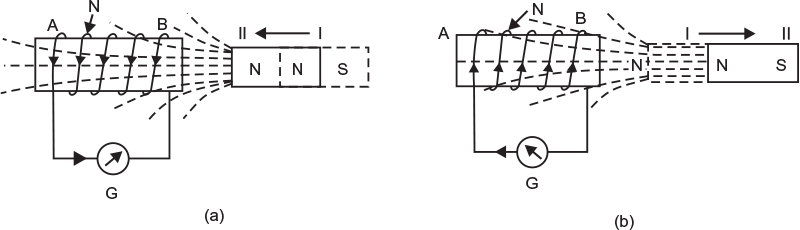
Fig. 5.28 Electromagnetic induction (a) Magnetic bar taken nearer to the coil (b) Magnetic bar taken away to the coil
5.15.2 Second Law
This law states that ‘The magnitude of induced emf in a coil is directly proportional to the rate of change of flux linkages.’
Rate of change of flux linkages 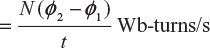
where N = number of turns of the coil; (ɸ2 − ɸ1) = change of flux in Wb
t = time in seconds for the change
According to Faraday’s second law of electromagnetic induction,
Induced emf, 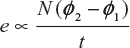
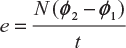 (taking proportionality constant as unity)
In differential form, 
Usually, a minus sign is given to the right-hand side expression that indicates that emf is induced in such a direction that opposes the cause (i.e., change in flux) that produces it (according to Lenz’s law).
Leave a Reply