
The following are the important terms related to an electric cell:
- Electromotive force (emf) of a cell: The energy supplied by a cell to one coulomb of charge is called emf of a cell. In general, it is defined as a potential difference (p.d.) between the two electrodes (positive and negative) of a cell on open circuit. It is represented by letter ‘E’.
- Internal resistance of a cell: The opposition offered to the flow of current by the internal composition of the cell itself is called its internal resistance. It is generally represented by letter ‘r’. Figure 4.1(a) shows a cell with its internal resistance.
- Terminal voltage: The potential difference across the terminals of a cell at load is known as its terminal voltage. It is generally represented by letter ‘V’.
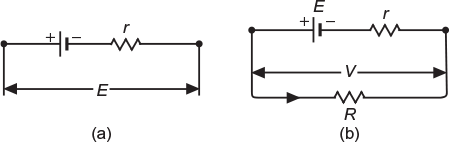
Fig. 4.1 Terminal voltage of a cell of no-lead and at load (a) Cell with internal resistance of no-load (b) Cell at load
When load is applied, it delivers current I to the external (load) resistor R as shown in Figure 4.1(b). The potential difference across the terminals reduces to V volts because of the voltage drop (I × r) in the internal resistance of the cell.
Therefore,
Leave a Reply