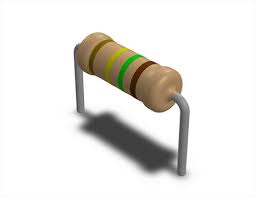
The opposition to load current inside the DC source is called its internal resistance. All DC sources (battery, DC generator, or rectifier-type supply) have internal resistance and is represented by Ri. The equivalent circuit of a DC source is the generated emf E is in series with internal resistance Ri of the source as shown in Figure 2.7.
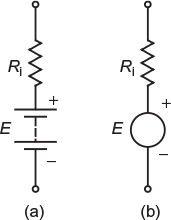
Fig. 2.7 (a) Battery and (b) Generator
When load (RL) is connected across the source (see Fig. 2.8).
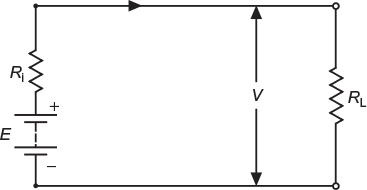
Fig. 2.8 DC source on load
Load current,

Terminal voltage, V = E − IRi or 
The voltage across the load terminals is reduced because of the voltage drop in the internal resistance of the source. A source having smaller internal resistance will have smaller voltage drop.
2.3.2 Ideal Voltage Source
A voltage source that has zero internal resistance is called an ideal voltage source. In such cases, the terminal voltage remains the same, irrespective of the value of load resistance. As we know,
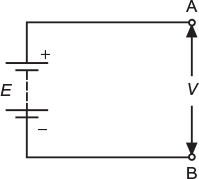
Fig. 2.9 Ideal voltage source
terminal voltage,
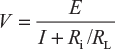
Since, Ri = 0,
V = E
An ideal voltage source is shown in Figure 2.9. An ideal voltage source cannot exist in nature, since all the voltage sources have some internal resistance (or impedance), although its value may be very small.
2.3.3 Real Voltage Source
An ideal voltage source is not practically possible. If it would exist, it would supply an infinite current at short circuit, which is not possible. Therefore, all the voltage sources have some internal resistance that limits the current at short circuit. A real voltage source is shown in Figure 2.10.
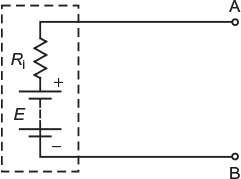
Fig. 2.10 Real D.C. Voltage source
However, it is always preferred to have a source that has very a small internal resistance, so that the terminal voltage of the source remains almost constant from no-load to full-load.
A voltage source that has very low internal resistance (or impedance) as compared to load resistance (or impedance) is known as a constant voltage source.
2.3.4 Current Source
A voltage source is a source that has low internal resistance, while a current source is a source that has high internal resistance.
2.3.5 Ideal Current Source
A voltage source that supplies a constant current no matter whatever is the load resistance (or impedance) is known as ideal current source.
A symbolic representation of such an ideal current source is shown in Figure 2.11(a). As above-mentioned, the current supplied by the source should remain constant at all values of load resistance, as shown in Figure 2.11(b) and (c). It means when the load resistance is infinite (RL = ∞), that is, terminal A and B are open, there should be some path (inside the source itself) through which the current IS can flow as shown in Figure 2.11(d). This shows that in this type of source, there will be internal power loss even at no-load. Hence, ideal current source is merely an idea and not the real one.
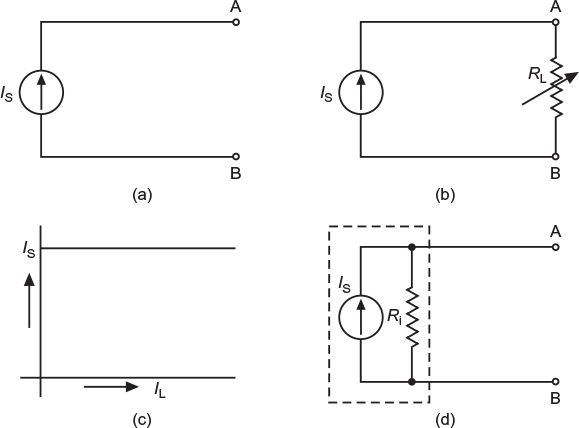
Fig. 2.11 (a) Ideal current source (b) Ideal current source on load (c) Relation between I and RL and (d) Practical current source
2.3.6 Real Current Source
An ideal current source is not practically possible. If it would exist, it would supply a constant current even at no-load, which is not possible. A real current source is basically a voltage source that delivers almost the same current at all values of load resistance.
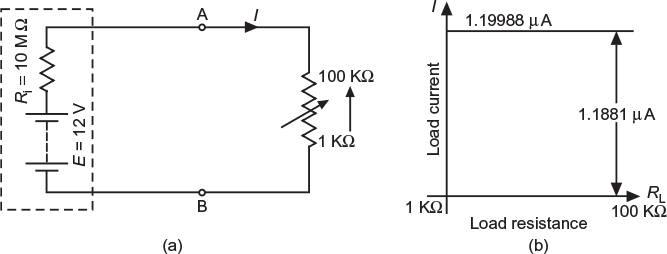
Fig. 2.12 (a) Real current source and (b) Load resistance and curve between I and RL
A source that has very high internal resistance (or impedance) as compared to the load resistance (or impedance) is considered as a constant current source.
A real current source having an internal resistance of 10 MΩ with a load resistance RL is shown in Figure 2.12(a). When load resistance varies from 1 KΩ to 100 KΩ, the current varies from 1.19988 μA (I = E/(Ri + RL) = 12/10.001) to 1.1881 μA.
This shows that the load current remains almost constant and the source behaves as a constant current source irrespective of the value of load resistance.
A current source is represented symbolically as shown in Figure 2.11(b).
2.3.7 Difference between Voltage Source and Current Source
Practically, there is no difference between voltage source and current source. In fact, a source can either be considered as a voltage source or as a current source. It basically depends upon its working conditions. When the value of load resistance (or impedance) is very large as compared to the internal resistance (or impedance) of the source, the source is treated as a voltage source. However, when the value of load resistance is very small as compared to the internal resistance of the source, the source is treated as a current source. Further, from the circuit point of view, it does not matter whether the source is treated as voltage source or current source
Leave a Reply