
The phase of an alternating quantity (current or voltage) at an instant is defined as the fractional part of a cycle through which the quantity has advanced from a selected origin (Fig. 6.23). In actual practice, we are more concerned withthe phase difference between the two alternating quantities rather than their absolutephase.
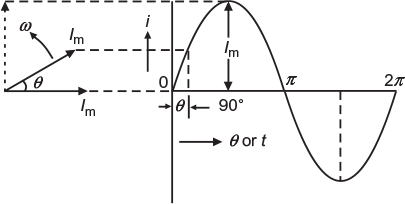
Fig. 6.23 Phasor representation and its instantaneous value on the wave diagram
The two alternating quantities having same frequency, when attain their zero value at different instants, the quantities are said to have a phase difference. This angle between zero points (and are becoming positive) of two alternating quantities is called angle of phase difference.
In Figure 6.24, two alternating currents of magnitude Im1 and Im2 are shown vecto-rially. Both the vectors are rotating at same angular velocity of ω radian per second. The zero values are obtained by the two currents at different instants. Therefore, they are said to have a phase difference of angle ɸ.
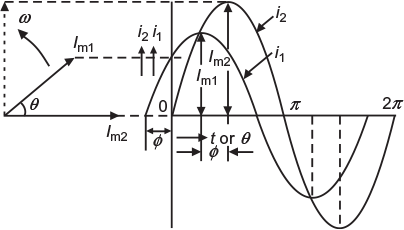
Fig. 6.24 Phasor and wave diagram of two ac quantities with phase difference
In other words, the phase difference may be defined as the angular displacement between the maximum positive value of the two alternating quantities having the same frequency.
The quantity that attains its positive maximum value prior to the other is called a‘leading quantity’, whereas the quantity thatattains its positive maximum value after theother is called a ‘lagging quantity’. In this case, current Im1 is leading current with respect to Im2 or is other words current Im2 is the lagging current with respect to Im1.
Leave a Reply