
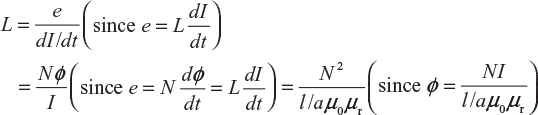
The property of a coil due to which it opposes the change of current flowing through itself is called self-inductance or inductance of the coil. This property (i.e., inductance) is attained by a coil due to self-induced emf produced in the coil itself by the changing current flowing through it. If the current in the coil is increasing (by the change in circuit conditions), the self-induced emf is produced in the coil in such a direction so as to oppose the rise of current, that is, the direction of self-induced emf is opposite to that of the applied voltage. On the other hand, if the current in the coil is decreasing, the self-induced emf is produced in the coil in such direction so as to oppose the fall of current. In other words, the direction of self-induced emf is in the same direction as that of the applied voltage. In fact, self-inductance does not prevent the change of current, but it delays the change of current flowing through a coil.
It may be noted that this property of the coil only opposes the changing current (i.e., AC). However, it does not affect the steady (i.e., DC) current when flows through it. In other words, the self-inductance of the coil (by virtue of its geometrical and magnetic properties) will exhibit its presence to the AC, but it will not exhibit its presence to the DC.
5.20.1 Expressions for Self-inductance
5.21 MUTUAL INDUCTANCE
The property of one coil due to which it opposes the change of current in the other (neighbouring) coil is called mutual inductance between the two coils.This property (i.e., mutual inductance) is attained by a coil due to mutually induced emf in the coil, while current in the neighbouring coil is changing.
5.21.1 Expression for Mutual Inductance

Leave a Reply