
When both the coil and magnetic field system are stationary but the magnetic field linking with the coil changes (by changing the current producing the field), the emf thus induced in the coil is called statically induced emf. The statically induced emf are of two types: self-induced emf and mutually induced emf.
5.19.1 Self-induced Emf
The emf induced in a coil due to the change of flux produced by it linking with its own turns is called self-induced emf. The direction of this induced emf is such that it opposes the cause that produces it (Lenz’s law), that is, change of current in the coil.
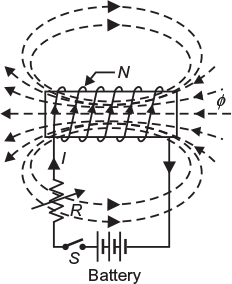
Fig. 5.30 Circuit for self induced emf
Since the rate of change of flux linking with the coil depends upon the rate of change of current in the coil. Therefore, the magnitude of self-induced emf is directly proportional to the rate of change of current in the coil. Therefore, the magnitude of self-induced emf is directly proportional to the rate of change of current in the coil, that is,
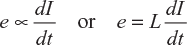
where L = a constant of proportionality and is called self-inductance or co-efficient of self-inductance or inductance of the coil.
5.19.2 Mutually induced Emf
The emf induced in a coil due to the change of flux produced by another (neighbouring) coil linking with it is called mutually induced emf.
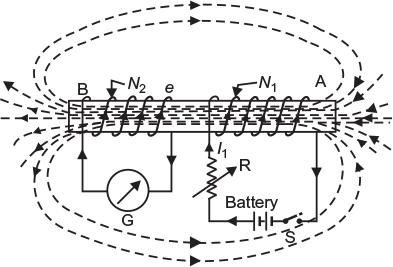
Fig. 5.31 Circuit for mutually induced emf
Since the rate of change of flux linking with coil ‘B’ depends upon the rate of change of current in coil ‘A’. Therefore, the magnitude of mutually induced emf is directly proportional to the rate of change of current in coil ‘A’, that is,

where M = a constant of proportionality and is called mutual inductance or co-efficient of mutual inductance.
Leave a Reply