One of the most significant mathematical tools available to electronics designers was actually invented for quite a different purpose. Around the 1850s, a British mathematician, George Boole (1815–1864), developed a new form of mathematics that is now known as Boolean algebra. Boole’s intention was to use mathematical techniques to represent and rigorously test logical and philosophical arguments. His work was based on the following: a statement is a sentence that asserts or denies an attribute about an object or group of objects:
Statement: Your face resembles a cabbage.
Depending on how carefully you choose your friends, they may either agree or disagree with the sentiment expressed; therefore, this statement cannot be proved to be either true or false.
By comparison, a proposition is a statement that is either true or false with no ambiguity:
Proposition: I just tipped a bucket of burning oil into your lap.
This proposition may be true or it may be false, but it is definitely one or the other and there is no ambiguity about it.
Propositions can be combined together in several ways; a proposition combined with an AND operator is known as a conjunction:
Conjunction: You have a parrot on your head AND you have a fish in your ear.
The result of a conjunction is true if all of the propositions comprising that conjunction are true.
A proposition combined with an OR operator is known as a disjunction:
Disjunction: You have a parrot on your head OR you have a fish in your ear.
The result of a disjunction is true if at least one of the propositions comprising that disjunction is true.
From these humble beginnings, Boole established a new mathematical field known as symbolic logic, in which the logical relationship between propositions can be represented symbolically by such means as equations or truth tables. Sadly, this work found little application outside the school of symbolic logic for almost one hundred years.
In fact, the significance of Boole’s work was not fully appreciated until the late 1930s, when a graduate student at MIT, Claude Shannon, submitted a master’s thesis that revolutionized electronics. In this thesis, Shannon showed that Boolean algebra offered an ideal technique for representing the logical operation of digital systems. Shannon had realized that the Boolean concepts of FALSE and TRUE could be mapped onto the binary digits 0 and 1, and that both could be easily implemented by means of electronic circuits.
Logical functions can be represented using graphical symbols, equations, or truth tables, and these views can be used interchangeably (Figure 10.30).
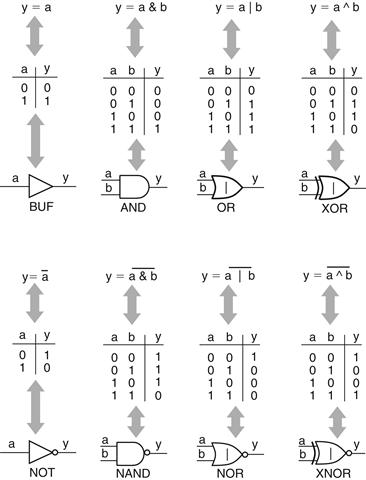
Figure 10.30 Summary of primitive logic functions
There are a variety of ways to represent Boolean equations. In this chapter, the symbols &, |, and ^ are used to represent AND, OR, and XOR respectively; a negation, or NOT, is represented by a horizontal line, or bar, over the portion of the equation to be negated.
Leave a Reply