In an R–L–C series circuit, when circuit current is in phase with the applied voltage, the circuit is said to be in series resonance. This condition is obtained in an R–L–C circuit shown in Figure 7.31,
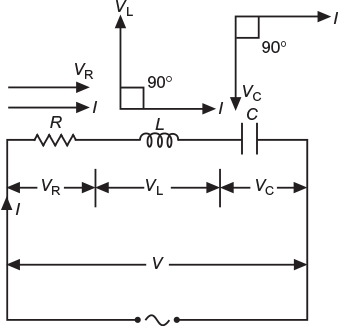
Fig. 7.31 R–L–C series circuit
when
XL = XC (or XL − XC = 0)
At resonance, XL − XC = 0 or XL = XC
Impedance, 
Current,

Since at resonance, the opposition to the flow of current is only resistance (R) of the circuit, the circuit draws maximum current under this condition.
7.13.1 Resonant Frequency
The value of XL (= 2πf L) and XC (= 1/2πf C) can be changed by changing the supply frequency. When frequency increases, the value of XL increases, whereas the value of XC decreases, and vice versa. Therefore, to obtain series resonance, the frequency is adjusted to fr, so that XL = XC, the condition at point P shown in Figure 7.32.
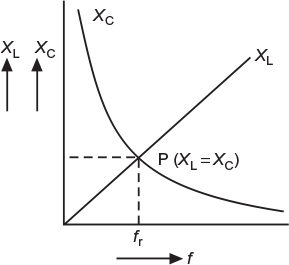
Fig. 7.32 Phasor diagram for series resonant circuit
At series resonance, XL = XC

where fr is the resonant frequency in Hz when L and C are measured in Henry and Farad, respectively.
7.13.2 Effects of Series Resonance
The following are the main effects of series resonance:
- At resonance XL = XC, and therefore, the impedance of the circuit is minimum and is reduced to the resistance of the circuit only, that is, Zr = R
- Since, impedance is minimum, the circuit current is maximum at resonance, that is Ir = V/Zr = V/R
- Power taken by the circuit is maximum, as Ir is maximum,

- As the current drawn by the circuit, at resonance, is very large (maximum), the voltage drop across L (i.e., VL = IXL = I × 2π frL) and (i.e., VC = IXC = I × 1/2πfrC) are also very large. In power system, at resonance, the excessive voltage built up across the inductive and capacitive components (such as circuit breakers and reactors) may cause damage. Therefore, series resonance should be avoided in power system. However, in some of the electronic devices (such as antenna circuit of radio and TV receiver and tuning circuits), the principle of series resonance is used to increase the signal voltage and current at a desired frequency (fr). Since a series resonant circuit has the capability to draw heavy current and power from the mains, it is often regarded as acceptor circuit.
Leave a Reply