If two complex numbers are equal, then their real parts are equal and their imaginary parts are equal. Hence, if a+jb=c+jd, then a=c and b=d. This is a useful property, since equations having two unknown quantities can be solved from one equation. Complex equations are used when deriving balance equations with AC bridges.
Example 7.3
Solve the following complex equations:
Solution
.
(a) 3(a+jb)=9 –j2. Thus, 3a+j3b=9 –j2
Equating real parts gives: 3a=9, i.e., a =3
Equating imaginary parts gives:

Thus, 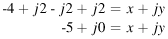
Equating real and imaginary parts gives: x =–5, y =0
Thus, (a+b)+j(–2b – 3a)=5 +j2
 (7.1)
(7.1)
 (7.2)
(7.2)
We have two simultaneous equations to solve. Multiplying equation (7.1) by 2 gives:
 (7.3)
(7.3)
Adding equations (7.2) and (7.3) gives –a=12, i.e., a =–12
From equation (7.1), b =17
Example 7.4
An equation derived from an AC bridge network is given by:
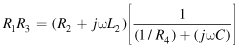
R1, R3, R4 and C4 are known values. Determine expressions for R2 and L2 in terms of the known components.
Solution
Multiplying both sides of the equation by (1/R4+jωC4) gives:

i.e., 
Equating the real parts gives: R2=R1R3/R4
Equating the imaginary parts gives:
ωL2=R1R3ωC4, from which, L2=R1R3C4
Leave a Reply