Metal oxide varistors (MOVs) are components that have a nonlinear V/I characteristic. In the case of varistors used for voltage protection, the voltage varies but little over a very wide range of current. The types used for power electronics are made by pressing and sintering wafers of zinc oxide ceramic with the characteristics determined by the process, the diameter, and the thickness. These devices are available in sizes from those suitable for surface mounting on PC boards to those for large station-type lightning arresters. The range spans sizes from a few millimeters to 90 mm in diameter.
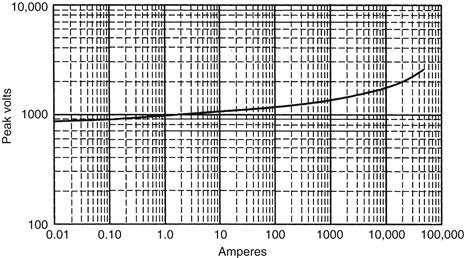
The V/I curve for a typical 60-mm dia., 480 V rated MOV is shown in Figure 15.7. Note that the current is only 1 A at 1000 V peak and virtually zero at the 680 V peak in a 480 V circuit. However, it will limit the peak voltage to about 1200 V at 1000 A. This means it will protect a 1200 V SCR or other semiconductor from peak transient currents as high as 1000 A. MOVs are generally applied at their nominal rms voltage rating and are expected to clamp transients to a peak voltage of 2.5 times their rms rating.
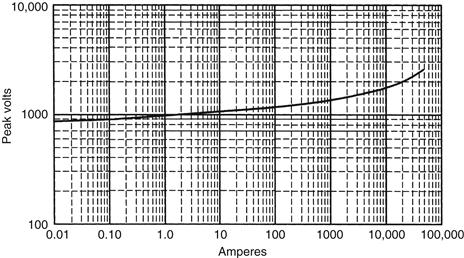
Figure 15.7 480 V, 60-mm MOV characteristic
MOVs have little power dissipation capability, and they can be easily destroyed by repetitive transients such as produced by SCR commutation. MOV catalogs show the lifetime characteristics as a function of the current magnitude and duration. When used for suppressing breaker chop, for example, the maximum lifetime exposure should be calculated so that a suitably sized MOV can be specified.
Leave a Reply