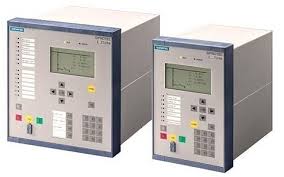
Utilities and large industrial plants use a variety of relay types to protect the system and its components against fault currents. The most basic types are overcurrent relays, which are available in a number of styles. All will trip a breaker on overcurrent, but the timing is widely variable among the several types. Relays are available from inverse to extremely inverse according to the design. All trip with a delay on low-current faults but trip more quickly as the fault current rises. Many are available with an auxiliary instantaneous element that will trip subcycle. Nearly all types are now electronic, with power derived from the protected circuit itself. They are usually cascaded with decreasing trip current settings as the system branches out from source to load through a succession of buses and circuit breakers. This allows an overcurrent to be cleared as close to the fault as possible so as to avoid disturbing other loads.
Another useful type is the differential relay. This relay has two sets of current coils and will trip on current imbalance between the two sets. When equipped with suitable current transformer ratios on the two sets, it can protect a transformer or generator from internal faults and distinguish between them and external faults. Most differential relays have delay elements to allow for inrush currents in transformers.
Electric utilities often use impedance or distance relays to protect transmission and distribution circuits. Although computers now take over many of these tasks, the principle remains the same. The impedance relay has both current and voltage coils, with the voltage coils used as restraint elements. If the voltage is high enough, the current coils are inhibited from tripping the associated breaker. In a sense, this relay measures the impedance and hence the distance to the fault, and it can decide whether a downstream breaker can clear the fault with less disturbance to the system.
Relays are identified on system single-line diagrams as type 50 for instantaneous overcurrent relays, 51 for time overcurrent relays, 64 for ground fault relays, 87 for differential relays, and 21 for impedance or distance relays. The relay designations are usually shown adjacent to the circuit breaker they trip, with instantaneous and time overcurrent relays shown as 50/51. Undervoltage, phase balance, phase sequence, directional power, and frequency relays are but a few of the many other types available.
This essay has been a bit cavalier in equating, by implication, impedance to reactance. In most power systems work, the resistive losses are small enough to have little effect on fault currents or regulation, so impedance is often considered as reactance in calculations. The same is true of commutation in converters where resistance does play a small role.
15.12.1 Analytical Tools
Several specialized analytical tools have been developed to aid in the solution of power and power electronics circuits. Learning these tools can make the design job easier, especially when studying the interaction between a power electronics system and the supplying utility system. Also, it is necessary to understand these analytical tools and their nomenclature to converse with utility and vendor engineers associated with the power electronics field.
Leave a Reply