Even the lowest-voltage systems require some consideration for the electrical clearances between conductors of different voltage. Standards have been developed by the Canadian Standards Association (CSA), Institute of Electrical and Electronics Engineers (IEEE), National Electrical Manufacturers Association (NEMA), and Underwriter’s Laboratories (UL). These standards cover everything from PC boards to high-voltage switchgear.
Spacings are generally considered in two classes: strike, the clearance through air paths, and creep, the clearance along insulating surfaces. Whereas the strike capability of an air path between spherical conductors may be much larger then the standards allow, the standards recognize the imperfect world of sharp-edged conductors, conductor movement on faults, voltage transients, and safety margins. Similarly, the creep standards recognize that insulating surfaces may become contaminated by conductive dust or moisture.
Understanding these standards is especially important in applying medium-voltage transformers that are directly connected to customer switchgear. The switchgear is the first line of defense and must cope with lightning and switching transient voltages, but it will pass along these transients to connected equipment. Unless equipment connected to customer switchgear is protected by auxiliary arresters and/or surge capacitors, it must meet the same standards as the switchgear itself. Table 15.1 is taken from the Westinghouse document, “Electrical Clearances for Switchgear,” and, although some years old, it is typical of the several extant standards.
Table 15.1
: Switchgear electrical clearance standards
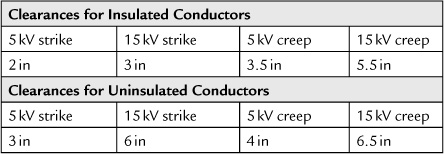
The insulated conductors include extruded insulations, insulating boots, and high-voltage taping. The standards recognize that these insulating materials may degrade with continued exposure to high voltages.
Leave a Reply