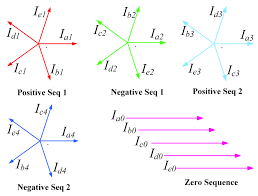
Analysis of a three-phase AC circuit with unbalanced currents or voltages gets into some rather messy complex numbers. In 1918, Dr. C. L. Fortesque delivered a paper before the AIEE, predecessor organization to the IEEE, which laid the groundwork for symmetrical components, a method of representing unbalanced voltage or current phasors by symmetrical sets of phasors. These symmetrical components are positive- and negative-sequence three-phase components as well as a zero-sequence single-phase component. This latter phasor is involved with four-wire systems, usually involving ground circuits. The network can be solved in the usual fashion with each of the symmetrical components, and then the individual solutions combined to represent the unbalanced system. Symmetrical components are universally used by power company engineers for system parameters.
Symmetrical component analysis uses a complex operator, a, where a=-0.5+j 0.866, a unit phasor at 120.Then, a2=-0.5 –j 0.866, and a3=1.0. If a set of asymmetric phasors are given as x, y, and z, then:
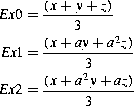
where all quantities are phasors. Ex0, Ex1, and Ex2 are referred to as the zero-sequence, positive-sequence, and negative-sequence components of x, respectively. Then, Ex0=Ey0=Ez0, Ey1=a2Ex1, Ez1=a Ex1, Ey2=a Ex2 and Ez2=a2Ex2.
This process is shown in Figure 15.8 where a (very) unbalanced set of phasors are x=6.0, y=-j2.0 and z=-0.707+j0.707. The sequence networks are shown at the right. In this case,
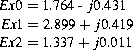
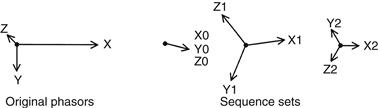
Figure 15.8 Symmetrical components
The original asymmetric phasors may then be reconstituted as:

If the set of phasors just resolved were to represent load impedances, the line currents could be determined by impressing the balanced line voltages onto the three sequence networks separately and adding the three components of each line current.
Symmetrical components are often used to describe the characteristics of overhead transmission lines. For example, the familiar set of three conductors in a horizontal row has equal couplings from the two outer lines to the center line, but they have a different coupling to each other. Hence, the mutual inductances and capacitances of the set are different. The use of symmetrical components of these impedances allows the line to be analyzed as two balanced positive- and negative sequence networks. The resultant currents can then be combined. Absent a grounded circuit, the zero-sequence network is not present.
The many circuit simulation software packages now available can reduce the need for using symmetrical components for circuit solutions, but they are still valuable for defining the unbalanced loading and fault performances of synchronous machines.
Leave a Reply