Alan Turing is a towering figure in computer science and AI. He is often called the “father of AI.”
In 1936, he wrote a paper called “On Computable Numbers.” In it, he set forth the core concepts of a computer, which became known as the Turing machine. Keep in mind that real computers would not be developed until more than a decade later.
Yet it was his paper, called “Computing Machinery and Intelligence,” that would become historic for AI. He focused on the concept of a machine that was intelligent. But in order to do this, there had to be a way to measure it. What is intelligence—at least for a machine?
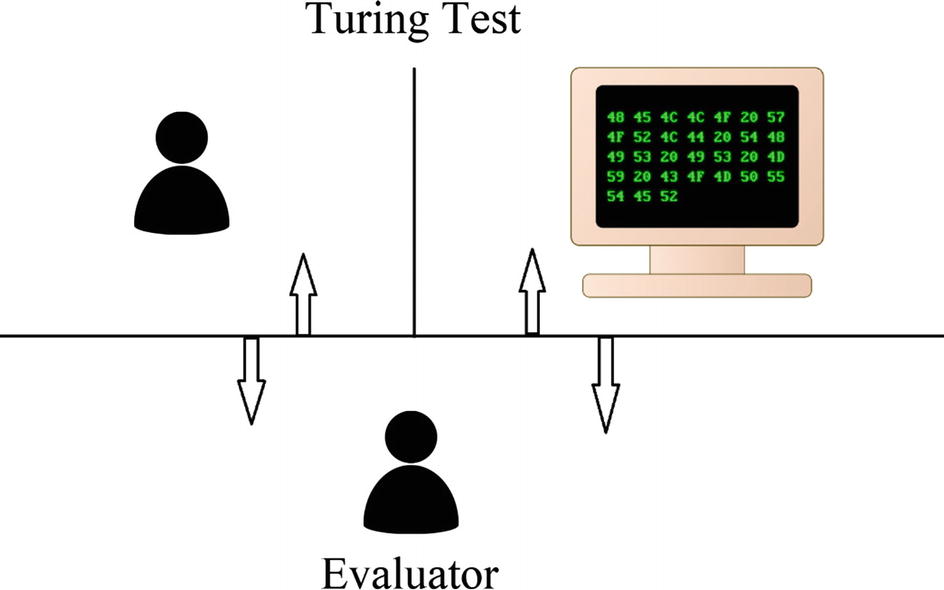
This is where he came up with the famous “Turing Test.” It is essentially a game with three players: two that are human and one that is a computer. The evaluator, a human, asks open-ended questions of the other two (one human, one computer) with the goal of determining which one is the human. If the evaluator cannot make a determination, then it is presumed that the computer is intelligent. Figure 1-1 shows the basic workflow of the Turing Test.
The genius of this concept is that there is no need to see if the machine actually knows something, is self-aware, or even if it is correct. Rather, the Turing Test indicates that a machine can process large amounts of information, interpret speech, and communicate with humans.
Turing believed that it would actually not be until about the turn of the century that a machine would pass his test. Yes, this was one of many predictions of AI that would come up short.
So how has the Turing Test held up over the years? Well, it has proven to be difficult to crack. Keep in mind that there are contests, such as the Loebner Prize and the Turing Test Competition, to encourage people to create intelligent software systems.
In 2014, there was a case where it did look like the Turing Test was passed. It involved a computer that said it was 13 years old.2 Interestingly enough, the human judges likely were fooled because some of the answers had errors.
Then in May 2018 at Google’s I/O conference, CEO Sundar Pichai gave a standout demo of Google Assistant.3 Before a live audience, he used the device to call a local hairdresser to make an appointment. The person on the other end of the line acted as if she was talking to a person!
Amazing, right? Definitely. Yet it still probably did not pass the Turing Test. The reason is that the conversation was focused on one topic—not open ended.
As should be no surprise, there has been ongoing controversy with the Turing Test, as some people think it can be manipulated. In 1980, philosopher John Searle wrote a famous paper, entitled “Minds, Brains, and Programs,” where he set up his own thought experiment, called the “Chinese room argument” to highlight the flaws.
Here’s how it worked: Let’s say John is in a room and does not understand the Chinese language. However, he does have manuals that provide easy-to-use rules to translate it. Outside the room is Jan, who does understand the language and submits characters to John. After some time, she will then get an accurate translation from John. As such, it’s reasonable to assume that Jan believes that John can speak Chinese.
Searle’s conclusion:
The point of the argument is this: if the man in the room does not understand Chinese on the basis of implementing the appropriate program for understanding Chinese then neither does any other digital computer solely on that basis because no computer , qua computer, has anything the man does not have.4
It was a pretty good argument—and has been a hot topic of debate in AI circles since.
Searle also believed there were two forms of AI:
- Strong AI : This is when a machine truly understands what is happening. There may even be emotions and creativity. For the most part, it is what we see in science fiction movies. This type of AI is also known as Artificial General Intelligence (AGI). Note that there are only a handful of companies that focus on this category, such as Google’s DeepMind.
- Weak AI : With this, a machine is pattern matching and usually focused on narrow tasks. Examples of this include Apple’s Siri and Amazon’s Alexa.
The reality is that AI is in the early phases of weak AI. Reaching the point of strong AI could easily take decades. Some researchers think it may never happen.
Given the limitations to the Turing Test, there have emerged alternatives, such as the following:
- Kurzweil-Kapor Test: This is from futurologist Ray Kurzweil and tech entrepreneur Mitch Kapor. Their test requires that a computer carry on a conversation for two hours and that two of three judges believe it is a human talking. As for Kapor, he does not believe this will be achieved until 2029.
- Coffee Test: This is from Apple co-founder Steve Wozniak. According to the coffee test, a robot must be able to go into a stranger’s home , locate the kitchen, and brew a cup of coffee.
Leave a Reply