Once the images are understood, computer vision is then used in the following areas.
- Facial recognition systems to recognize faces in images and videos. Applications like Google photos, Snap chat, Facebook, Instagram, etc. use facial recognition system to identify people.
- Almost every smart phone these days use facial-recognition algorithms (refer Fig. 6.4) to unlock phones. Facebook uses facial recognition to identify users in the posted pictures. In China, this technology is integrated with payment technology to allow users to do cashless payment.
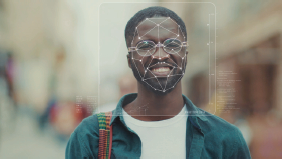 Credit: Fractal Pictures / ShutterstockFIGURE 6.4 Facial-recognition algorithms
 - Some government agencies in different countries are also using facial technology for surveillance. Though the use has raised concerns among rights and privacy advocates, nonetheless, facial recognition techniques applications are on a constant rise.
- Content-based image retrieval systems identify images by identifying image properties like composition, colour, texture, etc. Search engines like Google and Bing and software analysing CT scans and MRIs in hospitals, etc. used CBIR systems.
- Computer vision is extensively used in smart interactions to give input to computers. This is especially more helpful in case of gaming software and in systems designed for differently-abled individuals.
- Software used in home security systems, office security systems, drone-based surveillance systems, etc. (refer Fig. 6.5) also use computer vision techniques.
- Computer vision is the heart of augmented reality apps that detects physical objects in real-time to place virtual objects within the physical environment.
- Many agricultural organizations use computer vision techniques to monitor harvest and solve common agricultural problems including emergence of weeds or nutrient deficiency. Images collected from satellites, drones or planes are processed by computer vision algorithms to detect potential problems in the early phase, thereby avoiding unnecessary losses at a later stage.
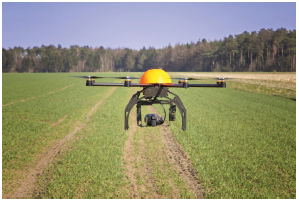 Credit: Robert Mandel / 123RFFIGURE 6.5 Drones for Survelliance
 - Self-driving cars (like Tesla) use computer vision to learn from their surroundings. Every smart vehicle has cameras to capture videos from different angles. These videos act as an input to the computer vision software that processes them to detect objects like road marking, pedestrians or other cars, traffic lights, etc.
- Websites like Facebook perform content moderation using computer vision techniques. Billions of posts posted by users every day are reviewed and any images/ videos that contain violence, extremism or pornography are immediately removed.
- 90% of medical data is present in the form of images. So, most of the diseases can be easily diagnosed by processing images available in the form of X-rays, MRI, mammography, etc. For example, computer vision algorithms can detect diabetic retinopathy, which is the most prevalent cause of blindness (refer Fig. 6.6). Going further, these algorithms can also process pictures of the back of the eye and rate their severity (in case the disease is detected). Computer vision algorithms can even detect cancer with much higher precision than human doctors.
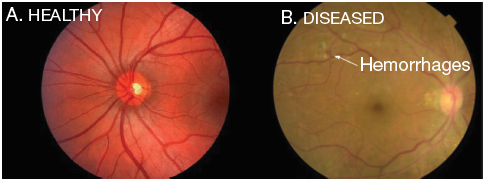 Credit (Fig 6.6(a)): Timothy Mainiero / 123RFFIGURE 6.6 Healthy Eye vs Diseased Eye
 - CV In Augmented Reality (AR) and Mixed Reality (MR): In AR and MR, computer vision enables computing devices (like smartphones, tablets and smart glasses) to overlay and embed virtual objects on real world imagery. For example, CV algorithms can help AR applications detect planes such as tabletops, walls and floors. Moreover, Snapchat Filters that overlay digital images onto your face is an application of AR. Another example of AR is Pokemon Go where users can walk around with their mobile phones and find Pokemon that are overlaid on the environment around the user.
- Inventory management: CV algorithms can analyse images from security cameras to generate a very accurate estimate of the items available in the store. Results obtained through this analysis can then be used by store managers to detect when there is an unusual increase in demand to react early and efficiently.
- Manufacturing: In this sector, most losses occur due to problems in machines or because of production of defective components. Computer vision algorithms can be used for predictive maintenance. Images obtained through cameras (probably fitted in the eyes of robots) can be analysed to detect potential problems they occur. CV can even be helpful to reduce defects. The system can identify defects in components throughout the entire production line to notify the manufacturers to take action in real time.
- The system is trained to classify a defect as a serious defect or a mild defect. In case of a serious defect, further production is completely halted until the issue is resolved.
- Insurance: CV is used in the insurance sector for processing claims. Clients can be asked to share images while documenting and claiming money. The CV system can analyse those images to estimate and adjust repair costs, determine if the insurance covers them and even check for possible fraud. In this way, clients get a better experience as the length of claim-cycle gets shortened due to automation.
- A CV system can also be used to avoid accidents by preventing collisions when integrated into industrial machinery, cars, and drones. This provision will have a huge impact on the insurance industry.
- Defense and security: CV systems are used in homes and companies with high security requirements (like banks) to identify customers based on analysing images from security cameras.
- Such systems can also be used to improve cargo inspection at ports or for surveillance of sensitive places such as embassies, power plants, hospitals, railroads, and stadiums. In these places, computer vision algorithm analyses and classifies images, create a detailed description of a scene in real time to help decision-makers take right action at the right time. In defense, CV systems can also be used to identify enemy terrain or enemies in images.
- Visual search engines: A visual search engine retrieves images that meets the specified criteria. For example, Google search engine allow users to present a source image so that it can find all images similar to it. Then, applications like Google Lens, can be used to obtain detailed information from images. For example, you can show an image of a dog to get information about its breed, or any other details.
- In the e-commerce market, Pinterest Lens can be used to find new ways to wear the dresses. For example, when you present a photo of an item, Pinterest Lens will return outfit ideas that include compatible clothing items that you would like to buy.
Amazon Go Store uses Computer Vision technique to allow customers who have installed the Amazon Go application on their mobile devices to no longer stand in long queues in the super market. They just go to the store, pick up their items and come back without paying at the kiosks.
Leave a Reply