
The term ‘metaverse’ is a combination of two words—‘meta’ and ‘universe’ which means an anticipated future iteration of the Internet that is often referred to as Web 3.0. The evolution of the Internet from Web 2.0 to Web 3.0 will cause a tremendous boost of online 3-D or virtually integrated environments that provide users immersive experience in true sense (refer Fig. 9.17).

Credit: marigranula / 123RF
Metaverse is a combination of the virtual reality, augmented reality, mixed reality, blockchain technology, Internet of Things (IoT), 5G, artificial intelligence (AI) and spatial technologies that is accessed through a browser or headset. It is a device-independent technology that is not owned by a single vendor. Metaverse is an independent virtual economy that uses digital currencies and non-fungible tokens (NFTs). It allows users to have real time interactions and experiences across distance.
Basically, metaverse is not just one type of experience. It actually encompasses a continuum of immersive digital experiences that will be available to users in the future to engage them in different activities in digital spaces. For example, a massive virtual reality multiplayer game can be accessed through a VR headset. Similarly, an integrated digital and physical spaces (like location-specific immersive digital content) that are often a need of business users, can be experienced using digital glasses or smartphones.
Many social media and tech companies like Meta Platforms (formerly known as Facebook) and Microsoft are investing heavily in Social VR to create platforms to allow people to connect socially and work remotely, respectively.
Metaverse is not one digital space but a combination of several digital spaces and experiences.
9.5.1 Use Cases of Metaverse
Metaverse is considered to be the next version of the Internet. The Internet started as individual bulletin board are rose to independent online destinations. Metaverse will make these destinations sites on a virtual shared space. Some examples are listed below.
Nikeland is a place to hang out, play and dress your avatar in virtual Nike products. More than 7 million people have already visited Nikeland.
In 2020, 12.3 million people attended a virtual concert by rapper Travis Scott, hosted in Fortnite. In this concert, the dancing figures were all people, connecting from different locations around the world.
The best part of Metaverse is that it allows users to mimic being together in ways that are not possible over Zoom. You can point to something to explain, use hand gestures or draw on a piece of paper or visit places together.
Metaverse makes it possible to collaborate with surgeons, or create a clay model for a new-car design.
Users can even purchase outfits and accessories for online avatars or buy digital land and construct virtual homes.
Virtual meetings in metaverse gives you the feeling of being together in a room. When participants need a work break, they can together play virtual games with colleagues from all over the world. This creates a real connection and builds social bonds.
Social media can move to the Metaverse, where users can interact through three-dimensional avatars.
Higher education, medical, military and other types of training can be delivered in a more immersive learning experience without creating additional infrastructure. Metaverse provides the framework to provide these services.
‘Metaverse will allow people to replicate or enhance their physical activities. This could happen by transporting or extending physical activities to a virtual world or by transforming the physical one,’ says Marty Resnick
Virtual malls use metaverse to extend their reach to an immersive shopping experience.
As of now, some aspects of the metaverse are integrated into existing Internet-enabled video games (like Second Life, Minecraft and Fortnite). These games offer immersive experiences in which players from around the world can engage simultaneously.
Did you know?
- Microsoft is working hard to integrate Microsoft Teams into the metaverse.
- Roblox, an online gaming platform (particularly for youngsters), is creating an integrated set of virtual experiences for gamers.
- Nvidia Corp is building an Omniverse platform that connects 3D virtual words in a shared universe. This can be used for creating simulations of buildings and factories.
- In 2021, Snapchat launched AR glasses to augment users’ experience of reality outside their app.
- Epic Games developed one of the popular digital game- Fortnight. It is now creating virtual social experiences like music concerts or dance parties.
Gartner estimated 25% of people will spend at least one hour every day in the Metaverse for work, shopping, education, social media and/or entertainment by 2026.
Woolsey said, an organization must go for metaverse solution if the following conditions are satisfied.
- The target customers are 15–30-year-olds. Metaverse engages the audience and makes them stay consistent with the brand. Businesses can even build a store that sells virtual goods or deliver an event or other type of engagement.
- The organization has a dispersed team and often goes for hybrid meetings, multi-location training programmes and institutional events that bring people together to build a community, affiliation and engagement.
- The organization needs to explore its internal operations—industrial or operational scenarios that would otherwise be very expensive to build in real life. Figure 9.18 shows some key elements of metaverse. Auto companies usually use digital twins to perform a dummy crash test in a metaverse world, and then collaborate on model modifications in augmented reality.
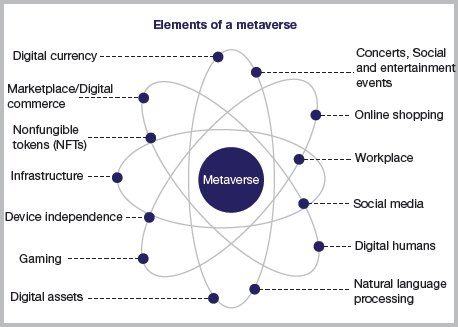
FIGURE 9.18 Elements of a metaverse
All in all, metaverse is seen as a significant business and financial opportunity for the tech industry and other sectors.
Woosely suggested that an organization must not dive into metaverse, just for the sake of doing metaverse. It should first analyse if any of the above-stated three scenarios are benefitted with this technology.
Once the technology is ready, first experiment it with a small audience so you can understand its actual value both qualitatively and quantitatively. Based on this learning, find the path that delivers strategic value and can be easily scaled.
However, the adoption of Metaverse technologies is still nascent and fragmented. Not many companies are planning to invest heavily in it, since it is still too early to determine which investments will be viable in the long term.
AR is used in Google Search to allow users to place 3D objects in their own space, allowing them to gain a better idea of an object’s scale.
Many critics are skeptical about the growth of metaverse as it has mostly failed to live up to its hype and revenue expectations. Moreover, critics have exhibited concerns about the privacy and health implications of the metaverse vision. So, instead of investing, companies are first learning, exploring and preparing for a Metaverse.
Recommendations for Technology Innovation Leaders
- Develop digital business strategies that leverage the built-in infrastructure and participants of the Metaverse.
- Lead ideas and innovation that focuses on new opportunities and business models with the Metaverse.
- Identify risks, privacy and security issues that are prevalent in this new persistent and decentralized environment.
- Enumerate the outcomes, opportunities and obstacles faced by Metaverse.
Side-Effects of Metaverse
According to Indo-Asian News Service (IANS) report, Meta (formerly known as Facebook) is aware that VR can be a really ‘toxic environment’, especially for women and minorities. Harassment in digital spaces is not uncommon.
India’s Role in Building Metaverse
The IANS report revealed that Mark Zuckerberg said that India and its vast pool of talent—the engineers, developers and creators and the whole vibrant startup ecosystem, is going to be a huge part of that journey. He is really excited about the role that India will play in building the future of Metaverse, which is going to be the successor to the mobile internet. India will have the largest app developer base in the world by 2024. It already has one of the largest ‘Spark AR’ developer communities.
9.5.2 Where is Metaverse Today?
As of now, Meta owns the leading producer of VR headsets, Oculus. Microsoft supports various enterprise use cases with its HoloLens MR smart glasses that ere first released in 2016. Apple will be soon releasing its AR and VR headsets. HTC, Pico, MagicLeap and other manufacturers are also moving to manufacture devices to support this technology. At the same time, cascade technology architectures are shifting various computational loads across back-end server infrastructures to edge devices. For example, Unity’s streams fully interactive real-time 3D environments. The job of rendering the environments is handled by their automatically scaling GPU server infrastructure.
Metaverse makes full use of ubiquitous computing experience to allow users leverage traditional devices like computers and mobile devices while experiencing with emerging immersive AR and VR wearables.
Like the internet, no one owns the metaverse. However, there are several key players in the space, and companies like Meta, Microsoft, Unity, Epic Games, Roblox and others are pouring billions of dollars into making the sci-fi dream come true.
The idea of metaverse was first coined by sci-fi author Neal Stephenson in his novel Snow Crash. Soon, it could become a reality because many large technology companies are betting that it will soon be as big as the Internet is today.
Leave a Reply