
Artificial intelligence (AI) works by combining massive data with fast, iterative processing and intelligent algorithms, allowing the software to automatically learn to deduce patterns in data. Building an AI system is a process of reverse-engineering human traits and capabilities in a machine. AI is a broad field of study that includes many theories, methods and technologies. To understand how artificial intelligence actually works, we must look into its various sub domains. All these domains have one thing in common. They all process large amounts of data with fast and intelligent algorithms to allow the software to learn automatically from patterns or features in the data. The sub-domains of AI are given in Fig. 2.1.
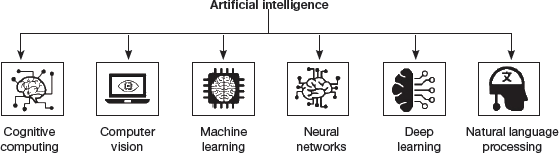
- Neural Networks: Neural networks work in the same way as human neural (brain) cells work. A series of nodes that capture the relationship between various underlying variables and processes the data. Every node (or neuron) process information by responding to external inputs and relaying information between each unit. The entire process of learning requires multiple passes at the data to derive meaning from undefined data (refer to Fig. 2.2).Note that even the most basic neural network consists of the following layers:An input layer, which is the layer from where data enters the network.
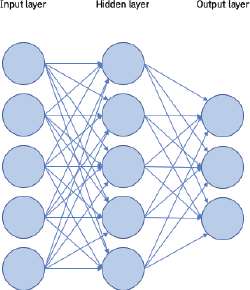 FIGURE 2.2 Basic neural networkAt least one hidden layer, where machine learning algorithms process the inputs. Weights, biases and thresholds are applied to the received inputs and the results of processing are passed to the output layer.An output layer, is the layer that gives the final result to be displayed.
 - Machine learning: Machine learning (ML) is a branch of computer science that analyses data and identifies patterns to teach a machine to deduce results and make decisions without any human intervention. ML algorithms learn from experiences rather than instructions. They automatically learn and improve by learning from their output. For this, humans do not have to write instructions for them to produce the desired output. They learn by analysing data sets and comparing the final output. In case of any error, they repeat the learning process until the accuracy of the outputs improve.This automation not only saves human time and effort but also make better decisions. In chapter 1, we have already seen that technologies like Machine Learning, Natural Language Processing, Deep Learning are all sub domains of Artificial Intelligence (refer Fig. 2.3)
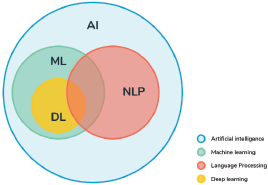 FIGURE 2.3 Relationship between AI, ML, DL and NLP.
 - Deep learning: Deep learning is an ML technique that teaches a machine to process inputs through layers to more accurately classify, infer and predict an outcome. DL creates huge neural networks with several layers of processing units to take full advantage of advances in computing power and improved training techniques. This helps the algorithm to learn complex patterns in large amounts of data. Some applications of DL include image and speech recognition.Deep learning models are based on deep neural networks (refer Fig. 2.4), that is, neural networks with multiple hidden layers. In such a network, each hidden layer further processes the temporary outputs received from the previous layer. This movement of computations through the hidden layers to the output layer is known as forward propagation.Once the final result is produced by the output layer, its accuracy is calculated. In case of unsatisfactory results, errors are identified, weights assigned to each node are updated, and pushed back to the previous layers to refine or train the model. This process of moving backward to update weights of all nodes is known as backward propagation.Deep learning models can work with labeled as well as unlabelled data. This means that deep learning supports both supervised and unsupervised learning.
- Natural language processing: NLP is a science in which a machine is made to read, understand, interpret and respond to a human language. This is specifically done to make machine capable of communicating with a human.
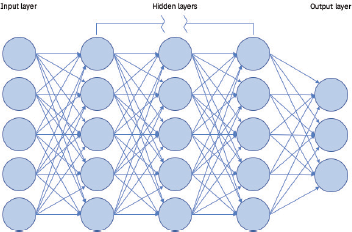 FIGURE 2.4 Deep neural network
 - Computer vision: Computer vision is a branch of AI that tries to understand an image by breaking it down into several parts and then studying each part of the image. This helps machine to classify and learn from a set of images so that it can make better decisions based on previous observations. For example, when a machine can process, analyse and understand images, they can capture images or videos in real time and interpret their surroundings.Computer vision techniques are used today for facial recognition that helps in surveillance and security systems, autonomous vehicles, retail stores for tracking inventory and customers, in medicine for diagnosing diseases, in financial Institutions to prevent fraud, and so on.
- Cognitive Computing: Cognitive computing algorithms try to mimic human brain by analysing text, speech, images or objects in the same way to give the desired output. It is basically a subfield of AI that is used to provide a natural, human-like interaction with machines. The ultimate goal of using cognitive computing is to make the machine speak coherently in response to a human.
Apart from the above-mentioned techniques, some additional technologies that enable and support AI include the following:
- Graphical processing units that provide heavy computing power required for iterative processing and training neural networks.
- Internet of Things to generate massive amounts of data from connected devices. Usually, this data remains unanalysed. Automating models with AI helps to analyse this data and extract useful information from it. Advanced algorithms can be used to analyse data faster at multiple levels to identify and predict rare events, understanding complex systems and optimizing unique scenarios.
Leave a Reply