Information as accessed by the human mind, and the myriad ways of process-
ing it, is what has set humankind apart in the animal world. The ability to use
the physical systems around us to encode and then to process information has
been evolving in leaps and bounds ever since the dawn of our race! The earliest
form of computation was probably in the form of account-keeping by counting
pebbles or on the fingers. This developed into the abacus, writing symbols,
the computing machine, and now, a laptop or a supercomputer: everywhere
we represent information by means of a physical system, and perform ma-
nipulations on that system to process the information in many desired ways,
including communication. The stress here is on the realization that the basis
of information is a physical system. The more advanced that system is and
the set of rules it functions on, the more capable our means of information
processing and communication. When the underlying physical system used for
encoding and processing information is a quantum system, we have quantum
information processing.
While technological advances have made it possible to reach astounding
speeds and processing power, the basic paradigm of current day information
processing is binary logic with currents or voltages in the semiconductor cir-
cuitry at the heart of the modern computer processors. However, it is impor-
tant to realize that the behavior of these high and low states of the circuit
is based on laws of classical physics. We know now that at the most funda-
mental level, physical systems obey the laws of quantum mechanics. These
laws are fundamentally different in many ways from classical laws of physics.
Therefore, the basic paradigm of information processing is different when we
come to quantum information processing. Not only are the algorithms and
the processing mechanism different, but there are distinct advantages of the
quantum over the classical.
According to recent data, the fastest current day supercomputer is capable
of performing at a speed of hundreds of Gflop/s.
1
The quantum paradigm
affords a speedup to many algorithms that are very slow to perform even on
this computer! Much of modern-day information security, for instance secure
online cash transactions, is based on classical cryptography. This has been
proved to be vulnerable if a quantum computer is used to crack the code!
I’ve been trying to motivate the need to study quantum information. But
1
Gigaflop per second, Giga = 10
12
, FLOP = floating point operation.
3
4 Introduction to Quantum Physics and Information Processing
the inquisitive scientific mind will no doubt want to grasp the basics of the
physical laws that make complex information processing possible: the laws of
quantum mechanics. Professor Richard Feynman of Caltech was supposed to
have famously said that no one understands quantum mechanics! How then are
we basing modern technology on it? With this book I’d like to show you that
despite its “weirdness”, by which I mean its distance from our common sense
understanding which appears wired to classical physics, the laws of quantum
mechanics can be apprehended by an undergraduate student, to be used as a
set of rules by which the game is played. The more philosophically inclined will
be drawn to ponder meaning and interpretation of these rules. And this latter
exercise is also rewarding, in bringing out fascinating new facets of quantum
theory, to be exploited in our ever-expanding game of information processing.
Several considerations make the transition to the quantum inevitable while
exploring efficient information processing. One is from the perspective of hard-
ware engineering, where miniaturization and the need to pack more structure
in less space must eventually lead to the limit set by the structure of matter:
the atomic or even electronic level. At this level, classical laws of physics are
no longer valid and we have to consider the essentially quantum nature of the
physical system used to store and manipulate information.
However, from the angle of the basic physical laws of quantum mechanics,
more complex ways of processing information should be possible. The manner
in which a quantum system evolves, transforms information and conveys it
in an experiment via a measurement, is fundamentally different from classi-
cal information. This was realized first by Feynman [33] in the 1980s when
he pointed out that a quantum process cannot be efficiently simulated on a
classical computer. He showed, however, that such a system may be efficiently
simulated on a quantum computer.
In the process of studying how this is possible, we are led into a deeper
probing of the foundations of quantum physics. In implementing a quantum
computer, physicists need to access and control individual quantum states,
prepare them, manipulate them and finally, measure them. The question also
arises of how to deal with practical systems that are not ideal and isolated from
their environments, but are subject to noise or errors due to inadvertent en-
vironmental effects. These considerations lead us into an experimental regime
of testing our ideas of quantum reality, and into discovering new quantum
phenomena.
The third perspective is from the theory of computation. The foundations
of modern computer science may be said to have been laid by the work of Alan
Turing in the 1930s [69], on abstract models of computing embodied in what
is now known as the Turing Machine. The Universal Turing Machine (UTM)
is an idealization of a model of computation that can execute any computable
algorithm, in short, any task that can be run on a modern programmable
computer. Notions of computability of problems and efficiency of algorithms
were developed. In rough terms, an algorithm is said to be efficient if it takes
polynomial time for execution. This means that the time required to run it
Introduction 5
grows as a polynomial in the number n of input bits, i.e., at most as a power
of n. A computationally hard problem is one for which the best algorithm is
exponential in the number of input bits, i.e., grows as a
n
where a is some
constant.
As Feynman pointed out, the evolution of a quantum system is one prime
example of a problem that cannot be simulated efficiently on a Turing machine,
while a quantum computer could quite naturally do so! This was a challenge
to the Church–Turing thesis that any computation can be efficiently simulated
on a Turing Machine. This thesis had been modified to include probabilistic
machines (based on fuzzy logic) but now has been extended to a quantum
version.
Problems in computational complexity have now been extended to include
the quantum Turing machine and the possibilities are exciting. While the
basic notion of computability of a given problem does not change when quan-
tum machines are included, problems that were hard classically may become
easy. Quantum computation may also resolve other questions in the area of
computational complexity.
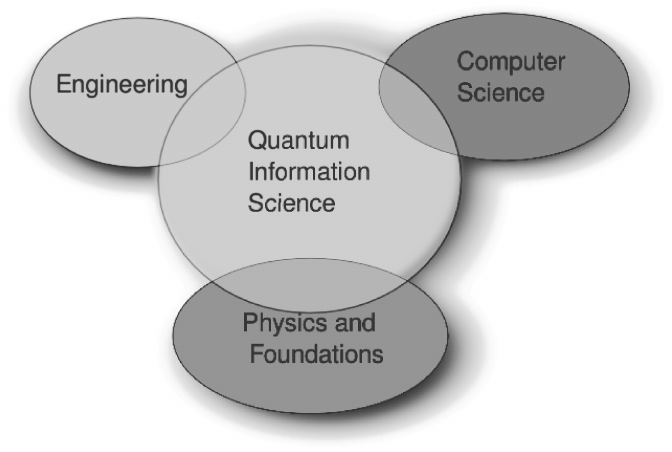
FIGURE 1.1: Three approaches to the quantum.
These three approaches (Figure (1.1) have historically motivated the study
of this field, which at present however, is rapidly blooming in several different
directions unforeseen in the last century.
6 Introduction to Quantum Physics and Information Processing
1.1 Bits and Qubits
So what is the fundamental difference between classical and quantum com-
puting?
Computation and information processing as we know it today is built upon
Boolean logic and algebra. Boolean algebra is binary, requiring two logical
units called bits. You can think of them as the possible answers to a decision
question: yes or no. The idea is that almost any problem can be reformulated
as a series of decision questions, and therefore can be encoded in bits. A
bit, or binary digit, is a physical system that can take on two logical states
represented by 0 and 1. In a typical digital computer these states are the low
and high voltage states in the microcircuitry.
To extend the capabilities of the computational system, probabilistic al-
gorithms are based on the notion of fuzzy bits, that can take the value 0 with
a probability p or 1 with probability 1 − p. This is the basis of probabilistic
computation, or so-called fuzzy logic.
When the logic is extended to binary states of a quantum system, we ar-
rive at the qubit, a quantum bit. A qubit can take values 0 or 1 but with
probabilities given by the mod-squared of complex numbers! A physical qubit
is a quantum system that will represent our Boolean units. The system can
therefore take on two quantum states that we will now represent in the nota-
tion |0i and |1i, to distinguish them from the states 0 and 1 of the classical
bit. This angular bracket notation is due to physicist Paul Dirac [29]. This
notation is very versatile and by itself a useful calculational tool.
A qubit is generically represented as a linear superposition of the basis
states:
|ψi = α|0i + β|1i. (1.1)
The coefficients α and β are called probability amplitudes, and satisfy such
that |α|
2
+ |β|
2
= 1.
The way to understand this statement is that upon measurement, the
generic qubit takes on one of the definite states |0i or |1i with a probability |α|
2
or |β|
2
. In this sense, a qubit is similar to a classical bit in that measurement
only gives one of two values. It is sometimes useful to think of these values,
or the basis states of the qubit, as classical bits.
Though the qubit is probabilistic, it differs from the fuzzy bit because
of the possibility of interference. This is characteristic that is captured by
the complex amplitudes. A complex number has a magnitude and well as a
phase. While composing two or more such numbers, the phases could result
in reinforcement or reduction in the strength of the resultant. The physical
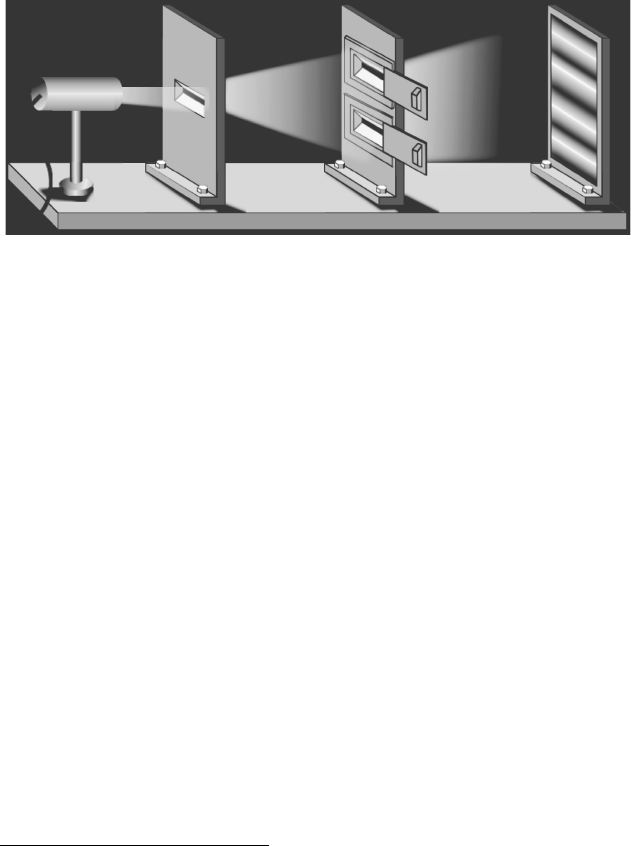
implications of this is familiar to us through the phenomenon of interference
in optics. When two beams of light, described by electric fields having defi-
nite phase relationships to each other, are combined, then there are regions
Leave a Reply