
As an illustration of the power of entanglement as a resource, we examine
the rather dramatically titled protocol of quantum state teleportation. This
idea was first introduced by Bennett in 1993 [6]. The teleportation problem is
the following: Alice needs to transfer to Bob (at a distant location) an unknown
qubit |ψi generically denoted by α|0i+ β|1i. The key point here is that Alice
does not know what α and β are. Quantum channels are not available for
use, so she cannot simply transmit the qubit to Bob. The unknown state of
the qubit cannot be determined since a measurement would destroy the state.
Multiple measurements need to be performed on identical copies of the state
in order to estimate α and β, but Alice has only one copy, and the no-cloning
theorem forbids her from making more copies.
Prior to the process, we assume that Alice and Bob share an entangled
pair of qubits in the state |β
00
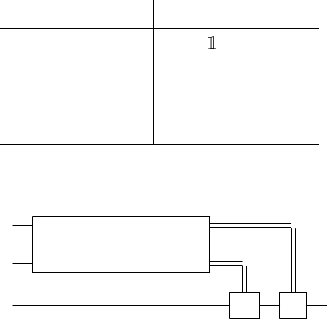
i. The protocol, illustrated in Figure 9.2, works
as follows: Alice first makes a Bell measurement on the two qubits in her
possession (one unknown qubit and the other entangled with Bob’s qubit).
Refer to Figure 7.12 of Chapter 7 for the circuit equivalent to this process.
The results of her measurements are two classical bits of information, which
Alice now transmits to Bob, through a standard classical channel. Then Bob
can basically retrieve the quantum state |ψi by performing certain predeter-
mined operations
ˆ
B on his qubit, that depend on the result of Alice’s mea-
surements. We can see how this works by representing the process as a circuit
(Example 7.2) and working through it. Bell measurement involves transform-
ing the two qubits into the Bell basis and then measuring them. The state of
the three particles just before Alice measures her two qubits is
|φi =
1
4
|00i
α|0i + β|1i
+
1
4
|01i
α|1i + β|0i
+
1
4
|10i
α|0i − β|1i
+
1
4
|11i
α|1i − β|0i
(9.1)
180 Introduction to Quantum Physics and Information Processing
Upon Alice’s measurement, all three qubits collapse to one of the states in
Table 7.1. Thus to retrieve |ψi, Bob must perform one of the set of conditional
operations in Table 9.1.
TABLE 9.1: Bob’s conditional operations in the teleportation protocol.
Alice transmits Bob performs
00
ˆ
B = (Identity)
01
ˆ
B = X
10
ˆ
B = Z
11
ˆ
B = ZX
The entire protocol can be represented by the circuit in Figure 9.3.
|ψi
Bell Measurement
•
Classical
Alice
•
Communication
|β
00
i
Bob
X Z
|ψi
FIGURE 9.3: Circuit for teleportation.
We’ve worked through this circuit in Example 7.2, and you should have no
doubts that the state |ψi, which was initially with Alice, is finally in Bob’s line.
This process uses up the entangled pair, which is why we regard entanglement
as a resource.
9.1.2 How teleportation does not imply faster-than-light
communication
A niggling question (which certainly worried Einstein as recorded in the
EPR paper [31]) would be how the information contained in |ψi was “instan-
taneously” transferred from Alice to Bob when Alice measured her qubits.
The key point here is that no such signaling that is faster than light (thereby
violating the special theory of relativity) is in fact occurring. Until Bob actu-
ally knows what the outcome of Alice’s measurements were, he does not know
that he is in possession of the qubit |ψi. Thus, information is transferred only
when Alice conveys to him her measurement outcomes, and in this scheme,
she does not signal faster than light, but is in fact using conventional (classi-
cal) methods of communication. In fact, the processes adopted in this typical
protocol are an example of “local operations and classical communication” or
LOCC, which is one of the key phrases in quantum information theory.

Information and Communication 181
Box 9.1: No Signaling Theorem
The fact that quantum mechanics does not allow distant parties to ex-
change information instantaneously using the non-local correlations of entan-
glement, can be proved neatly using the density operator formalism. Suppose
Alice and Bob share a state
ρ
AB
=
X
i,j
p
ij
|ii
A
|ji
B
that may be entangled. Suppose Alice performs a measurement on her system,
characterized by generalized measurement operators M
m
. How does this affect
the state of Bob’s system? Bob’s new density matrix is
ρ
0B
= Tr
A
“
X
m
(M
m
⊗ )ρ
AB
(M
†
m
⊗ )
#
=
X
m
Tr
A
(M
m
⊗ )ρ
AB
(M
†
m
⊗ )
=
X
m
Tr
A
(M
†
m
M
m
⊗ )ρ
AB
= Tr
A
“
X
m
(M
†
m
M
m
⊗ )ρ
AB
#
= Tr
A
ρ
AB
= ρ
B
.
Thus it is not possible to affect Bob’s state by any local operation performed by
Alice: Bob’s knowledge cannot be changed — information cannot be conveyed
— by Alice through the non-local correlations of entangled states.
9.1.3 How teleportation does not imply cloning
Another common misconception for a beginner in quantum mechanics is
that teleportation looks as if the state |ψi is copied out from Alice’s location to
Bob’s. A little consideration will show that in fact this is not happening. The
moment Alice measures her qubits, the state |ψi ceases to exist on her end.
She only has two classical bits with her. The unknown state with its implicit
α and β coefficients is completely transferred to Bob. The state |ψi exists only
in one location: either at Alice’s end or at Bob’s, and is NOT cloned at any
point.
Leave a Reply