
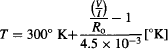
Solder two temporary wires to the two electrodes of the lightbulb that you will use for the blackbody radiation experiments. Measure and record the room-temperature resistance (Ro) of the tungsten filament using a precision multimeter. Unsolder the wires and place the lightbulb on its base. Connect the lamp to the variable power supply and two multimeters so you can simultaneously measure the voltage between the lamp’s terminals and the current through the filament. Increase the voltage in 1-V steps up to 14 V (or your lamp’s rated voltage). Measure current at each voltage. Estimate and plot the filament’s temperature at each voltage using:
2. Use a setup constructed as shown in Figure 21 to measure the spectrum of the light emitted by the filament at three lamp voltages corresponding to temperatures of 3,800° K; 3,300° K; and 2,700° K. Correct your measurements according to the responsivity curve of your sensor (Figure 22b). Plot the intensity of the light as a function of wavelength. What happens to the spectrum of the blackbody radiation as temperature increases? Explain.
3. Calculate the Wien peak of the blackbody spectrum at the three filament temperatures at which you obtained your data:

How well do the peaks in your data compare to Wien’s estimate?
4. Do your experimental results match the spectral curve predicted by the expression developed by Rayleigh and Jeans? Explain.
5. How do astronomers measure star temperatures?
6. The peak of the solar spectrum is 502 nm. Estimate the temperature on the surface of the sun.
7. Use the setup of Figure 26 to measure the stopping voltage Vs for each wavelength. Plot the stopping voltages against LED frequency. Fit your measurements to a linear equation using linear regression. The slope of the graph you create is an estimate of h/e based on Einstein’s equation for the photoelectric effect. Just as in the prior experiment, estimate Planck’s constant h. How well does this estimate of h match the accepted value for Planck’s constant?
8. Does the color of light affect the maximum energy of the electrons emitted from the photocathode? Explain.
9. Extend the line you obtained when graphing your data to the point where Vs = 0 to estimate the threshold frequency for photoemission for your phototube. Use an IR LED with a wavelength under the estimated threshold for photoemission to illuminate your phototube. What is your measurement of Vs for this LED? Explain your result.
10. Use a green LED in the setup of Figure 26. Power the LED at its nominal voltage and measure Vs. Reduce the LED supply current by 10% to reduce the intensity of the light. Measure Vs once again. Do the same after dropping the current a further 10%. What is the effect of varying the intensity of the light on Vs? Explain your results. Does the intensity of the light affect the maximum energy of the electrons emitted from the metal?
11. Use the same setup as before, but set Vs = 0. Measure the photocurrent at the three LED intensities (100%, 90%, and 80% of nominal LED current). Does the intensity of the light affect the rate at which the electrons are emitted from the metal? Explain.
12. Use the setup of Figure 27 to measure the time that it takes for the LED light to cause a photoelectric current. What is the worst-case time needed for the photoelectric current to appear after the LED is powered? How does this compare to the time expected for the photoelectric effect if the wave theory of light would apply? Provided you wait a sufficient amount of time, will an electron always be emitted when you shine light on a metal? Explain.
13. Connect the circuit of Figure 34 to the PMT probe. Power the PMT probe from a low-noise, low-ripple power supply (such as the one in Figure 31). Using the setup of Figure 33, adjust the discriminator threshold until you can hear the clicks produced by single photons releasing photoelectrons in the PMT. Count the number of clicks within 1 min and calculate the average time interval between clicks. If the speed of light is assumed to be 300,000,000 m/s, what is the average distance between two successive photons causing clicks in the system? How does that distance compare to the dimension of the optical tube (the distance between the first neutral-density filter and the face of the PMT)? Using this average, and assuming that a single ND filter at the beginning of the tube would be used, what is the maximum number of photons present within the optical tube at any one time?
* Specifically, a branch called “statistical mechanics,” which deals with the behavior of groups of many particles. For example, the pressure of a gas is not caused by the behavior of a single molecule of the gas, but rather by the statistical behavior of a huge number of molecules at a specific temperature.
† Frequency is often represented by the Greek letter “nu” (v). However, to keep things consistent, we’ll represent frequency by the Latin letter “f.”
‡ Make sure the LEDs are packaged in clear, not colored, plastic.
§ Our experimental setup does not really measure Wo of the photocathode, but rather a closely related value that includes the work function of the electrode collecting the photoelectrons. This is ignored by many textbooks, but is an important distinction that must be made when dealing with real-world applications of the photoelectric effect.6
¶ No, it was not E = mc2. The 1921 Nobel Prize in Physics was awarded to Albert Einstein “for his services to Theoretical Physics, and especially for his discovery of the law of the Photoelectric Effect.”
|| The laser-line band-pass filters may be omitted if you operate the setup in a dimly lit room.
** The pulses produced at the anode of the PMT by a single photon or short photon burst are negative-going and last for about 1 μs. For this reason, the op-amps selected for this application have very high bandwidth. If you need to substitute the MC34081 for a different model, select a JFET-input op-amp with at least 10-MHz bandwidth.
†† “Photon bunching” does happen sometimes in an attenuated photon beam. For this reason, physicists who conduct rigorous single-photon experiments usually use a photon source that not only emits one photon at a time, but also provides confirmation of the photon’s emission. We will learn about these entangled photon sources in Chapter 8
Leave a Reply