
The number of syndromes in a 5-qubit scheme would be 5 × 3 + 1 = 16.
We’d thus need 4 stabilizer operators since 2
4
= 16. We’ll simply give the
operators (see Mermin [48] or Laflamme et al. [44]):
M
0
= Z
1
X
2
X
3
Z
4
, M
2
= Z
3
X
4
X
0
Z
1
,
M
1
= Z
2
X
3
X
4
Z
0
, M
3
= Z
4
X
0
X
1
Z
2
. (10.25)
208 Introduction to Quantum Physics and Information Processing
These operators satisfy
M
0
M
1
M
2
M
3
= . (10.26)
We can see that each operator flips 2 qubits, and the encoding is more usefully
defined in terms of these:
|
¯
0i =
1
4
( + M
0
)( + M
1
)( + M
2
)( + M
3
)|00000i, (10.27a)
|
¯
1i =
1
4
( + M
0
)( + M
1
)( + M
2
)( + M
3
)|11111i. (10.27b)
One thing to notice is that |
¯
0i is composed of 16 basis states, each with an even
number of 1’s, while |
¯
1i is composed of states with an even number of 0’s, so
that the states are mutually orthogonal. Each M
i
commutes or anti-commutes
with the X
i
, Y
i
, and Z
i
error operators, so that the fifteen syndromes and the
uncorrupted state are distinguished by different sets of ±1 eigenvalues of the
M’s. Measuring them would therefore diagnose the syndromes.
Exercise 10.3. Compute the 5-qubit codewords.
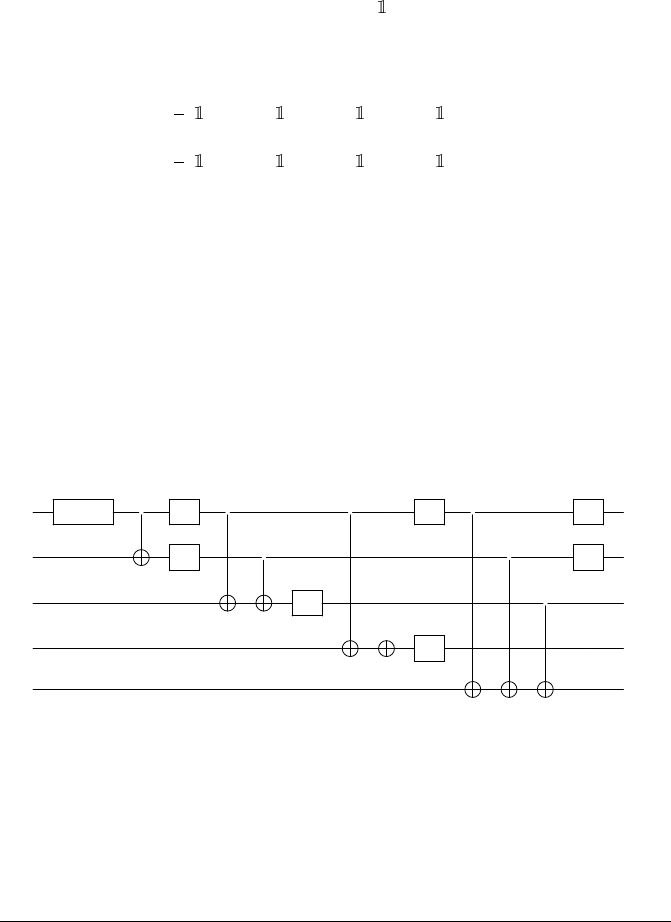
Exercise 10.4. Verify that the circuit of Figure 10.11 performs the 5-qubit en-
coding.
|ψi
ZHZ
•
H
• •
H
•
H
|0i
H
• •
H
|0i
H
•
|
¯
ψi
|0i
H
|0i
FIGURE 10.11: The encoding circuit for the 5-qubit code
As you are probably feeling, this code is harder to analyze and less trans-
parent than the Shor code. For practical purposes, the 7-qubit code due to
Steane is more popular.
10.6 The 7-Qubit Code
We again give the stabilizers, codewords for the logical bit states and the
encoding circuit, for completeness. You can refer to the text by Mermin [48]
Quantum Error Correction 209
for a full discussion on how the scheme works to correct errors. The 7-qubit
code is stabilized by 6 operators that distinguish the syndromes due to X, Y ,
or Z acting on any one qubit. These are the Steane operators:
N
0
= X
0
X
3
X
5
X
6
; N
3
= Z
0
Z
3
Z
5
Z
6
;
N
1
= X
1
X
3
X
5
X
6
; N
4
= Z
1
Z
3
Z
5
Z
6
;
N
2
= X
2
X
3
X
5
X
6
; N
5
= Z
2
Z
3
Z
5
Z
6
. (10.28)
Observe that they mutually commute, and N
2
i
= . The 7-qubit encoding is
defined by the operations
|
¯
0i =
1
√
8
( + N
0
)( + N
1
)( + N
2
)|0i
7
(10.29a)
|
¯
1i =
1
√
8
( + N
0
)( + N
1
)( + N
2
)|1i
7
. (10.29b)
You can see that |
¯
0i is a state with an odd number of 0’s while |
¯
1i has an even
number. The usefulness of this code lies in the easy way in which many 1-qubit
operations generalize to operations on the 7-qubit codewords. For instance,
defining
¯
X = X
⊗7
,
¯
Z = Z
⊗7
,
¯
H = H
⊗7
, (10.30)
we find that
¯
X|
¯
0i = |
¯
1i;
¯
Z|
¯
0i = |
¯
0i;
¯
H|
¯
0i =
1
√
2
(|
¯
0i + |
¯
1i); (10.31a)
¯
X|
¯
1i = |
¯
0i;
¯
Z|
¯
1i = −|
¯
1i;
¯
H|
¯
1i =
1
√
2
(|
¯
0i − |
¯
1i). (10.31b)
This makes it a lot more convenient to use this encoding in various circuits.
|0i
|0i
|0i
|ψi
•
|
¯
ψi
|0i
H
•
|0i
H
•
|0i
H
•
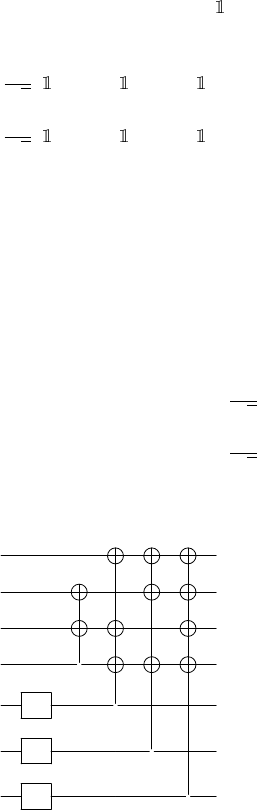
FIGURE 10.12: Circuit for the 7-qubit encoding. The qubits are arranged
according to significance from highest to lowest, top to bottom.
210 Introduction to Quantum Physics and Information Processing
You can also show that the rather cute circuit of Figure 10.12, again due
to Mermin [48], performs this encoding.
Exercise 10.5. Draw a circuit to measure the syndromes for the 7-qubit code.
While we have discussed the basic reasons for the success of quantum error-
correcting codes, we have barely scratched the surface of this complex and
intriguing field. In general, errors need not be restricted to single-qubit errors.
Nor need they be unitary. The full theory of quantum error-correcting codes is
beyond the scope of this book. That theory examines how the system can be
embedded in a larger system with a number of entangled qubits. Measurement
of some of the ancilla qubits can lead to error diagnosis and correction. A very
readable account of this is given in the book by Reiffel and Polak [58].
Another important subject we are not dealing with is fault tolerant com-
putation. The assumption in all we have studied so far is that the gates and
circuits we employ are potentially error-free in themselves. This can hardly
be guaranteed in practice. However by special coding a circuit or a gate can
be made tolerant to errors
Leave a Reply