
In Chapter 4 we had discussed in detail on how firm’s can understand their core competency mix through internal capability analysis (see section titled ‘Core Competencies Analysis’ in Chapter 4) and also saw the examples of Google and Apple to understand how core competencies would differ across competitors. In this section, we shall understand how companies which have different business structures/objectives (specifically those which are transitioning from offline to a major online presence) need to regularly map the changing OVP for their customer set to align core competencies to revised industry/sector/competitive value propositions.
Let us look at Fig. 5.3 to understand concepts like Value Shift Functions (VSF) and Core Competency Alignment (CCA).
While developing an understanding of the concept of OVP in Chapter 1 under the section titled ‘Delivering Enhanced Customer Value,’ we had looked at how new firms and those entering newer segments can understand customer’s stated and unstated needs to come up with a value proposition which satisfies customer’s specific problem areas. For mature players though, once the market for a product is developed, market challengers and new competitors entering the market bring forth new value propositions which established brands either have to match or create new set of value additions to keep differentiating and maintaining the brand position they enjoy.
Apart from competition, there are also market factors like changes in customer preferences, product consumption pattern shifts, technology intervention, reduced component costs, changing tariff structures, government regulations and compliances, etc., which can impact the way ‘value’ within the industry shifts from one set of players to another. Together, these market and competitor-driven factors shift the earlier value which was being provided to the customer to create a new set of value functions. We term these as ‘Value Function Shifts.’
The concept of CCA relates to the response which any specific firm of a particular industry will develop to match and compete in the wake of the multiple value shifts caused in its sector. Here, we need to understand that CCA is not about a firm changing its core competencies, but instead aligning them to changing industry value function shifts so that they are able to use their core strengths and enhance them in the best possible manner to changing environment and competitive forces.
As we can see in Fig. 5.3, once the firm has aligned and developed a new set of core competencies based on emerging market structures, it can define its overall strategy accordingly to create/refine its set of OVPs to match the changes in customer value and achieve its short and long-term objectives.
For a better understanding of the concepts shared earlier, we have taken an example of one of the rising and most value generating industries of present time, the telecom sector, to look at how multiple changes in the market and competitive factors have caused value function shifts (driven mostly by individual brands) and impacted overall customer value in the industry.
We chose the telecom industry and smartphone sector specifically as that is where we see online and digital platforms playing a large role in causing value shifts and being the key differentiators for the industry. For understanding the concepts of CCA, we have taken the example of a fictitious local brand to explain how it could have responded to changes in the industry caused by global and national players to align its core competencies of being a regional brand with the knowledge of local/mass segments to differentiate itself in the market and later be a major player in the segment (once the hardware/equipment manufacturing costs, internet access costs, etc., come down).
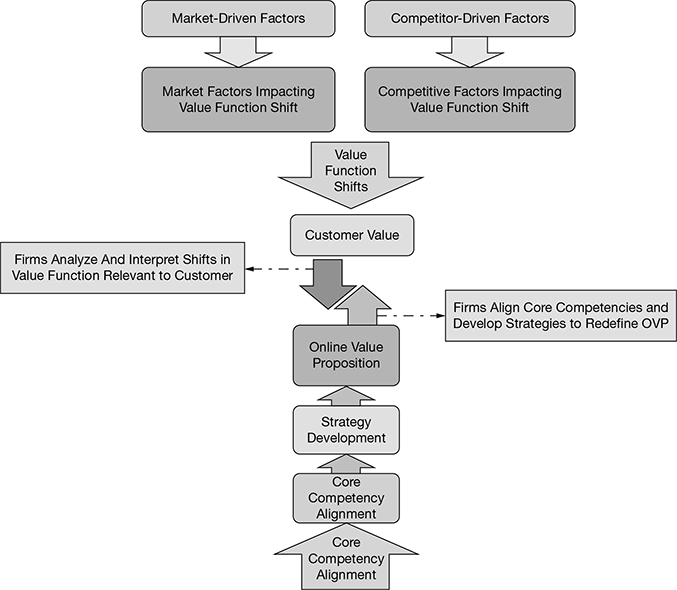
Figure 5.3 Aligning Core Competencies to Shifts in Value Function
Figure 5.4 expands on all the key stages depicted in Fig. 5.3. At the top are illustrated the major market and competitive factors which impact customer value and cause value function shifts. The arrows below them correspond to individual value shift functions (which can either be market or competition driven or driven by a combination of both). In the following customer value layer depicted through a five-stage example of the top five mobile brands (across the past decade), we will see how customer value functions for the entire global industry shift.
The CCA exercise is depicted in the bottom two layers wherein the last layer of arrows showcase CCAs (which competitors across the industry execute in response to the changing value shift functions) and the layer above that provides an example of a local brand and the specific alignments it would need to make to its core competencies, to respond to and grow in the light of competition across each of the five customer value stages. Let us go through each of these five value-shifts and CCA response stages in more details below.
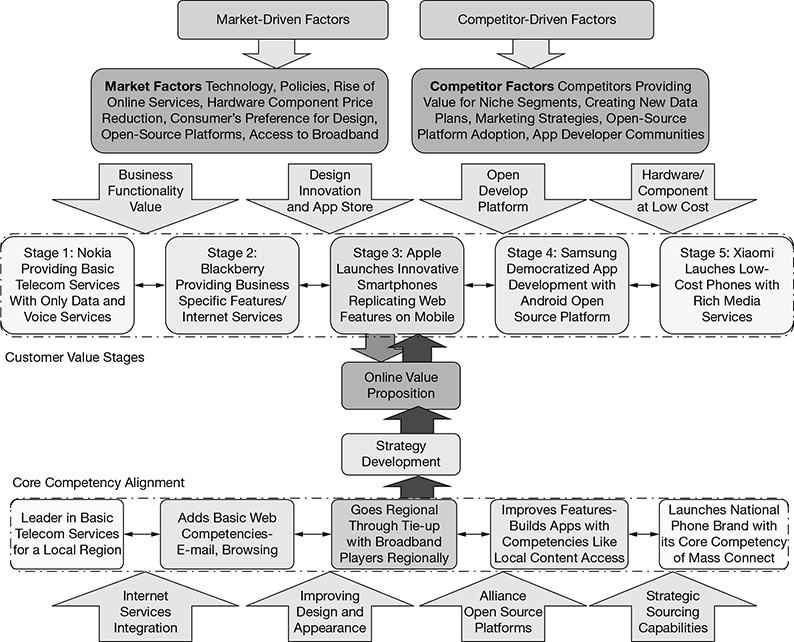
Figure 5.4 Applying Core Competencies Alignment Concepts to Telecom Industry
- Stage 1
- Showcase brand: Nokia
- Value function: first-mover advantage and top recall as a mobile manufacturer
- Customer value: Nokia started with basic telecom services (including voice and data). With limited broadband development in this period, there was no specific OVP developed for the industry
- Industry alignment: very few local players had forayed into this sector
- Local brand CCA alignment: we take the example of a local manufacturer which starts to replicate basic voice and data services specific to a local region only
- Stage 2
- Showcase brand: Blackberry
- Value function: first brand to offer business functionality and features
- Customer value: one of the first brands to provide online convergence to support push e-mail, internet faxing, and web browsing as OVPs
- Industry alignment: other mobile companies started to integrate internet services as a part of their core offerings
- Local brand CCA alignment: local brand follows industry leaders to integrate e-mails and web-browsing based on the bandwidth provided in its local region
- Stage 3
- Showcase brand: Apple
- Value function: market altering innovations like Design/App Store/Touch, etc.
- Customer value: a game changer in the premium category, iPhones integrated online features through its app store, and replicated web experience on mobile
- Industry alignment: with iPhone, basic standards of mobile development improved, for example, user experience, app platform, visual interfaces, etc.
- Local brand CCA alignment: local brand goes regional with advanced online features and tie-ups with regional broadband players for service variety
- Stage 4
- Showcase brand: Samsung
- Value function: adoption of open source and developer community set-up
- Customer value: Samsung democratized app development with android open source platform and offered cheaper app packages for larger online access
- Industry alignment: mobile companies started expanding on android platform wherein they could get mass audiences with lower investment outlays
- Local brand CCA alignment: local brand makes use of open source to build local apps utilizing its competency in working with local content and developers
- Stage 5
- Showcase brand: Xiaomi
- Value function: one of the leading brands makes use of hardware and component cost reduction which has brought down smartphone rates
- Customer value: providing phones at lower cost with rich media services
- Industry alignment: mobile companies started to develop low-cost phones through strategic integration with global suppliers and investor funding
- Local brand CCA alignment: local brand becomes a national phone brand by extending its core competency of mass connect and developing low-cost smartphones for this segment with astute national marketing
Here, the telecom industry and the local mobile manufacturer follow key value function shifts in the market and act proactively to align their core competencies accordingly to come up with compelling OVPs to provide customer value and grow to a national level.
This example showcases how various business structures (as shared in the last section) need to keep tab of the changing and emerging business structures to map value shifts and differentiate their business model and core competencies accordingly. The key here is for the firm to have a clear view of their customer set, the meaning of incremental value to them, and how they would like to receive services from known and new brands.
The next section focuses precisely at this area of identifying the right customer through the application of STP marketing techniques to the digital world and then developing the right OVP through careful analysis of value functions and core-competency alignment.
Customer Development Strategy (STP 2.0 Framework)
With an understanding in the last section on how firms can align their core competencies to suit and serve changing customer value functions, we would look at the most important element of digital strategy which is defining and developing the target customer. We would examine how the classic functions of STP (discussed earlier in Chapter 4, section titled ‘Marketing Mix Analysis Share’) have evolved to STP 2.0 and the elements which constitute its formation.
As understood in the earlier sections on ‘Consumer Behavior’ and ‘Managing Consumer Demand’ in Chapter 3, the key characteristics of digital platforms is that they provide firms with not just a broad-based segmentation of their customers, but gives the ability (through technology) to narrow those segments into like-minded customer groups, business-oriented customer personas, and the knowledge and identification of customers at an individual level.
Angus Jenkinson in his essay ‘Beyond Segmentation’(Journal of Targeting, Measurement and Analysis for Marketing), presents his views on how a ‘grouping’ approach on segmenting customers helps create ‘customer communities’ or clusters which support creation and preservation of loyalty within these groups, thus helping firms target micro-communities within the broader segments which used to be defined traditionally.
This chapter aims at developing the next advanced level of STP which we term as STP2.0 Framework and discusses new approaches to all the three elements of segmenting, targeting, and positioning. It involves looking at how concrete customer action data (derived through analytics) and knowledge of customer’s buying intent and final action (through search and conversion keywords and data) can help marketers develop highly refined target segments, and position them through personal communication and channels which could never be deployed earlier because such data was never available in the first place.
This refined STP Version 2.0 is depicted in Fig. 5.5 which showcases a new approach to developing each of the three components. The framework has been developed keeping in mind the latest approaches to market segment creation, consumer, and buyer persona development, mapping the consumer journey in real time and creating multiple positioning strategies to target customers uniquely across each of the consumer funnel stages through a mix of channel and communication approaches.
We would like to state here that with advances in technology, both quantitative and qualitative data is being accessed, interlinked, and applied in multiple ways by companies and it is not possible to cover all of those newer techniques and advancements in detail here. The intent of the framework is to provide a base on top of which marketers can use data from multiple channels to feed information, refine their segments, and position themselves real time in the most customized fashion.
At a broad level, STP 2.0 Framework differs primarily from traditional STP as follows:
- Segmentation 2.0: The key difference between traditional and online segmentation relates to the kind of data that was available, collected, and the manner in which segments were developed. All these three aspects differ primarily with the online channels, as not just basic demographic, psychographic, and behavioral data but also data at each customer transaction level can be analyzed with sophisticated technologies to yield highly refined and actionable audience clusters.
- Targeting 2.0: Earlier, once the customer segments were created, marketers had limited options to choose from the segment mix and even media planning for traditional channels only allowed targeting to such broad-based classifications. Targeting 2.0, on the other hand, deploys the concept of user personas which involves defining audience clusters and making use of more authoritative and quantitative data available across multiple online elements.
- Positioning 2.0: With digital marketing providing the possibility of understanding audiences at an individual level (for each of the chosen target clusters) and segregating them across the marketing funnel, marketers have the power to position differential, customized messages in real time across each of the funnel stages depending upon the customer type and conversion metrics being targeted for that channel.
To understand STP2.0 Framework, we would need to understand the analysis behind each of the three key elements in Fig. 5.5:
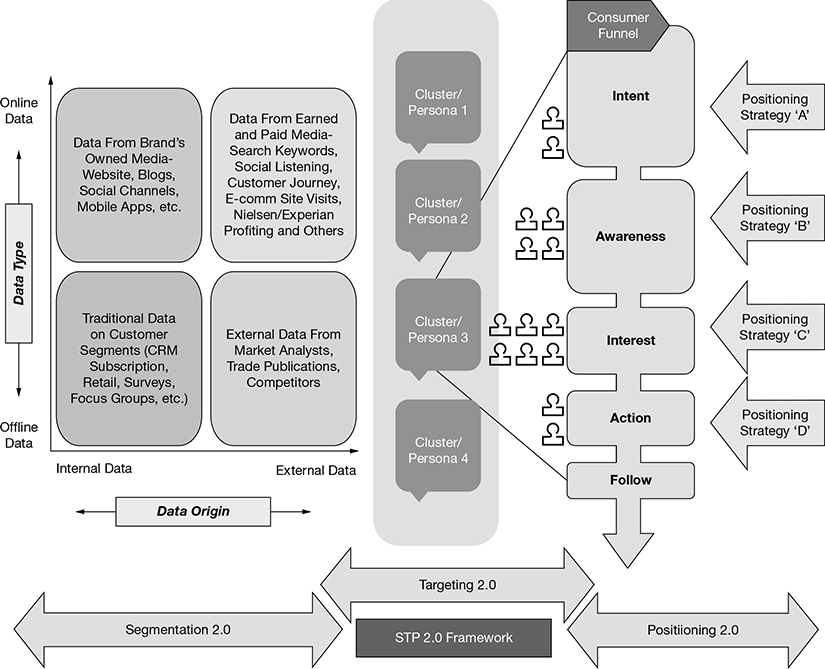
Figure 5.5 Elements of STP2.0 Framework
- Data segmentation matrix (Segmentation 2.0): To understand the kind of extended customer transaction data which can be used to develop segments in present times, we have developed a data segmentation matrix with data origin (across X axis) and data type (across Y axis), mapping all data collated across internal/external or offline/online generated data. The four quadrants which emerge from this matrix include:
- Traditional data: Involves data sets which are internal to the company and derived from traditional (non-online) data sources. These include company’s CRM/internal systems data, subscription/retail sales transaction data, and other qualitative data like customer surveys, focus groups, interviews, etc.External data: Includes other offline data collated from external sources like market analysts, trade publications, competitor, and third-party data, etc.Data from brand’s owned media: Includes all data collated online from firms’ owned properties only. Examples include websites, microsites, blogs, social channel pages, mobile apps, etc.Data from earned and paid media: Takes stock of all other customer transaction-related online data channels (earned and paid media), which could range from search keywords, social listening data, transaction data from customer’s journey across the funnel stages, e-commerce site visits, etc.The data segmentation matrix provides an easy-to-classify framework for all data which can be collated across online and offline presences to integrate it and develop clarified, meaningful, and actionable segments which customers can further target.Traditionally, consumer segments were generated using key variables of demographic, psychographic, and behavioral data, but with the present set of advanced online and transactional data available, market segmentation has turned into a highly sophisticated and data-intensive exercise. With companies like Nielsen, Experian devising customized segmentation techniques for different clients based on their needs, firms can make use of such predefined microsegments to discover which segments are best suited and most probable to respond to marketing efforts targeted to them. To share an example of how Nielsen segmentation system helps customers customize their segmentation exercise, let us look at Fig. 5.6 which provides a screenshot of one of the segmentation types—Nielsen PRIZM, based on consumer lifestyles, shopping behaviors, and media preferences.Apart from this, Nielsen also has other segmentation types available for firms as products like Nielsen P$YCLE (identifies households by financial behavior and wealth), Nielsen ConneXions (segments based on consumer technology usage and behaviors), Find MyBest Segments, etc., which provides firms with interactive tools that they can slice and dice to arrive at top segments most suited to their market and product strategy. For effective segmentation, the five key aspects which firms should always keep in mind (according to Philip Kotler, Marketing Management, millennium edition) include:
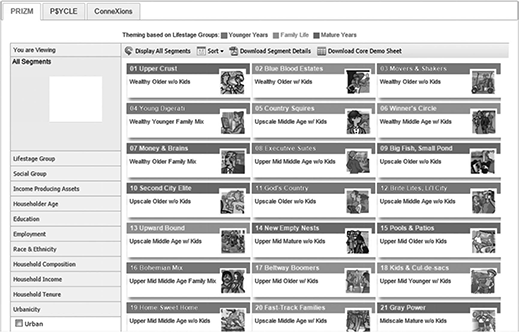 Figure 5.6 Nielsen’s PRIZM Segmentation FrameworkSource: Michael King, ’Personas for SEO in 2012 (PubCon)’, 16 October 2012, https://www.slideshare.net/, accessed on 27 February 2017 at 8.49pm. Measurable: The size, purchasing power, and characteristics of the segments should be measurable.Substantial: Segments should be large and profitable enough to serve. A segment should be the largest possible homogeneous group worth going after with a tailored marketing program.Accessible: The segments can be reached and served effectively.Differentiable: Segments are conceptually distinguishable and respond differently to different marketing mixes. If two segments respond identically to a particular offer, they do not constitute separate segments.Actionable: Effective programs can be formulated for attracting and serving the segments.
- Traditional data: Involves data sets which are internal to the company and derived from traditional (non-online) data sources. These include company’s CRM/internal systems data, subscription/retail sales transaction data, and other qualitative data like customer surveys, focus groups, interviews, etc.External data: Includes other offline data collated from external sources like market analysts, trade publications, competitor, and third-party data, etc.Data from brand’s owned media: Includes all data collated online from firms’ owned properties only. Examples include websites, microsites, blogs, social channel pages, mobile apps, etc.Data from earned and paid media: Takes stock of all other customer transaction-related online data channels (earned and paid media), which could range from search keywords, social listening data, transaction data from customer’s journey across the funnel stages, e-commerce site visits, etc.The data segmentation matrix provides an easy-to-classify framework for all data which can be collated across online and offline presences to integrate it and develop clarified, meaningful, and actionable segments which customers can further target.Traditionally, consumer segments were generated using key variables of demographic, psychographic, and behavioral data, but with the present set of advanced online and transactional data available, market segmentation has turned into a highly sophisticated and data-intensive exercise. With companies like Nielsen, Experian devising customized segmentation techniques for different clients based on their needs, firms can make use of such predefined microsegments to discover which segments are best suited and most probable to respond to marketing efforts targeted to them. To share an example of how Nielsen segmentation system helps customers customize their segmentation exercise, let us look at Fig. 5.6 which provides a screenshot of one of the segmentation types—Nielsen PRIZM, based on consumer lifestyles, shopping behaviors, and media preferences.Apart from this, Nielsen also has other segmentation types available for firms as products like Nielsen P$YCLE (identifies households by financial behavior and wealth), Nielsen ConneXions (segments based on consumer technology usage and behaviors), Find MyBest Segments, etc., which provides firms with interactive tools that they can slice and dice to arrive at top segments most suited to their market and product strategy. For effective segmentation, the five key aspects which firms should always keep in mind (according to Philip Kotler, Marketing Management, millennium edition) include:
- Clustering and persona creation (Targeting 2.0): By definition, ‘User Personas’ is a representation of the goals and behaviors of a hypothesized group of users. Persona development as an exercise involves building archetypes of the members of a target audience to create reliable and realistic representations of them. The chosen segments are referred to as clusters since their members share a common set of needs and display similar buying characteristics which the brand has willingly chosen to target. Persona creation has become common for large marketing companies and there are multiple ways in which marketers can attempt to create them depending on the information available and specific outputs companies are seeking through the exercise.Once a firm has a clear idea of the high-level demographic, psychographic, and behavioral variables it wants to include as a part of its segmentation strategy, it would look at analyzing some of the following key factors stated below, to finalize its target segments and develop representative personas related to each segment:
- Segment size and growth
- Company’s strategic direction
- Product mix and product life cycle stage
- Competitor’s market strategy
- Emerging marketplace and consumer trends
- Target segment identification: To begin with persona development, firms must have identified multiple segments/clusters for which they would want to develop detailed personas. The initial inputs towards building personas would be basic demographic data, along with a clear assessment of the needs and pain points which drive them. At this stage, it would really help to know (through earlier available data) typical interactions and perceptions of identified segments with the brand, their value expectation from product/service, and specific engagement needs of the segments.
- Understanding values, behaviors, and interests: The next stage involves going deeper into customer’s purchase patterns, their motivations and driving factors, key sources of influence, their role in decision making, specific interest areas related to a firm’s product set, common values they exhibit during their interactions and other such information. For companies launching new products, it would also hold good for firms to research competitor’s customers to understand their behaviors and buying motivations.
- Research site analytics, search keywords, social media listening: The biggest advantage which digital channels provide is the capability to gain insights from multiple consumer touchpoints and channels to understand interactions and consumer preferences across all the funnel stages right from intent to credible historic purchase patterns. With previous reporting available through site analytics, providing details on the sites referred, content consumed, keywords searched, social interactions undertaken, etc., firms can now overlay and use all this data to understand and extract chunks of micro-text and develop personas in ways which were not traditionally possible.
- Qualitative data-audience interviews/focus groups/affinity mapping: Once basic historical research and quantitative inputs have been mapped, firms also conduct multiple qualitative assessment techniques including specific segment interviews, focus groups, use-case scenario development, affinity mapping, etc., to graft finer elements of the personas. Affinity mapping, which involves taking representatives from different teams and brainstorming on persona-building exercise, is specifically useful, as it binds together the experience of multiple stakeholders to arrive at more actionable personas.
- Naming the persona: A persona should have a name so that it feels like a real person. It is generally suggested to have between three to seven personas for relevance and practicality of the exercise.
- Developing the persona: Apart from name, other sections could include:
- Demographic details like age, education, income, job, role, company;
- Persona’s goals and challenges, pain-points, motivations, values, and fears;
- Type of product experiences they desire, main sources of information/influences;
- A day in the life of the persona, key activities they perform online;
- Types of sites visited, social media usage, content preference, etc.
- Refining the persona: Once a profile has been created, it is repeatedly put to test to check what holds true and valid for that persona and whether it really represents the needs of that group (from their viewpoint) post which it is refined accordingly.
- Positioning across consumer funnel scenarios (Positioning 2.0): Once marketers have identified key customer segments and developed personas to target, they need to develop messages and actions to complete the objectives set for each of the customer interaction stages. In this aspect, it is important to develop an appreciation of customer journeys across the funnel stages to understand the specific positioning which firms need to develop. A customer journey involves the path a customer must take in order to fulfill a particular need or goal. Personas are typically developed by marketers in order to know the customers better to help fulfill their goal across the funnel stages. The typical flow of actions from ascertaining the need to its fulfillment follows the path:CUSTOMER JOURNEY (Need Definition across Funnel Stages) →PERSONACREATION → POSITIONING(Need Fulfillment for each Cluster/Individual)
Let us look at examples of positioning for identified personas and their customer journeys across a firm’s key product site through application of consumer funnel stages:
- Intent: In the first stage of the funnel, a typical example could be:CUSTOMER JOURNEY—Customer has heard of a brand a lot and has visited the site for the first time by searching Google with a specific set of keywords. There is no specific need which the customer intends to fulfill at present.PERSONA CREATION—A persona by the name ‘Curious Customer’ is developed for this segment of new consumers enquiring about the brand with no specific intention to buy on their first visit to the brand site.POSITIONING—Marketer’s task is to make the experience of a prospect’s first landing on the firm’s website an impactful and experiential one where he/she gets to take away a positive opinion of the brand and its imagery.
- Awareness: Typical example includes:CUSTOMER JOURNEY—Customer has interacted with the brand and looked through two–three key pages of the website, identified brand’s social media page, discovered and read a couple of articles on its blog. There is passive interest shown by customer which points to a possibility of converting it into a lead.PERSONA CREATION—A persona by the name ‘Passive Prospect’ is developed for this segment of new consumers who have shown more than just intent to touch-base with the brand, though still at a passive level.POSITIONING—A marketer would want to make sure that the design, layout, first-touch content on the site, blogs, social channels is developed in a way that positively showcases the core attributes and brand values. Positioning here should focus on more emotional aspects to develop consumer connect.
- Interest: To cite an example:CUSTOMER JOURNEY—Customer shows active interest in the brand and has a definite need which he/she wants to fulfill, hence, spends considerable time on the brand site, performs searches, views demos, fills enquiry forms, etc.PERSONA CREATION—A persona by the name ‘Active Lead’ is developed for this segment of new/returning consumers who like the brand and are close to the conversion stage, provided their clarifications have been well addressed.POSITIONING—With a prolonged sales cycle for consumers at this stage, marketers need to position their messages in an informative manner and focus on functional aspects so that consumers know the value of the brand.
- Action: An example of this stage:CUSTOMER JOURNEY—Customer has conducted all the necessary research and comparison with competitors and is completely sure that he/she wants to buy a product from the marketer.PERSONA CREATION—A persona by the name ‘Last Mile Purchaser’ is developed for this segment of new/returning consumer whose main objective is the ease with which he/she can conduct transactions most efficiently.POSITIONING—Marketer’s task is to optimize the site heavily around not just getting the new visitor to place an order, but also increasing the average order size of the returning customer by reinstating post-purchase benefits.
- Follow: A typical example would be:CUSTOMER JOURNEY—Customer has become a strong supporter of the brand or has fallen out to another competitor. The needs of both kind of groups are completely opposite and need to be devised accordingly.PERSONA CREATION—A persona by the name ‘Brand Loyalist’ or ‘Brand Estranged’ can be developed for these two distinct segments. The interaction objectives of the estranged group would have to be re-assessed.POSITIONING—Marketer’s task is to make stronger post-purchase connection with loyalists to further develop them as brand referees and for those who have fallen out, they need to devise a completely new positioning strategy.
With the above examples we learn that the objectives of each firm should follow the customer journey across funnel stages and position accordingly. In the next section, we shall look at how marketers develop their strategic positioning for customers across the funnel with the help of traditional 4Ps and the extended Ps.
Leave a Reply