Why has digital become so important and prominent lately and how does it matter to practitioners of marketing?
To understand and appreciate the rapid rise of digital marketing over its preceding concepts, it would help to gain an understanding of how the marketing function has changed over the years in terms of the most important parameter—customer interaction.
We define customer interaction as the manner in which any potential lead or customer gets to know or interacts with any product or service with the intention of gaining information or to respond to the marketer’s goal of considering him/her as a consumer and finally convincing the latter to buy its products. This leads us to a key question as to what does a consumer really look for from marketing?
Any consumer, in a reactive or proactive mode, is typically looking to obtain information on any specific area of interest. He/she might not be looking at a product or a service itself but information which would solve any one of the problems at hand. He might also be just curious to gain knowledge on any subject (academic or general interest) or might just generally want to know what is happening currently around his neighborhood, city, or the world at large.
In the traditional form of marketing, the information to be delivered to consumers was decided, selected, or created by a group of media experts who took the decision of what knowledge would be circulated, printed, or broadcasted (in the relevant examples of newspaper, magazines, radio, and TV), which format it would be shared, and at what price would it be delivered. The consumer was more of a passive receptor of information and while in certain feedback columns or radio programs he could raise some questions. He was essentially gaining information and knowledge pre-curated for him and packaged with advertisements and promotions which he had no control over and maybe not much interested either.
The difference which successive marketing concepts kept bringing about till the present digital marketing era relate most to the manner in which the power of consumer choice has shifted from being a tame receptor to an active seeker of information. And, it is in this active seeking of information process that the heart of digital marketing lies. With this understanding, we would now put forth the two most important concepts which define and differentiate digital marketing—Pull and Push marketing.
Pull and Push Marketing
Any type of customer interaction with any digital media can be most simply be divided into two types depending upon where the contact is initiated:
- Medium-initiated contact (Push marketing): This is the traditional type of marketing where marketing messages are packaged with information pre-configured for a particular set of users. Take the example of a newspaper, which typically is current information packaged across different verticals like politics, economics, sports, etc., and packaged along with large ad columns which bring in the revenue (along with the classifieds). In contrast, let us understand what pull marketing entails.
- Consumer-initiated contact (Pull marketing): Pull marketing involves a consumer placing his intent and specific interest for a particular type of information and being offered that information along with relevant marketing messages suited to his intent, query, or profile-based interests. In the same example of a newspaper, as above, consider that the company decides to provide information in a way that each article of the newspaper is tagged and categorized based on multiple criteria to be searched upon a digital platform. In this case, when a consumer makes a specific search for a piece of content and chooses matching information/news, promotions are sent based on his profile preferences, real-time location, and the topic of the article he found interested in reading. This would then become be an example of pull marketing.
Based on key characteristic of these two types of marketing, the development of new digital platforms can be explained and understood. Digital marketing includes all those techniques and concepts that utilize the intent (pull-based) action of the consumer to market products and services (in a push-based manner) which would be most needed, relevant, and of interest to him/her.
Let us understand a few key types of digital marketing areas to see how digital technologies have been built around the combinations of pull–push marketing concepts:
- Search marketing: Search was one of the most pioneering pull–push marketing concepts which involved providing a technology platform to consumers to help them express their intent towards finding a particular piece of information and building a push marketing-based business around that search. (We would cover this particular topic and its technologies in detail in subsequent chapters and sections).
- Display advertising: Similar to print advertisements, display advertising was built on pulling data from consumers’ readership interests on any particular website wherein display ads were pushed next to the content being read for consumers to interact, click, and buy on landing pages created for this action.
- Social media marketing: With the power of social networks coming to internet-based platforms, a marketer could not only use the information pulled from customer intent but also from the intent of his social networks which would be marketed back to him in the form of sponsored and native advertisements.
Media Consumption Drivers for New Marketing Environment
With the understanding of the pull–push concept, one would naturally tend to think about the key drivers behind this change in marketing to digital platforms and the reasons for shifting consumption patterns:
- Emergence of internet as discussed in the previous sections was one of the biggest factors of the transition to digital marketing. With growing availability of the internet, it became possible to access data and information as and when required.
- Rise of millennial generation or Generation Y (those born during the 1980s and early 1990s) with their differing attitudes and aspirations and also the rapid rise of social networking and collaboration concepts has led to the acceptance of digital as a major buying platform. It has grown tremendously to a level that certain product categories now are being bought only through digital channels.
- Technology advancements in devices and investments in hardware, infrastructure, location positioning and device memory, have brought forth convenient and feature-rich platforms like mobile, PDAs, tablets, etc., whose computational power and storage options have made it possible to execute research, personal interactions, and commerce, all on the go.
- Advancements in design/UI is becoming crucial. With Apple bringing design to the fore and ease of access becoming important by the day, digital has the fillip over other traditional platforms in being a slicker, more user-friendly platform where brand experiences can be felt and shared in their tangible and intangible forms not possible earlier.
- Consumerism/rising global economies in the context of emerging nations since the past two decades and with the rise of discretionary income across many work sectors, it has become easier for a large middle-class population to consume smartphones and tablets at prices never thought before. Also, with the rise in education levels and increasing accessibility, the effect of digital is reaching far and wide to even smaller towns and cities, thus increasing the consumer net rapidly.
Digital Marketing Channels: Types and Business Models
Before we to understand the digital marketing types, it is important to realize the difference between the concepts of digital media and digital marketing which sometimes are used interchangeably but are distinct from each other. Digital marketing, typically, refers to the electronic channels through which marketing is performed while digital media includes the process of digitization of media content (text, audio, video) to be transmitted over internet or online platforms. Typically, digital media/content is placed over multiple digital channels to achieve the objectives of marketing.
Digital Marketing Types Explained through REAN Marketing Engagement Framework
To explain digital marketing types, we first need to develop an understanding of the historic marketing funnel models and use one of them as a base to explain how different digital marketing types cater to each of the marketing funnel stages of that model. A marketing funnel model also referred to as a ‘purchase funnel,’ ‘customer funnel,’ or ‘sales funnel’ aims to put a structure to explain how a marketer or consumer goes through the various stages of marketing and consumption to finally purchase any product or service online.
One of the earliest models, which is still the most prevalent is the AIDA model which when expanded stands for Awareness, Interest, Desire, and Action stages. There are depicted in a trickle–down funnel-type diagram and showcase how a marketer induces awareness, generates interest for his product, creates a desire or impulse to buy, and finally, takes the customer through the action of purchasing the product or service. This model was introduced in 1893 by Addison Richards, an advertising agent from New York City, who wrote an advertisement for his business containing virtually all steps from the AIDA model, but without hierarchically ordering the individual elements.
Following this model, there have been numerous iterations and improvements based on the changing demands and functions of marketing and the addition of new digital marketing elements. The one we have used here as a base to explain the multiple digital marketing types is the REAN (Reach Engage Activate Nurture) model developed in 2006 by Xavier Blanc. We have added a Plan Stage before the four stages (to include the set of activities which involve planning and creation of the marketing material) and termed it as the ‘Marketing Funnel’ view. To explain the concepts further and understand the corresponding impact and involvement on the consumption side, we have also created a mirror funnel called the ‘Consumer Funnel’ which replicates the stages of the marketing funnel to look at consumer inputs and impact on the marketing cycle across each of the stages, which also impacts the overall digital marketing types deployed at each stage.
Explanation of Marketing and Consumer Funnel Stages
‘Marketing Funnel’ as depicted in Fig. 1.4 consists of four REAN model stages (including the additional added stage of Plan) which can be described as:
- Plan: Develop marketing plan, content strategy, and branding material which would be used to conduct marketing across the following funnel stages.
- Reach: Involves the set of activities to raise prospect’s attention to marketer’s brand product or service. (This is the stage where prospects are created.)
- Engage: The gradual, typically multi-channel set of activities needed to engage the prospects developed during the ‘Reach’ stage (This is the stage where leads are generated.)
- Activate: The activities needed for prospects to take the actions marketers want them to take. (This is the stage which relates to final converts or those who purchase.)
- Nurture: The activities needed to nurture the customer relationship created in the activation stage. (This is the stage which relates to creation of loyalists.)
With digital marketing providing a strong platform for consumers to proactively show their intent and interest towards a product, service, or brand, we felt it imperative to move beyond the regular ‘Marketing Funnel’ model to also add the ‘Consumer Funnel’ to it to help understand key interaction points which would form a base to describe the major digital marketing types.
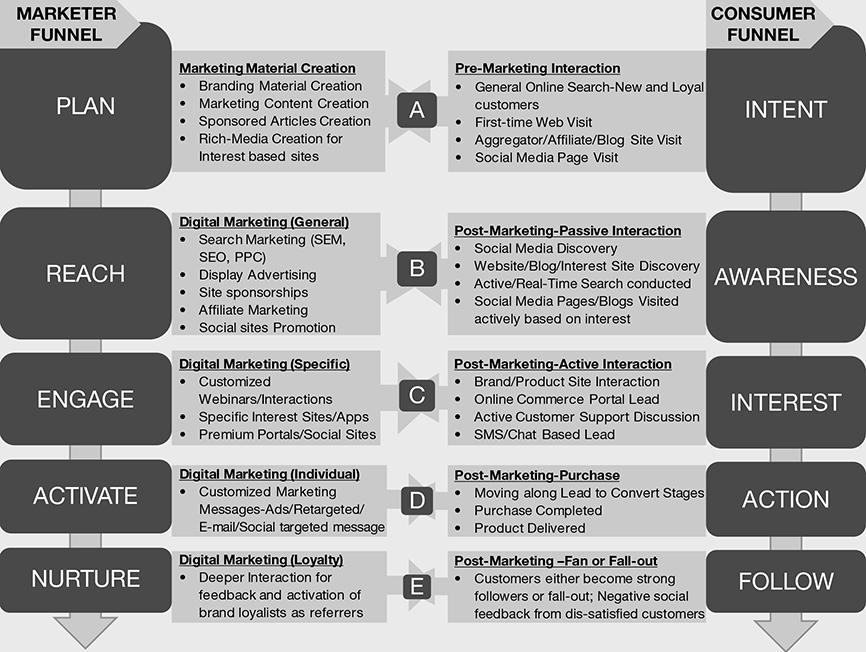
Figure 1.4 Digital Marketing Areas and Activities Explained through REAN Marketing Engagement Framework
Interaction Points of Marketing and Consumer Funnel Stages
- Interaction Point A (PLAN-INTENT): Involves integration of marketer’s activities related to planning and consumer activities related to pre-marketing intent (towards brands, products, and services even before they have been exposed to any type of marketing). Typically by collating consumer intent-based activities, marketers can plan better for the search keywords they would invest in, customer support to be provided during the marketing cycle, and type of interest-based portals, aggregator sites, blogs etc., that, their target customer segments are specifically interested in.
- Interaction Point B (REACH-AWARENESS): This is the first stage of digital marketing activities wherein marketers typically invest in the most basic marketing activities like publishing content on major platforms, social sites, and most prominent interest portals/blogs. On the consumer side, this is the ‘Passive Interaction’ stage wherein the consumer initially discovers the marketing message but is not actively looking to interact and purchase. Investment areas for marketers here include Search Marketing (SEO/SEM/PPC), Display Advertising, Site Sponsorships, Affiliate Marketing, Social Sites Promotion, etc., which we will discuss in detail below.
- Interaction Point C (ENGAGE-INTEREST): This next stage involves marketers realizing a general interest for their consumer segment for any of the marketing messages shared and investing further in the marketing funnel to convert this ‘interest’ into a ‘lead’. The consumer in this stage shows an ‘active interest’ in the marketing message which is tailored according to his needs and also starts to take part in active online and offline discussions and brand/product site visits to know more about the product for a purchase.Marketing activities here are the ones closer to consumer interests, specific to his communication devices, and directed at times when he/she is most willing to indulge. Digital marketing areas for marketers include customized webinars/collaterals on main website/specific interest sites, premium portals, and social sites. It also includes personal device-based communication like personalized SMSes, e-mail messages, targeted coupons of special interest, etc. Marketing at this stage could be more expensive on a per message basis for the marketer.
- Interaction Point D (ACTIVATE-ACTION): In this stage, which involves conversion of a lead to a final purchase, marketers are fully aware of the prospect planning to buy a particular product/service and their main task is to support and entice the customer to complete the last mile so that a sale is registered at their end. The consumer side, which we have termed as ‘action,’ involves the consumer picking up a specific platform, brand website, or e-commerce site for purchase and following through all the stages of plan selection and payment to accomplish the buy action.The major digital marketing types deployed by marketers here are those involving a lot more automation and marketing technology like re-targeting ads and offers, native messages on social platforms used by consumer, personalized e-mail messages to convert their interest, and so on. This stage becomes even more expensive for the marketer as targeting can be as advanced as providing 20 known parameters about a particular profile which involves inclusion and usage of high-end analytics, big data, and advanced technology intrusions.
- Interaction Point E (NURTURE-FOLLOW): This final interaction point has become most important these days as it has been well established that the cost of retaining a customer is much lower than getting new customers (considering the cost involved in going through and spending on the whole cycle again and again for new customers). In this regard, marketers have to make sure that they invest in enterprise-wide customer loyalty management and interaction systems to not only keep the customer excited on a continual basis, but also to know and rectify any negative feedback he/she might have on the product or the experience of it. On the consumer side, the greater aim for the marketer is to make the satisfied client become a long-term fan of the product. Such consumers become a part of the brand’s-clan/community, rather than falling-out, develop into a brand ambassador themselves to bring in new followers through word-of-mouth and product-championing.
With a good understanding into marketing and customer models, we are now in a position to understand better the key digital marketing types (as mentioned in the earlier section) which form the underlying basis for all digital marketing activities:
- Intent-based marketing (search marketing)
- Brand marketing (display/digital advertising)
- Content marketing (website, blog, native content)
- Community-based marketing (social media, business communities)
- Partner marketing (affi liate marketing, sponsorships, PR)
- Communication channel marketing (e-mail, messaging, SMS)
- Platform-based marketing (mobile, video, out-of-home, media platforms (surface), kiosks, in-apps)
Table 1.4 gives a quick peek into the different classifications of digital marketing. We will go in depth to understand and distinguish the various types and examples of digital marketing, as described earlier, in the following sections.
Table 1.4 Digital Marketing Types Explained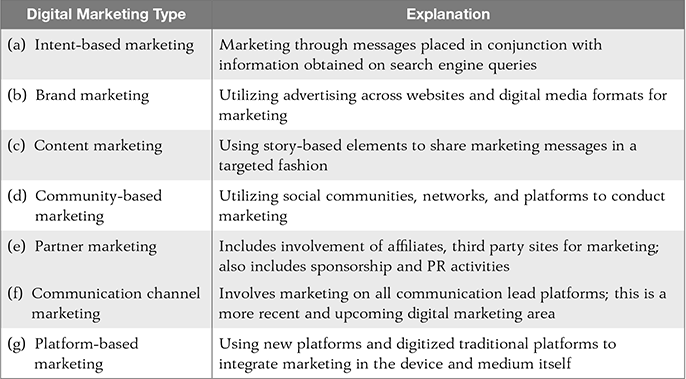
Understanding Digital Marketing Business Models
Moving forward let us look at the key digital marketing business model types deployed for marketers to earn revenue from their investments across various digital media types described earlier.
Largely, there are five different types of digital marketing business models which are further classified into sub-types based on transaction and application. These are—advertising, subscription, commerce, transaction fee, and social collaboration-based revenue models. Their key definitions, sub-types, and examples are discussed in Fig. 1.5. It should also be noted here that the fulfillment of these models is done through a variety of platforms and channels, most suited to each business model.
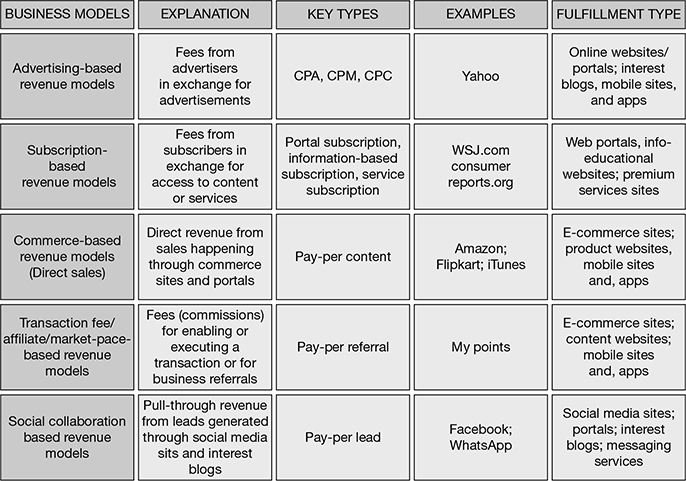
Figure 1.5 Digital Business Model Types
Next we move to understand key digital marketing applications and the benefits they provide to marketers at large. The true extent and reach of these applications will be understood once we have gone through the whole book and become familiar with the various ways how digital marketing is applied across multiple industries.
Digital Marketing Applications and Benefits
Digital marketing has become indispensable for almost all types of businesses, organizations, and, if we dare say, to even individuals. There is not a day in present times, when we at a personal, professional or societal level do not interact or are not affected by digital marketing. From the time we open WhatsApp in the morning to check messages from our social groups to the time we hit the first search on Google, to looking at the latest scoreboard on our smartphone cricketing app, we are interacting with digital media applications and being affected by digital marketing all the while.
The key applications for marketers utilizing digital marketing channels and platforms would include:
- Enhancement of revenues: The most pertinent application of all business models is the potential to increase revenue beyond present numbers and digital does so in multiple ways. From top-branded product manufacturers to local small and medium businesses, all are embracing the power of digital to get enhanced revenues and move from just a physical sales model to an omnipresent sales channel where the biggest orders can come in at times and from locations not even known to the marketing manager.
- Brand presence amplification: Marketing done only across traditional channels is typically time consuming and requires a large effort to gather new prospect base. Digital marketing helps reach out to newer target segments in a much lesser time-span and amplify brand presence multiple times over.
- Support information-seeking and customer validation exercise: Digital marketing’s biggest application for marketers is its impact across multiple channels to support the customer gather information, compare competing products, and validate his purchase decision through comments and thoughts from multiple online sources which he was not able to gather in the physical world.
- Develop customized forms of consumption (like applications and social pages for targeted communities): One of the most interesting aspect of digital application is towards creation of targeted low-cost apps, social media pages, and curated articles on interest blogs and platforms, which provide a way to not only personalize information but also how it is accessed with utmost ease by the target segment in which the marketer wants to engage.
- Mixing multiple digital channels and online-offline media: With newer innovations like integration of Twitter with e-commerce companies to place orders in e-carts by inclusion of special hashtags in their tweets, marketers are utilizing multiple digital media platforms and integrating online–offline media to help customers complete the purchase cycle, on whichever medium, channel or platform they are present. These growing integrations we believe will impact even the most physical of industries like agriculture and healthcare in ways never thought of before.
- Instant response generation mechanism to negative customer feedback: We have seen a lot of instances wherein brands have not only been able to identify when customers are not feeling good about certain products and experiences on offer but have also been able to avert huge losses and save face in the outcry of key issues important to them both on the product and brand side. In some instances, digital media has even led to companies take back stocks worth millions of their wares to maintain customer trust and brand integrity.
There are multiple such applications which we have seen across industries and client interactions on digital platforms which can be shared here. We would be going through a lot more examples in the book as we move forward to chapters which detail each media and the use of technology towards making digital media such a huge part of the marketing mix these days.
Key benefits of digital marketing include:
- Provides a level-playing field be it a small or large business
- Much cheaper to run campaigns, collaborate, and analyze insights
- Helps to reach out to customers in real time based on their latest actions
- Easier to measure effectiveness of a campaign or a marketing message
- Viral effect includes ability of a strong concept to reach the mass market instantly
- Provides greater engagement with the use of imagery, content, information, customer support, and personalization
- Utilizes multiple technologies and collaborative platforms available to harness the power of big data and internet reach
- Acts as a medium to understand customer segments and their actions better
- Helps understand customer intent across multi-channel platforms
- Utilizes the power of social networks to reach out to multiple users in a trusted environment
- Integrates traditional campaigns to extend the reach of branding to its longest possible tail
- Change marketing messaging based upon latest feedback or acceptance to campaigns
- Make collaboration, feedback, and continued engagement with the brand possible in online–offline mode
Leave a Reply