
In the section on Chapter 1 titled “Digital Marketing Channels—Types and Business Models,” we had looked at the key stages of the consumer funnel which any consumer would typically go through before finally buying a product. These stages (intent, awareness, interest, action, and follow), describe the journey of the customer from an initial thought to sealing the purchase.
But even before all of this occurs, a marketer has to be completely clear and focused on which consumer segments he/she is planning to target the product portfolio and which consumer segments are the most important for the product. And, to do that successfully, he/she needs to understand the basic concepts of consumer behavior and how it varies across the emerging digital channels.
According to ‘Schiffman and Kanuk’, the leading authority on Consumer behavior, this marketing field is defined as “the behavior that consumers display in searching for, purchasing, using, evaluating and disposing of products and services that they expect will satisfy their needs.” It would be important here to understand that it is not only the consumer’s personal thoughts and dispositions which matter during product selection but also the influences and interplay of external forces like people, ideas, environment (social, political, and economic), which impact a consumer’s mindset towards a particular product interaction.
Over the years, there have been multiple models developed by different researchers to explain consumer behavior process and factors impacting it. Traditional consumer behavior models, which were developed, drew their origins from varied disciplines (see Table 3.1).
Although the above models explained a generalist view of how consumer behavior works, they were limited in their approach, composition, and lacked a broader perspective. This led to the development of the modern consumer behavior models, the most influential of which included ‘The Howard Sheth Model of Buying Behavior,’ ‘The Nicosia Model,’ and the ‘Engel, Blackwell, and Miniard (EBM)’ Model.
The Howard Sheth model was pivotal in bringing forth the ‘Theory of Buyer Behavior’ which provided “a sophisticated integration of various social, psychological, and marketing influences on consumer choice into a coherent sequence of information processing.” The model though revolutionary in its approach and construct was quite complex and included variables which were not too well defined and difficult to measure. For this reason, it underwent improvements in the form of new models, the most applied among them being the EBM model which we would discuss in detail (see Fig. 3.1).
Table 3.1 Traditional Consumer Behavior Models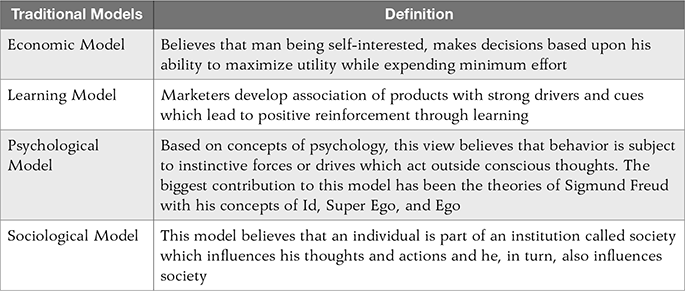
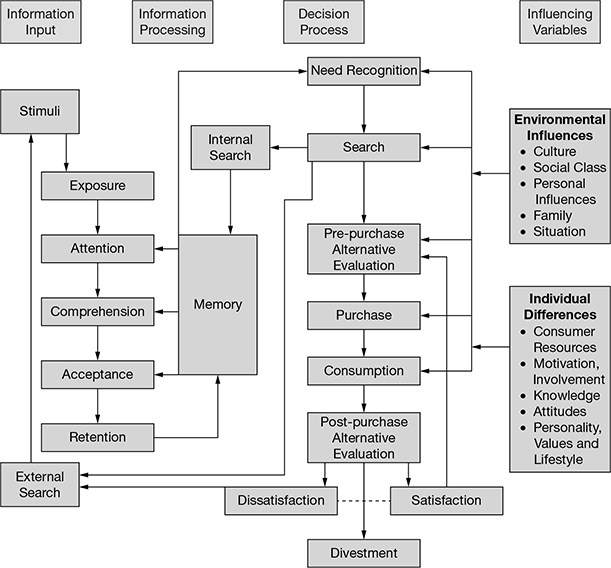
Figure 3.1 The ‘Engel, Blackwell, and Miniard (EBM)’ Model
The ‘Engel, Blackwell and Miniard (EBM)’ Model encompasses all types of need-satisfying behavior for a consumer, including a wide range of influencing factors and different types of problem-solving processes. This model has been influential since it has undergone multiple revisions and has included works of other researchers too.
The model consists of four key stages:
- Information input stage: This stage includes all the inputs and stimuli from marketing (like advertisements in television, radio, newspapers, internet, word of mouth, etc.) and non-marketing sources which form the basis for information processing in the next stage. The stage also includes additional external information search which the consumer conducts, especially when not enough information is available from memory or when post- purchase dissonance occurs.
- Information processing stage: The information processing stage is similar to the consumer funnel, discussed in the beginning of this section, which involves the consumer getting exposed to the marketing message, paying attention to it, comprehending its intent, proactively or subliminally accepting it, and retaining in memory to make a decision the next time he/she is exposed to a similar message.
- Decision process stage: Involves the following key stages which are commonly looked at as the Consumer Decision Process (CDP) Model steps. These have become quite important since with the advent of internet, the way consumers perform the following activities has been completely altered.
- Need recognition: With the availability of multiple touchpoints to various products through the internet, the need recognition stage has expanded from being just a reactive need-based model to a more proactive instant-purchase phenomenon.
- Search: In contrast to search pertaining to a more physical context of moving around and searching for a product, in the present times, focus has shifted to an all-pervasive information search model which is accessible anytime and throws up amazing amounts of data for a pre-purchase evaluation.
- Pre-purchase alternative evaluation: It involves the ability which a consumer has in the digital age to compare multiple alternatives before buying and also points to the opportunity marketers have of influencing a customer towards their product, even seconds before a customer is planning to complete the final purchase.
- Purchase: It involves the act of finally purchasing the product. Traditionally, trust has played a major factor for customers purchasing online, a phenomenon which is undergoing rapid change with consumers increasingly becoming more comfortable with buying online (as is evident from the increased online penetration of e-commerce sites and their rising revenues).
- Consumption: Relates to the actual usage of the product bought and includes important concepts like the lag time between an online purchase and the actual time when a customer receives the product at home/office and consumes it.
- Post-purchase evaluation: It is the stage when the consumer decides if he was satisfied with the purchase and the likeliness of a second buy or a referral to others on a trial of that product. This is a very crucial stage for the marketer as true brand loyalty originates or dwindles in this stage.
- Divestment: The final stage of the CDP model involves the consumer divesting the product which is not dependent on the purchase channel or buy pattern.
- Variables influencing the decision process: Includes two broad categories—
- Environmental influences: It includes factors like culture, social classes, personal influences, family, and other situations which impact a consumer’s decision process throughout the CDP stages.
- Individual differences: This includes more individual-driven factors which differentiate one kind of consumer from another, based on factors like consumer resources, motivation and involvement, knowledge, attitudes, personality, values, and lifestyle all of which could have a huge impact on a consumer’s final decision towards a product or service.
With an understanding of the evolution of consumer behavior and key models which have shaped it over the years, we move forward to understand the impact digital technologies have had on decisions and motivations of online buyers and how the internet has impacted consumer behavior and changed the marketing landscape.
Leave a Reply