
With an understanding of the transition from Brick and Mortar to Bricks and Clicks model, it is important to know the meaning of the term “interactive” which is one of the key terms most often used in digital marketing to differentiate products and services across traditional versus online platforms.
Interactive by definition implies any medium which allows a two-way interaction between a human and an electronic medium often in a conversational manner to obtain data or information and to give immediate results. The platforms which provide the capability for such exchanges are known as interactive platforms. The best example is the difference between traditional media platforms (like television, radio, newspaper) which typically are not interactive (even if sometimes radio took requests from their listeners or newspaper published reader’s letters) and the latest digital platforms like personal computer, mobile, kiosk, gaming consoles, etc., which enable interaction of data either between individuals or between human and a machine through the electronic medium.
Table 2.1 Uniqueness of Each Model—Brick and Mortar versus Bricks and Clicks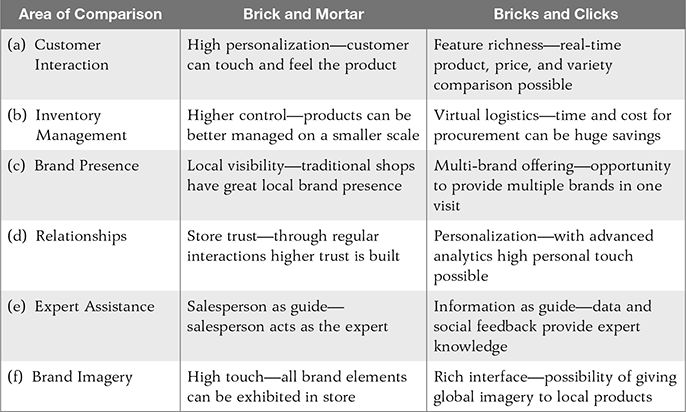
Impact and Importance of Interactive Platforms
The development of interactive platforms started primarily (as explained in the first chapter) with the growth of the web and applications built on it like chat, e-mail, comments section, etc. Users for the first time got the option to share a thought, put a comment, or send a piece of information, and in return be able to interact in real-time with another person, an expert or an automated robot to get an almost instant (or rather very quick) response to the communication or query (see Fig. 2.2).
Let us understand the key types of interactions supported by interactive platforms which help digital marketers reach their goals more effectively.
- Information-seeking interactions: The biggest impact of any interactive platform is to help a customer seek answers and gain information towards his needs and problems, an activity which can also be directed to match the query with relevant products and services. This is precisely what search marketing does and that is why it is still the most effective and widely used digital marketing channel.
- Problem-solving interactions: The next level of interaction is when the customer and marketer have a real-time ability to conduct a one-to-one discussion to listen and provide solutions to the problems a customer is facing while interacting with a product or service. Such interactions which started as more of casual chats between strangers in chat rooms have advanced to become interactive tools, that B2B and B2C companies have built in as a standard feature on their website, giving them huge returns thereof.
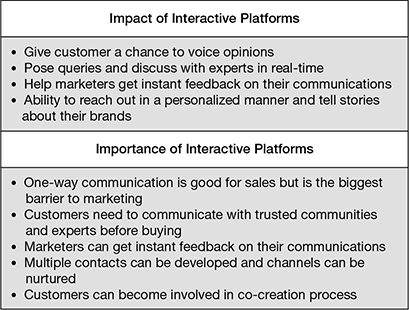 Figure 2.2 Impact and Importance of Interactive Platforms
 - Community interactions: The next level of interactions utilize the effect of networks in a manner never imagined. Multiple sites with collaboration/group-creation features or niche areas, broad-based social networking sites like Facebook, in-game group interactions (which are immersive in nature) are examples where several like-minded people are able to share information and marketers can benefit out of those interactions and market their brand to an actively involved audience.
- Activity/promotions-based interactions: One of the most interesting kind of interactions which marketers have used very effectively is to conduct activities and events-based interactions like contests for online participation. Customers are made to interact with key elements of the product/service/brand to help promote its attributes and usefulness; At the same time, customers are kept highly engrossed; and lured with the possibility of interesting returns, rewards, rebates, improved social status, etc.
- Expert opinion interactions: Apart from general query-based interactions, interactive platforms have also given marketers a chance to showcase expert knowledge and opinions about their products/services through designated product experts who are available online. This has helped brands retain their edge over competition and at the same time help the customer throughout the marketing funnel activities.
- Feedback eliciting interactions: The best way to elicit direct and pertinent feedback for a brand and its products is through mini-feedback forms or quick post-buy surveys which are not time consuming or intrusive. Interactive platforms have helped brands get responses to the various attributes of sales and marketing through such tools.
The growth and proliferation of interactive platforms thus have given power to both customers and marketers to understand, influence, and accomplish their objectives in ways which were never possible before with one-way traditional communication channels.
The New Network Economy
In the last section we saw the importance of community interactions and how they have impacted the growth of digital marketing. This section will help us appreciate how the phenomenon of network economy has evolved on the internet and taken shapes and forms which have helped the concept grow and become widely prevalent in present times.
The Network Economy Phenomenon
The concept of network economy involves value being added to products and services through social networks operating on a large or global scale. This is in contrast to the economies of the industrial era wherein a single firm was responsible for providing all the intellectual property behind a product or an idea.
The core principle behind this economy is termed as the “network effect.” The concept states that a product displays positive network effects when increasing usage by a user augments the product’s value for other users (and sometimes all users). The best example to understand network effect can be seen in the way Facebook grew through social connections and each of us found more value from the product only if we had our friends, relatives, and contacts join in and keep sustaining that value.
The effects we describe here are known as “positive externalities,” wherein an externality is any situation in which the welfare of an individual is affected by the actions of other individuals, without a mutually agreed-upon compensation. We make a case for the word “externalities” as there could be situations termed as negative network externalities too, where more users make a product less valuable (more commonly referred to as network congestion).
Evolution of Network Effects
Network effects was first studied in the context of long-distance telephony in the early 1970s (one of the earliest papers on the topic is Rohlfs, 1974). Today, they are widely recognized as a critical aspect of the industrial organization of IT industry and are prevalent in a wide variety of sectors, including software, microprocessors, telecommunications, e-commerce, and electronic marketplaces. Empirical evidence of network effects has been found in product categories as diverse as spreadsheets (Brynjolfsson and Kemerer, 1996), databases (Gandal, 1995), networking equipment (Forman, 2001), and DVD players (Dranove and Gandal, 2003).
Types of Network Effects
Network effects can be classified on the basis of cause and effect relationships of the networks in hand. Key classifications include:
- Direct network effects where increase in usage of a particular good or service leads to a direct increase in value and subsequent adoption for other users. The most common example is the telecom industry where increased adoption of a mobile network raises the value for other users joining the network as this might reduce the costs, allowing more services, and facilitating better investments for research by the company operating the network. This clearly describes the direct network effect.
- Indirect network effects where increase in the usage of one product or service augments the value of a complimentary product or service which in turn raises the value of the original product. A good example here is the increase in adoption of external hard drives, compatible with laptops or other computing devices. The more laptops are sold, the more hard drives would be adopted or sold (as they gather more value to act as storage devices for increased content storage needs), thus increasing the use of laptops as a home-computing device.
- Two-sided network effects where increase in the usage by one set of users increases the value of a complementary product to another set of users distinct from the first set and vice versa. One good example of this type is the development of video games on gaming consoles. Developers charge a price for developing these games for which users pay. As the network of users who play the game increases, the value of the developers who develop it rises, and in turn, the game has better developers, hence increasing the value for the players.
- Local network effects where the micro-structure of the networks influences how much network effects matter to each group. In this case, the value increase that a particular good typically witnesses with the number of increased users does not have impact on the growth, of say its two subset groups, whose usage might depend on each other’s presence in the network. The best example is instant messaging.
Leave a Reply