
In the last chapter, we learnt about the stakeholder-based ‘digital transformation model’ to understand how various elements affect the interactions of a firm with their suppliers and intermediaries, and how internal processes can yield necessary transformation elements for customer satisfaction.
Starting with elements of the same model, we would start to map out key value chain elements, focusing on key process functions like procurement, production, and delivery. Instead of the consumption function, here we would concentrate on a new function called the expert function, which would emphasize on new-age intermediaries who bring their expert knowledge, reduce transaction cost (explained later), and develop new value-led models. We would also take up the case of journal publishing to elaborate its generic value chain process steps and contrast it with revised value chain elements brought about with the help of intermediaries.
Understanding Value Chain Functions
A value chain is defined as a chain of activities that a firm operating in a specific industry performs in order to deliver a valuable product or service for the market. To go through the concept in depth let us look at the revised Porter’s model (see Fig. 2.4), we went through in the last chapter.
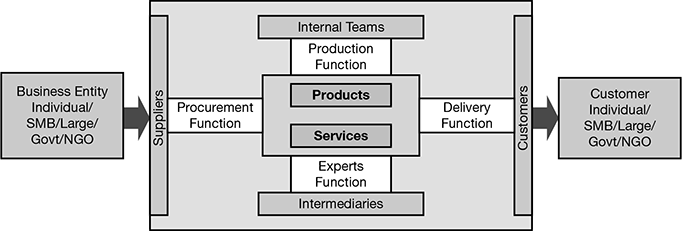
Figure 2.4 Key Value Chain Functions
Figure 2.4 represents a high-level view of the key elements of production any business entity would have to go through to supply goods and services to any type of customer. The business entities and customer types mentioned here span across individual business owners/customers, SMBs (Small and Medium Businesses), large businesses, government divisions, and NGOs (Non-governmental Organizations). The production element has four distinct “Interaction Functions” related to four types of stakeholders.
- Procurement function: Related to all activities for procuring raw material and other types of input content (for services) from multiple supplier sets
- Production function: Involves the set of processes towards creating or in certain cases assembling new products and services to be sold to multiple customer groups
- Delivery function: Involves the set of activities geared towards warehousing, delivering, and ensuring final consumption at the customer’s end
- Expert function: Relates to expert activities or services provided by multiple intermediaries or as we call them here “expert partners” who can bring down operational costs and provide higher value across the process through their expert knowledge in multiple sub-activity areas and processes
The key takeaway from this representation is to give a better idea of how key value chain processes are structured along the four functions and how in the modern digital age, the fourth function is providing efficiencies to help generate new “value it should be ‘value-driven’ driven” business models for business entities.
Key Value Chain Process: A Basic Understanding
With key value chain functions defined, let us move on to get a basic understanding of the key processes across each of the procurement, production, and delivery functions, and also look at the impact of the expert function and how intermediaries provide value across the value chain. Figure 2.5 showcases key value chain processes across procurement, production, and delivery functions. Below is a detailed understanding of each of these processes:
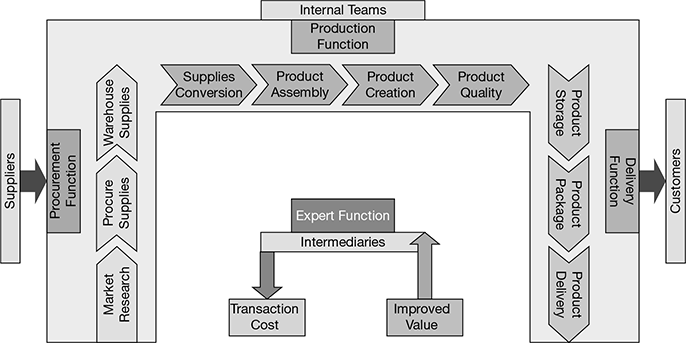
Figure 2.5 Key Value Chain Functions
- Procurement function processes
- Market research: involves activities related to researching the market for the best suppliers, quality supplies, and optimum prices
- Procure supplies: includes steps for procurement like collaborating with vendors, making an order, and paying for the supplies
- Warehouse supplies: involves executing a quality check on supplies procured, raising red flags for bad supplies, and storing supplies in warehouses either managed by business or leased firms across production locations
- Production function processes
- Supplies conversion: involves conversion of supplies into readily usable raw material which would be put in an assembly line for production
- Product assembly: aligning all raw materials, people, and machinery in line for production. In the case of services, it would involve putting in place all the necessary tools for production purposes
- Product creation: actual production process takes place and the final product is created
- Product quality: involves a quality review of the final product before storage; products not following quality norms are sent back for revision
- Delivery function processes
- Product storage: involves storage-related activities across multiple locations for-client fulfillment
- Product package: activities related to packaging the product as per customer demand and requirements and making them ready for shipping
- Product delivery: activities related to final delivery and distribution according to client demands and market potential; delivery could be online or offline or a mix of both
Transaction Cost Concept for Expert Function
With the knowledge of the basic process steps across the value chain, we now move to an understanding of the impact of expert functions and how they provide value to the overall chain. Towards this we first need to understand the concept of transaction cost.
Transaction cost by definition is the cost incurred in making an economic exchange. Now, every transaction that we see happening across a value chain process will involve some specific cost. These transaction costs typically add friction to commerce. Expert functions are the intermediaries which while acting as experts across different areas of the value chain, help reduce this cost and provide most value to the process. We would look at a detailed example in the next section wherein transaction cost reduction concept is applied to the journal publishing value chain. This example would help explain how these intermediaries reduce economic friction and add tremendous value not only for them but also for the overall value chain.
Value Chain Elaboration: A Case of Journal Publishing
With an understanding of the basic value chain functions and key process areas across them, we would apply the concepts to a specific example to see how the value chain is laid out for that product and how the concept of transaction cost helps reduce friction and develop a revised value chain with the help of expert intermediaries.
The example we choose here is of journal publishing which is interesting in the way that although the final product is in a physical form, the content pertains to it being disaggregated into service-led models (we would take a closer look at this in the next section).
In line with the value chain function and processes as elaborated in the last section, here we explain the key process steps (see Fig. 2.6) for journal publishing (physical form).
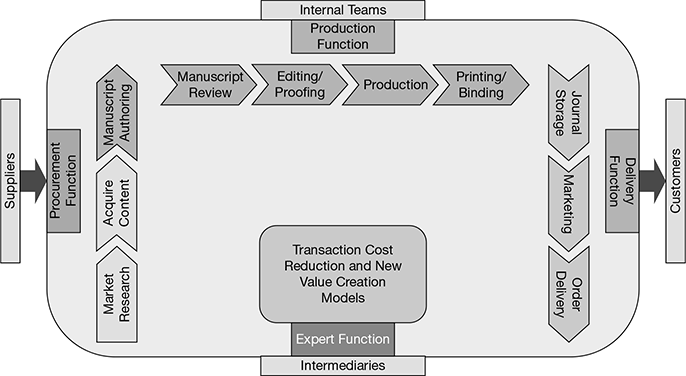
Figure 2.6 Journal Publishing Value Chain
The key process functions are described below:
- Procurement function
- Market research: involves activities related to research on trending topics, top authors in each area, subjects which readers would want to read most, and the market where certain kind of content needs to be published
- Acquire content: involves journals opening up for submissions in specific areas and obtaining solicited and unsolicited manuscripts. Journals can also acquire historic content for reference or re-publishing
- Production function
- Manuscript authoring: involves activities related to authoring of major titles using various content pieces sourced to create compelling pieces of content
- Manuscript review: consists of activities related to reviewing articles once they have been written to check quality benchmarks before it goes to the editorial and proof-reading team
- Editing/proofing: includes editing and approving a piece of content and proofreading it so that the content can be published
- Production: involves collating the final content, sourcing images and diagrams, executing design and layout, and developing the blueprint for printing
- Printing/binding: involves physical printing of pages and binding into a journal format to be shipped to multiple locations
- Delivery function
- Journal storage: refers to activities related to storage of the journal in boxes in designated warehouses situated near fulfillment locations from where it is to be delivered, based on demand
- Marketing activities: involves demand creation and promotion, both of which impact sales and final delivery effort
- Order delivery: includes the final steps of reaching the individual subscriber, library owner, corporate researcher, and order execution
Role of the Expert Function
As discussed in the previous sections, expert functions are those which help reduce transaction costs and create a digitized value chain which lends itself to creating more business models and subsequently (as we see in the last section of the chapter) create more digital marketing models.
Leave a Reply