
In the last section, we covered the basics of search campaign planning, set-up and execution of SEM, and SEO in detail. In the present section, we would cover the second prominent type of digital marketing campaigns which relates primarily to brand-building activities and is also known as display advertising in common industry parlance.
Display Campaign Management Basics
In Chapter 6, we understood the basics of display advertising and focused on display ad servicing mechanism and key display ecosystem players. In this section, we begin with a basic understanding of key players involved in initiating and executing a display campaign and the types of display campaign inventories. Post that we will cover the key stages of display campaign management and typical stakeholder interactions that take place from the time inventory is sold and ads are delivered on multiple channels.
Understanding Key Display Advertising Players
Before we go into understanding each of the key stakeholders in detail, let us summarize what display advertising is at the most basic level. Display advertising, by definition, includes all activities involved in creating, placing, and analyzing RoI for image-based ads placed across multiple inventory types on the web, mobile, and other digital channels. There are four types of ad formats which constitute display ads:
- Text ads involve lines of text, similar to search ads.
- Banner ads involve images placed above, below, and to the side of content being viewed.
- Rich media ads which are high on interactivity and animation, usually of a larger file size than banner ads.
- Video ads include promotional video content embedded inside rich media ads which also constitutes the larger set of display ads.
With this basic understanding of major display ad types, let us now look at the key stakeholders who initiate, manage, and support overall display campaign management activities. These include the advertisers, agencies, publishers, and tech-tool providers. Here are the key roles and objectives of each of these players:
- Advertisers: They form the Buy Side of display advertising along with agencies. Advertisers can be classified on the basis of their overall spend budgets and the brand portfolios they handle in terms of large, medium, or small/local advertisers. Based on the portfolio of brands and respective marketing implementation stage for each brand, advertisers of any size could look at a mix of display marketing objectives (based on the 6S digital marketing implementation model):
- Engagement objective (launch stage): Spend during this stage is primarily focused on branding. Typically, it is applied during new product launch to create buzz/awareness and establish the product in its category.
- Conversation objective (growth stage): Advertisers spend more on prospecting and retargeting for higher leads primarily through CPC/CPM models.
- Sustenance objective (established stage): For products in their mature stage, spend has to be mixed across branding, prospecting, and retargeting to maintain brand leadership or support revitalization of a stagnating/declining brand.
- Agencies: Agencies is an industry term for a bunch of varied companies supporting advertisers with their brand and marketing objectives. The core role of agencies is to help their clients (advertisers) manage advertising budgets in the most effective manner and help them achieve desired objectives across the brands they operate. Agencies have been broadly classified as marketing agencies (those which help with media buying activities) and creative agencies (those which support creative development and deployment). But today, with a wide portfolio of digital activities to be performed across multiple channels, specialized agencies have evolved which support various parts of the advertising value chain with their revenue model being the fee-cut they obtain from owning, developing, and running these campaigns.
- Publishers: Publishers are known as the Buy side of display advertising. Also referred to as media owners, these entities sell out real estate on their web pages, known in the industry as ‘inventories’, which are the spaces where we see digital ads regularly. Publishers could vary from regular blog owners, to large news web pages, e-commerce sites to social media channels, mobile apps to online games, etc. Publishers typically decide the type of inventories and the price at which they would be sold to buyers.
- Tech-tool providers: As discussed in Chapter 6, section titled, ‘Brand-Based Marketing (Display Marketing),’ multiple tech-focused entities have developed across the ecosystem to support the ever-growing complexities of display campaign management. These tech-tool providers in the process of providing technology-based empowerment to players on both the buy side and the sell-side are also creating a niche for themselves and completely changing the landscape to compete with agencies themselves by building automated media buying and selling platforms. The most prominent of these tool providers today are Google and Facebook who are taking over a large pie of the media spend through their extensive DoubleClick and Atlas platforms, wherein they also provide campaign support services (which was earlier a core agency job). The next section on programmatic buying extensively covers how these tech-tools are taking over the display advertising process wherein more than 50 per cent of the ads, in present times, are being delivered programmatically.
Understanding Display Inventory Classification
Since inventory is the key asset which is sold by publishers to advertisers throughout the whole media buying and selling process, we will first look at how publishers forecast and classify the display inventory available to them across their websites (and web pages). Next, we will cover the display media sales process to share key interactions between advertisers and publishers during buying and selling.
Display inventory, in most basic terms, is the number of total impressions available in an aggregate manner on all web pages of a particular website, whose inventory a publisher is looking to sell. The key difference though is the nature of this inventory which is expandable in comparison to regular media vehicle inventory (like TV, radio) which is of a fixed nature. To understand this concept, we would need to begin with the basic starting point wherein the publisher forecasts and classifies its inventory at hand.
Let us (for an easy understanding) discuss the case of a single publisher group and only one of their many websites to understand how they forecast the inventory available for sales to advertisers. The general rule for this calculation involves multiplying the number of page views in a particular period (aggregate across all web pages) for the chosen website with the average number of ad inventories available on the web page (which is typically three inventories). The number arrived through this calculation is an approximation of the total ad impressions which can be garnered across the website. Apart from the data gathered from historical pageviews (across past months), publishers utilize inputs from multiple tech-based tools with sophisticated algorithms to forecast the available inventory. Key among them include:
- The ad server’s in-built forecasting capabilities
- Technology solution as a feature of workflow/order management tool
- A stand-alone digital inventory management tool
Publishers, once they have approximately forecasted the available inventory during specific range dates, also need to provide attributes to each inventory and their related page so that they can be sold based on multiple targeting criteria which the advertisers would like to select. This refinement of inventory can be done on attributes like:
- Media attributes: contextual targeting, inventory Quality Score, rich media units
- Audience attributes: geographic, demographic, psychographic, behavorial, etc.
- Page attributes: above the fold, below the fold, section specific
With an understanding of how inventory is forecasted, let us now look at the basics of how media inventory is classified in the industry. In this section, we would explain in detail two key ways of selling inventory in the traditional (manual) fashion. The newer ways of display sales, with the use of programmatic tools and real-time technologies, would be discussed in the following section in detail.
In Fig. 8.8, we showcase the key classifying parameters for display inventory sales:
- Interaction based: Direct and indirect inventory
- Sales mechanism based: Manual and programmatic sales
As discussed earlier, we would only cover the two key ways of manual sales of inventory in this section. These include Premium (Guaranteed) and Remnant (Non-Guaranteed) Inventory. To understand the basic difference behind these two sales types, we need to go back to the prime objective of any online publisher, which is to sell maximum percentage of its inventory at a premium price. Publishers judge the pages with most profitable inventory primarily through leading indicators (like home pages and section landing pages will be the best inventory for sponsorships) and sifting through page analytics (to see which other pages are visited the most, both above and below the fold).
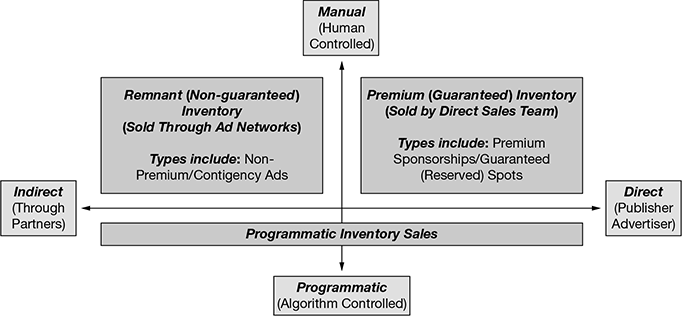
Figure 8.8 Display Inventory Sales Classification (Manual)
Based on multiple reports and tool analysis, publishers on an 80–20 principle, typically pick up the top 20 per cent of their inventory which they know would yield 80 per cent of their overall display sales revenue known as premium inventory (the first of the two types of inventory sales being discussed). Premium inventory is also termed as guaranteed inventory because while selling it to various advertiser groups, publishers make sure that the number of contracted impressions would be delivered to the advertiser at the end of the campaign. Typically, a sales team has to be set up which meets advertisers in person to confirm the booking of these slots much in advance of the actual dates when these campaigns are actually run.
The second type, known as Remnant (last minute sales) inventory, forms the rest 70–80 per cent inventory across other non-premium pages. This is the inventory which publishers have not been able to sell to advertisers directly through manual sales and depend primarily on ad networks who pick up these bulk inventories at lower prices in a non-guaranteed fashion. Ad networks, as discussed in Chapter 6 earlier, help publishers sell their excess inventory to a broad range of advertisers, which they are not able to directly sell through their salesforce. On the advertisers side, ad networks help advertisers aggregate the best possible inventory from multiple publishers based on their specific demand. From an execution standpoint, it is the agencies who typically manage the ad networks in terms of inventory selection, execution, and effectiveness of inventory buys. There are multiple categories of ad network types available for advertisers including horizontal, vertical, targeted, performance, mobile ad networks, which go to show the market maturity of this type of inventory sales.
Figure 8.9 shows the key advantages for advertisers and publishers specific to each of the manual display inventory sales channels types. With an understanding of these channels, we would now look at how a standard display campaign is run and the key steps involved. Since premium inventory sales and campaign cycles are the most elaborate to run and also account for the maximum spends, we would take that as a base to explain display campaign stages and the key interactions between advertisers, agencies, and publishers.
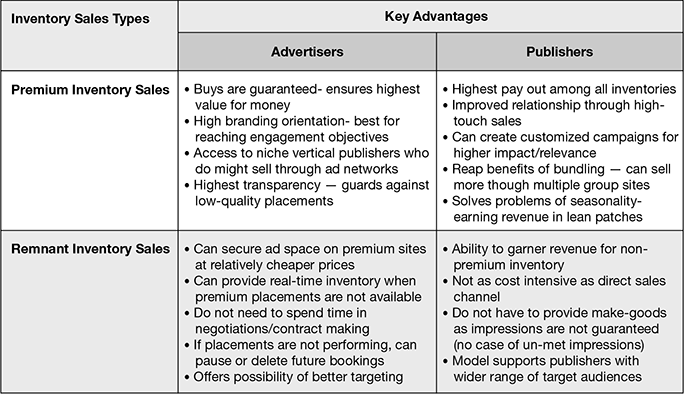
Figure 8.9 Advantages of Manual Inventory Sales
Standard Display Campaign Workflow
Figure 8.10 shows the four key stages of any standard display campaign and the key interactions between the three critical stakeholders—advertiser, agency, and publisher. In a lot of cases, the activities of an agency will be divided between a creative agency (which builds the creative) and a media agency (which is involved in buying and selling inventory for advertiser). But for the sake of ease, we would treat both as a single identity (though in certain cases like smaller companies, the creative might also be developed in-house).
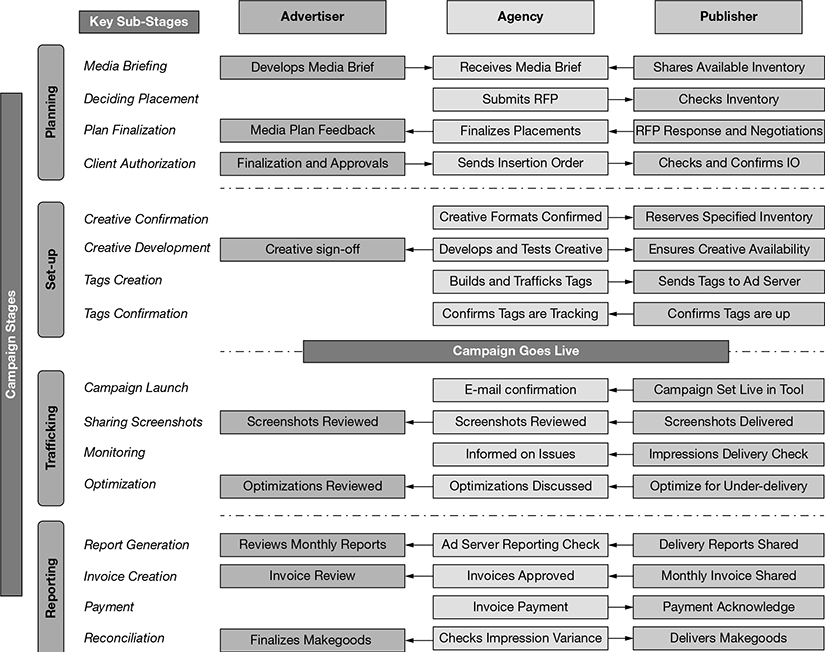
Figure 8.10 Standard Display Campaign Workflow Stages
Let us now go into an in-depth understanding of each of the four key stages to understand key activities behind campaign run:
- Stage 1: Campaign Planning: This is the first stage of setting up a campaign and it typically starts with an advertiser developing a media plan based upon his advertising objectives and the kind of digital properties and inventories he would want to advertise (keeping in mind the budget at hand). As discussed earlier, an advertiser would typically have three kinds of advertising objectives: engagement, conversion, or sustenance. A typical media plan would consist of:
- Campaign objectives: The advertiser shares high-level objectives for the campaign along with a broad idea of the expected output and RoI.
- Audience and targeting: The advertiser specifies his preference for inventory and user targeting, based upon experience and specific context related to objectives at hand.
- Pricing estimate: The advertiser gives an indicator of overall spend across each key channel and a general idea of the deal mix (CPM-CPC-CPA) which would be best suited.
- Metrics and reporting: Finally, the advertiser would also share the metrics he considers most essential for the specific campaign and standard/customized reports.
- Researching inventory mix: Agency would do a detailed analysis of the type of display inventory best suited for the campaign (Page inventory–Top/Bottom of the Fold, Run-on-Site (ROS), Run-On-Network, Standard or Rich Media Units).
- Refining target audience: Agency would pick up advertiser’s directions and further refine the target audience based on gender, age, region, buying preferences (for example, 18–25-year-old living in tier 2/3 city with a monthly mobile bill above ₹ 3000 spending a minimum of ₹ 2000 per month on e-commerce buys).
- Deciding on channels and publishers: Agencies finalize the placements available to them like specific sites, top networks, niche portals, and the type of targeting (geo-based, user-based, inventory type, day-parting, etc.) and reach/frequency.
- Develop creative strategy: The creative arm of the agency or a separate creative agency decides on the messaging and brand elements to be targeted to different sites, placements , etc.
- Deciding deal type: Typically, for a brand awareness campaign, CPM is the best way to start. For conversion objectives, agencies typically put more spend on CPC and CPA with a good mix of CPM to maintain brand interaction.
- Flight dates (start and end dates)
- Target sites and networks
- Impressions to be served
- Ad unit dimensions and creative sizes
- Details on how to handle under- and over-delivery scenarios
- Monthly billing amounts and pricing structure
- Stage 2: Campaign set-up: This is the second stage of campaign management and is also generally referred to as the campaign ‘pre-live’ stage wherein agency and publishers perform activities which are necessary to kick-start any live campaign. Key sub-stages include:
- Creative confirmation: It involves agencies confirming the exact creative formats to be placed in specific sections of the publisher’s sites. At their end, publishers would check internally and confirm those placements.
- Creative development: The agency’s creative team, in the meanwhile, would develop different types of creatives (standard and rich media) and, after testing, share it with the advertiser for their approval. At the publisher’s end, they communicate with the agency to make sure that creatives are available in time and do an internal quality assurance (QA) to ensure necessary standards approval are run on the website.
- Tags creation: Ad tags are the HTML code used by a browser to pull an ad from an ad server. For each of the creative, an ad tag has to be built and shared with the publisher’s team, which in turn, places it on its ad server to call from the specific website page on which the ad has to be displayed.
- Tags confirmation: Once the publisher places the tags, it confirms with the agency on tags being up and, from their end, the agency confirms back that tags are being tracked. Setting up and running ad tags is important as it lets both advertisers and publishers measure and compare impressions for each creative. This is done through the implementation of conversion tags on the advertiser side and inserting landing page tags on the publisher’s site.
- Stage 3: Campaign trafficking: Also known as the Campaign Go-live Stage, this is the point where the campaign is finally launched and trafficked. ‘Trafficking’ as a term has a specific meaning in the advertising industry and by definition refers to the process of setting up, monitoring, and optimizing an ad campaign to meet the desired objectives. Key sub-stages during trafficking include:
- Campaign launch: The Campaign Go-live stage starts when the trafficker sets a campaign live in ad platform which is then informed to the agency via e-mail.
- Sharing screenshots: Once the campaign starts delivering, agency and advertisers need to know that the campaign is running and ads are appearing on web pages. To support this, publishers typically send out campaign screenshots to agencies which review them at their end before sharing with advertisers for their confirmation.
- Campaign monitoring: Since a campaign typically runs for large periods (even around a month), the key job of a trafficker and the campaign manager is to regularly monitor the campaign to ensure that campaign goals are being met on a daily/weekly basis and campaigns are not under or over-delivering. If the campaign is seen as under-delivered, a publisher can also take agency’s approval to re-allocate inventory so that it is able to meet the targets in specified time.
- Campaign optimization: Campaigns can also be optimized for under-delivery using a set of techniques which are executed in the name of campaign optimization. Optimization typically involves working with parameters like bid, pacing, frequency, targeting, etc., which we shall cover in more detail in the next section on real-time programmatic buying.
- Stage 4: Campaign reporting: As campaigns are being run, the publisher’s team has to share regular delivery reports with the agency/advertiser (as agreed upon in the contract). There are different sets of reports typically created at each end (agency and publishers) which help them track their campaigns and make the payment (agency to publisher) or go through with penalties (publisher side) accordingly. Key sub-stages include:
- Report generation: It involves creation of standard delivery reports (impression reports) by the publishers to share them with agency/advertisers. Agencies also receive reports from their ad servers (also known as third party reports), which they compare with publisher’s reports to ensure publishers have actually delivered the promised impressions for the period measured.
- Invoice creation: Once delivery reports have been cleared, a monthly invoice is shared by the publisher, which gets approved by the agency, and after review by the advertiser, it is put up for publisher’s payment.
- Invoice payment: It involves activities related to invoice payment being initiated from the agency side and payment acknowledgement from publishers. In parallel, the agency also submits its campaign-run invoice (agency fee) to the advertiser who makes a separate campaign payment to the agency for its work.
- Campaign reconciliation: Once the campaign ends, a final report is generated by the agency which shares any discrepancies in campaign delivery and invoicing. If it is found that the campaign has over-delivered (meaning publishers have given more impressions than they signed up for), an additional payment is made to them. On the other hand, if it is seen that the campaign has under-delivered, then the publisher has to pay a penalty in the form of make goods (which involves running the campaign for a few extra days without charge or running a percentage of impressions free during the next campaign). Only when the campaign reconciliation is complete, it is said that the campaign has finally ended. The agency at this level also shares the final campaign report with the advertiser showcasing that it has met all the key objectives stated to achieve.
Leave a Reply