
Digital Revenue Generation Models
As discussed earlier in Chapter 5, section titled, ‘Offering Mix for Digital,’ firms deploying digital marketing typically fall in one of the five product-service states. For a company in any of these five states, it is crucial that they earn revenue on the digital platform be it a pure play offline product company which is planning to launch pure tangible goods online, or a pure services only firm which only has digital services to offer, or even a firm which has a hybrid model and is planning to generate revenue from the sale of digitized products which have a good tangible and intangible mix.
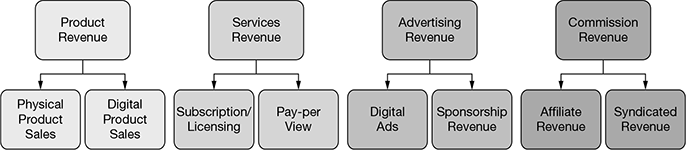
Figure 9.1 Digital Revenue Generation Models
In Fig. 9.1, we have categorized digital revenue generation models into four broader categories which can be elaborated as follows:
Product Revenue Model
These models generate revenue primarily from direct sale of physical/digital products (or any related information/data) which happens more as a one-time payment exercise. Direct trade or e-commerce companies are the best examples as their proprietors use digital marketing to:
- Create a new channel to sell products for which they already have a broader market in the physical world
- Increase awareness of their products to present a set of customers already available online
- Compete against top competitors present online, in their specific categories
- Sell digital products with a direct payment model
- Sell information/data/market research as one-time-buy reports
Services Revenue Model
This model involves selling in a recurring fashion and generally includes the following two types:
- Subscription/licensing: Both the terms refer to a business model wherein consumer pays a recurring subscription to get access to a certain service for a specific period of time. In typical subscription models, the user does not own the product but is getting a period-based window to that specific service on certain pre-decided payment models. Another form of subscription is the licensing of software products. The best and most common example is the worldwide usage of Microsoft Office, whereby users have to pay for a period-based license to access online applications like Word, Excel, PowerPoint, etc.
- Pay-Per view: In this upcoming model on digital content revenue generation, certain pages/chapters of a digitized book can be accessed for an à la carte price. We have already covered aspects of such a model in detail in Chapter 2, sections titled, ‘Value Chain Elaboration: Case of Journal Publishing’ and ‘Emergence of Digitized Value Chain,’ and explained the emergence of a digitized value chain.
Advertising Revenue Model
One of the most commonly talked about and discussed online revenue models is that of advertising (which includes most of the multiple digital advertising types we have already covered in the preceding chapter) and the sponsorship revenue model (which has helped sustain a large number of small and medium digital enterprises over the past twenty years). Although not as big in terms of the revenue it generates for an enterprise moving online, it is still one of the most dependable models for any firm to start earning initial revenue.
Commission-Based Revenue Mode
This type of model is typically adopted by companies which are affiliate networks and helps provide leads to bigger online companies in lieu of specified pre-decided commissions. Another revenue model, which is also close to this type, includes examples of companies which generate revenue by syndicating content across multiple channels and gaining a cut of the revenues (earned by other companies) from utilizing that content in various forms.
With an understanding of the four major types of digital revenue generation models, we will now look at how companies create a loyal stream of customers to keep generating continual revenue and converting them into future advocates for a firm’s multiple lines of products and services.
Customer Loyalty Management in the Digital Era
Managing customers and converting them into loyalists has been one of the most critical objectives for any business to earn recurring revenues. According to Stuart Evans (2007), in one of his articles, he defined Loyalty Marketing as an approach in which a company focuses on growing and retaining existing customers through incentives. Rajat Paharia, in his book Loyalty 3.0, has shared the three stages of loyalty evolution as below:
- Loyalty 1.0: It included programs that were purely transactional, completely focused on customers, and were failures at generating the kind of loyalties that businesses really wanted. The critical flaw with these programs was the long wait for any kind of loyalty program to turn into fruition.
- Loyalty 2.0: In the 1990s the concept converted into a one-to-one marketing approach, which focused on making the loyalty experience more targeted through segmentation and personalization, emphasizing largely on direct mail and e-mail campaigns. The effectiveness of this approach, however, diminished as open rates plummeted and consumers were overwhelmed by the sheer amount of noise.
- Loyalty 3.0: According to the book, there are three key enabling components which have helped the development of Loyalty 3.0:
- Motivation: It refers to understanding what compels and motivates human behavior to create stronger engagement and true loyalty.
- Big data: It denotes gathering and consuming large amounts of data generated through technology to understand, engage, and motivate consumers.
- Gamification: It involves utilizing gaming techniques for data-driven motivation, which can be a powerful tool to drive engagement, participation, and high-value activity for firm’s customers, employees, and partners.
Mckinsey & Company, in their whitepaper titled, ‘The New Era of Customer Loyalty Management’ have outlined the following three key opportunities for firms to implement in the area of loyalty management:
- Managing customer migration, not defection: Migration is a powerful leading indicator that allows early corrective action for companies to manage customers who are increasing their spending. Its value is more than 10 times that of defection.
- Integrating attitudes, needs, and satisfaction to understand drivers of migration: Tracking customer satisfaction alone is not sufficient and is often misleading. But when combined with two other factors—loyalty attitudes (that is, emotive, deliberative, or inertial) and needs and discretion—it can play an important role.
- Tailoring investments and loyalty approaches to most critical parts of the opportunity: Capturing the opportunity is usually based on addressing one or more of the following five levers:
- Pursuing customers actively choosing to go or stay
- Building ‘emotiveness’ into the customer base
- Making it easier for customers to stay, harder to go
- Reducing or eliminating sources of dissatisfaction
- Focusing on customers’ changing needs
To make the most of these new changes, driving customer loyalty management in present times, marketers (according to a whitepaper on Customer Loyalty Management by TIBCO) can look at the following as the four pillars of customer loyalty management in the digital era:
- Combining traditional loyalty with new programs: Maritz, which is the leader in loyalty programs, in its 2013 Maritz Loyalty Report has stated that “71 per cent of (loyalty program) members would join more loyalty programs, even though the average member is already enrolled in 7.4 programs.” This shows that traditional loyalty programs are still the best bet across the industry to develop a first hook with the customer, be it loyalty cards or e-commerce-specific coupons fetching reward points for each consumer activity in the online cart. Traditional loyalty data, once available, can help increase data capture opportunities and connect to ‘private’ event streams to provide better insights into recognition and reward.
- Blending wider event streams: It refers to an ability to capture wider set of impactful events and recognize patterns which impact consumer involvement to help respond with the most engaging ideas. Gartner’s Kimberly Collins in his article, ‘Consider Automating These Top 12 Marketing Processes in 2013,’ has shared that “By 2016, marketing organi-zations that leverage big data for micro-segmentation and targeting will achieve response rates of 70 per cent or higher.” Typical event streams mentioned in the TIBCO whitepaper include:
- Controlled digital touchpoints like websites, e-mail, apps, messages, signage, and kiosks
- Influenced digital touchpoints like social platforms, hosted campaigns, and partnerships
- Non-digital touchpoints, because even when we engage face-to-face, our experiences are heavily influenced by digital channels and capabilities
- Social ecosystem and the way we connect to the world through our ‘network of networks’
- Supply chain with its many points of demand–chain integration
- Marketing-driven relationship management: The latest trend in loyalty management (which will be covered in detail in the next section) is that of relationship marketing, which as Mari Smith claimed in her book, on The New Relationship Marketing, is a blend of the offline and online worlds. Relationship marketing emphasizes on the ability to continually balance the supply of offers with aligned customer demand as the best path possible for customer retention. Astute marketers can utilize relationship marketing models to form specific consumer connections for their multiple brands and products by identifying propensities, patterns, and correlations from past behaviors and marrying them with customer lifecycles and ideal purchase patterns on a segment-by-segment basis.
- Test and learn (empowering creativity): The test and learn mechanism involves measuring analytics to determine changes in performance with small but statistically relevant sample sizes. It also involves predictive analytics, which helps measure costs relative to budget and predict impact confidently. This goes to show how scientific insights combined with marketer’s creativity can help engage and create the most satisfied set of loyal customers.
Leave a Reply