
With an understanding of the concepts of web usability and evaluation, in this last section, we would look at key service quality elements which firms should take into consideration while developing their service quality.
With the rise of e-services, concepts like e-tailing, customer support, service delivery models, etc., have become important for firms to understand how their customers perceive their services and evaluate service quality at their end. This is where E-service Quality (e-SQ) becomes important. The first formal definition of website service quality, or e-SQ, was provided by Zeithaml, Parasuraman, and Malhotra (2000). In their terms, e-SQ can be defined as the extent to which a website facilitates efficient and effective shopping, purchasing, and delivery of products and services. According to them, there are typically four types of potential disconnects between the customer’s and company’s view of e-service quality–communication gap, design gap, information gap—all three of which result in fulfillment gap (the fourth type) for the customer. Fig. 7.4 showcases the processes both on the customer and company side for a comparison.
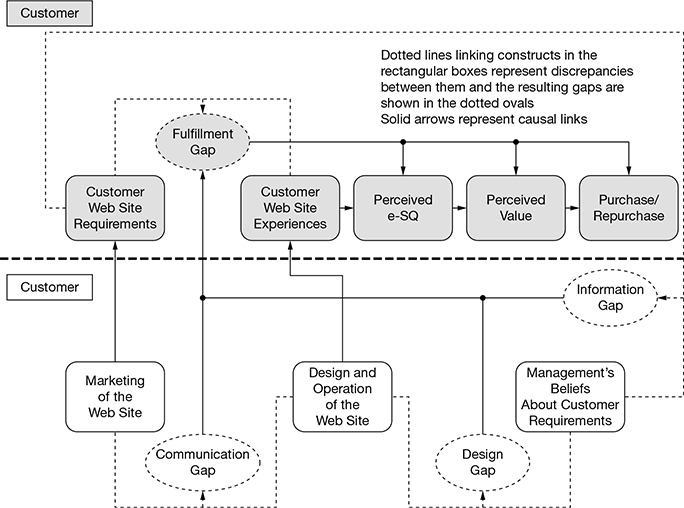
Figure 7.4 Conceptual Model for Improving E-Service Quality (e-SQ)
Since e-service quality measurement through websites is still a growing research concept, several businesses have developed their own methodologies to measure service quality provided by online retailers. Some examples of such methodologies are the ones provided by BizRate.com and Gomez.com. BizRate scale has 10 dimensions: ease of ordering, product selection, product information, price, website performance, on-time delivery, product representation, customer support, privacy policies, and shipping and handling. Gomez.com provides an alternative evaluation system that uses researchers rather than consumers to evaluate sites. Measurement involves direct examination of the website, performance monitoring of various pages on the site, pricing transactions, mock transactions (account opening), interaction with customer service representatives, and a questionnaire filled out by each company.
In contrast to these self-developed methodologies by firms, academic research has also laid out multiple approaches to categorizing e-SQ dimensions which, over time, have been revised with newer or altered dimensions of the original ones. One of the early researches in this area was performed by Zeithaml, Parasuraman, and Malhotra’s (2000), who categorized e-SQ across 11 dimensions:
- Reliability: correct technical functioning of the site and the accuracy of service promises (having items in stock, delivering what is ordered, delivering when promised), billing, and product information
- Responsiveness: quick response and the ability to get help if there is a problem or question
- Access: ability to get on the site quickly and to reach the company when needed
- Flexibility: choice of ways to pay, ship, buy, search for, and return items
- Ease of navigation: functions on the site that help customers find what they need without difficulty and allows the customer to maneuver easily and quickly (back and forth) through the pages
- Efficiency: simple to use site, which is, structured properly, and requires minimum information as input by the customer
- Assurance/trust: reputation of the site and the products or services it sells, as the well as clear and truthful information presented generates confidence in the customer
- Security/privacy: instilling the belief in the customer that the site is safe from intrusion and personal information is protected
- Price knowledge: the extent to which shipping price, total price, and comparative prices during the shopping process can be determined
- Site aesthetics: appearance of the site
- Customization/personalization: how much and how easily the site can be tailored to individual customers’ preferences, histories, and ways of shopping
Firms should have a closer look at the key dimensions shared here to compare and understand how their service quality stacks up against competition and if they are being able to provide the level of service envisioned for their customers.
Leave a Reply