
With an understanding of how loyalty management as a function is shifting in the digital era, in this section, we shall look at the emergence of relationship marketing and how firms need to convert loyalists into advocates to further their cause of increased revenues and customer satisfaction. Relationship marketing as a concept was shared by Christopher (et al. 1991) which, according to him, recognizes that the focus of marketing is to change from making a single transaction to moving on to the next customer, hence, building a relationship with existing customers. He proposed that the objective of relationship marketing is to turn new customers into regularly purchasing clients, and then to progressively move them to become strong supporters of the company (and its product) to finally being active and vocal advocates for the company.
The key differences between transaction marketing and relationship marketing are listed below (Jackson, 1985):
- Transaction marketing: Attracting customers using offensive strategies, for example, encouragement of brand switching; recruiting dissatisfied customers of competitors.
- Relationship marketing: Retaining customers using defensive strategies, for example, minimizing customer turnover, maximizing customer retention.
To make the concept clear, we will take up the ‘Ladder of Customer Loyalty’ which Christopher (et al. 2002) presented to showcase the six key stages which a relationship manager can utilize to help advance relationships up the ladder.
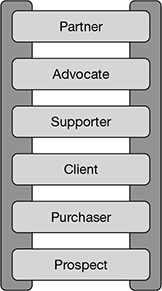
Figure 9.2 Ladder of Customer Loyalty
Figure 9.2 showcases the ascending order of the six stages of relationship marketing which can be explained as follows:
- Prospect: A prospect is one who pays attention to a firm’s promotion and might be persuaded to buy its products.
- Purchaser: A purchaser is a person who has recently bought from the firm or executed any business transaction.
- Client: A client is one who has done business more than once with the firm but his disposition or engagement status with the firm is not necessarily positive.
- Supporter: A supporter is a client who has positive disposition towards the firm but might not be actively engaged with the firm’s activities.
- Advocate: An advocate is a person who is deeply involved with an organization and also influences others through positive word-of-mouth communication.
- Partner: A partner is a client who is working together with the firm for mutual benefit and has a stake in its growth.
Relationship marketing essentially involves knowing each of the firm’s customers, their environment, and present relationship with the brand, and most of this is not a single task. For continuous engagement and to take the prospects up the ladder to the advocate level, Chris Fill (2002) suggested a technique known as DRIP marketing, wherein with the help of four kinds of communication on a regular basis, firms can keep strengthening their relationships with clients. DRIP is an acronym for Differentiate, Reinforce, Inform, and Persuade, which also are the four communication techniques through which marketers can drive their relationship marketing agenda. Let us look at each of these in more detail:
- Differentiate: It helps channel members understand how a manufacturer or a specific product adds value and is different from the competitors and other products that they carry. The best example would be a toothpaste brand like Sensodyne, putting forth teeth ‘Repair and Protect’ as a differentiating theme from market leader Colgate.
- Reinforce: It involves reminding downstream members regularly about their needs, problems, and how the brand is working hard on their behalf to provide them with unique product features and benefits. For example, Bournvita, reinforces mothers regularly by telling them that their product is the best for child’s overall growth.
- Inform: This includes keeping customers informed about multiple brand facets, new initiatives undertaken, market leadership achieved, etc., so that prospects themselves feel as owners of brand growth, thereby develop an urge to advocate the products proactively.
- Persuade: It involves persuading customers regularly to have a look at the features of the product or give specific reasons on why they should buy more or carry extra stock with themselves (which could include long-term benefits/discounts).
In the last section of this part, we will go a bit deeper to understand how brands can drive new digital revenues through higher engagement with brand advocates.
Leave a Reply