
With an understanding of the basics of search engine marketing (paid) campaigns, we would look at the other equally important aspect of search marketing known as SEO or Search Engine Optimization. By definition, SEO consists of all activities and techniques applied towards making a website (and inclusive webpages) rank at the top of any search engine’s organic results listing. The prime aim of any SEO exercise for a marketer is to help generate awareness for its brand website by gaining attention through content relevance and keyword prominence rather than paying for it through SEM campaigns.
As we saw earlier in Chapter 6, section titled, ‘Intent-Based Marketing (Search Marketing),’ a search engine’s key task is to crawl and index billions of websites (and their content), rank the crawled and indexed content, and present the most relevant answers to any particular query by matching them to searched keywords. A look-back at the history of how SEO services emerged, takes us to the time when the key activity behind SEO involved only submitting web page URLs to various search engines which used to crawl pages, index them, and show them up for relevant keywords for which they were developed. With marketers realizing the importance of new traffic generated through SEO and the need to show up in the top 10 results for keywords important to their business, they started manipulating the process first by stuffing keywords onto their titles, content, and keyword meta-tags (we shall cover this concept later). The search engines tried to outsmart by giving higher prominence to incoming links on web pages. The prominence of link management as a concept is also attributed to the emergence of Google’s unique PageRank algorithm which along with incoming links, also shared a host of other parameters which would determine the overall ranking of websites (and webpages) for any keyword query.
Marketers then started newer forms of spamming (to get close to gaming Google’s algorithm) by buying links from other sites, or swapping links in bulk. Search engines again had to qualify this parameter further so that link building retained the distinction of being the quality determinant of the website chosen by other top authority sites and not just developing links with any non-related sites. The above examples showcase the importance of search engine’s ranking algorithms and how search engines like Google, Yahoo/Bing have to keep including newer and more relevant parameters as the online landscape changes and also to reduce spamming techniques so that users get the best results at the top, quality content creation is encouraged, and spamming malpractices are reduced.
To understand the basics behind SEO, we first need to develop an understanding of key classifications like whitehat and blackhat SEO, On-Page and Off-Page optimization, and key concept areas for website execution. Ideally for marketers, SEO should start right from the stage where any website is developed. While we discuss key SEO concepts, we would also share best practices and avoidance strategies (dos and dont’s) for marketers to execute SEO successfully.
Understanding WhiteHat and BlackHat SEO
As shared in the discussion of SEO history, marketers have always tried to be one-up to prove search engines that they are better than other competitors vying for the same PageRank. Practices which are in line with how SEO companies want websites to showcase authority and superiority in their domain are known as whitehat SEO practices while those techniques which search engines find manipulative and which violate the Webmaster guidelines are known as blackhat SEO tactics.
Key examples of whitehat SEO include the website following search engine’s guidelines, developing good quality, useful content, and web pages, and ensuring that the web pages are built for customers rather than search engines. Blackhat SEO (also known as spamdexing) includes practices like paying for link building, keyword stuffing, cloaked pages, including hidden texts and links, among others. Top-of-the-order companies typically make sure that they clearly understand and follow specific search engine webmaster guidelines so that they are not unnecessarily penalized and take time to again retain their rankings status. New or aggressive companies, on the other hand, might be the ones following blackhat activities since they know that developing strong organic rankings takes time, patience, and effort, which they are typically trying to bypass.
Basics of On-Page and Off-Page Optimization
Whitehat and Blackhat SEOs are typical classifications which let marketers know the do’s and dont’s of SEO. To understand how SEO is essentially carried out, we need to look at the definitions of On-Page and Off-Page optimization.
On-page Optimization It includes all activities which can be executed on the web pages themselves for SEO. These are parameters that typically can be controlled by coding on the page. Key activities include keyword development, meta tags management, improvement of quality content, web-page interlinking, etc.
Off-page Optimization It covers activities that take place outside web pages which cannot be controlled just through web page optimization. Key examples include link building, increasing link popularity in directories, leveraging social interactions, guest blogging, etc.
Understanding Key SEO Concepts
In this section, we would understand the key areas which form a part of on-page and off-page optimization and how they impact SEO activities:
- On-page optimization impact parameters:
- Search indexing and website navigation
- Web page tag management
- Quality content and keyword inclusion
- Content discovery and linkages
- Usability/user experience impact
- Off-page optimization impact parameters:
- Link building
- Social reputation
- Website authority and trust
- Personalization and localization
Detailing On-Page Optimization Parameters
- Search indexing and website navigation: Let us begin our understanding of SEO by taking example of the launch of the ‘Xquisite’ watch portal we took earlier for SEM. We start looking at each element of the website and its pages which can be optimized to support higher search engine rankings, the first of them being search engine submission.
- Search engine submission: For a new website like ‘Xqusite.com,’ it is essential to first be listed in key search engines and directories like Google and Yahoo so that when users search for watch-specific content related to this site, the website’s name comes up. The first action point for Xquisite would be to submit their website and business-related details to major search engines and get them included in their list, so that next time, the search engines are able to direct user queries to the website.
- Website navigation: Once search engine details have been submitted and approved, next key aspect for the website is to create a robust and easy-guided navigation structure which starts from the homepage and maps the users’ journeys towards discovering key products and services. Navigation structures, which have an intuitive and logical flow, are not only good for visitors but also for search engines which are able to relate to a clear flow on how the website structure flows.
- URL structure: Easy-to-follow filenames and URL structures are keys to support search engines in crawling better. Since URLs are individual addresses for documents on the web and are also an integral part of the search ad copy, a well-planned URL structure can also help improve search ranking if they include a descriptive use of keywords. For search engines (even if they are good at crawling complex URLs like Google), it should be made sure that enough time is spent so that there are not too many unrecognizable parameters which result in unnecessary penalization.
- Web page tag management: A title tag by definition is an HTML tag placed within the <head> tag of the HTML document. This element is meant to be the precise description of the page’s content. Each page of the website should ideally have a title tag as it tells both users and search engines the specific topic covered in that particular page. Title tag of each page is also displayed as the first line of the search result. For the ‘Xquisite’ watch portal launch, a typical way in which a title tag would be represented in HTML code and also as a headline in the search tag is shown as below:
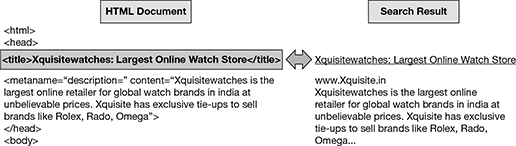 Figure 8.7 Understanding Tag ManagementFigure 8.7 showcases how title tags look like in an HTML document and the same title is used as the headline for the corresponding search result. Below the title tag (in the HTML document) is also provided the meta tag (also known as ’Description Tag’) which gives a brief description of the page. As can be seen in Fig. 8.7, meta tag can also be picked up by search engines as snippets for the search result.
 - Quality content and keyword inclusion: Creating quality text content, which is targeted in nature, is one of the most integral aspects of SEO. Good amount of research should have gone into understanding key visitors and their needs from each web page, followed by the development of easy-to-follow and useful content refreshed regularly with structured headlines, titles, and description for each content piece. An important aspect specific to SEO which needs to be taken care is Canonicalization, which happens when two or more duplicate versions of a web page appear on different URLs. In this case, webmasters need to make sure that each of their content is related to one and only one URL and, if there are multiple versions present, then a canonical tag is used within the page that contains duplicate content which points to the master URL for which the company wants to rank.
- Keyword inclusion: A key aspect of SEO and especially quality content creation is knowledge of major keywords that visitors typically use to search for company-related topics on the web and how marketers intelligently include these keywords not only in title and description tags but across content articles. As discussed earlier, in paid search marketing sections, search engines measure the use of keywords on a page to match the relevance of a query with a particular webpage to direct traffic over there. Pages which have included user-query-relevant keywords in their content/articles wisely have a much higher chance of ranking better in search. Concepts like keyword density and keyword abuse are important because search algorithms are advanced enough to realize whether keywords have been stuffed into articles without context merely for ranking purposes or if they are actually helping visitors with more relevant and usable content. Keyword usage tactics like keyword prominence and placement are important to search marketers and the internet is abound with multiple articles and views on how to best execute and reap benefits from keyword inclusion.
- Content discovery and linkages: A search engine typically does not view a website in the same way a human does. For example, it cannot intuitively understand flash content, rich images, forms, and content embedded within such components. Key considerations for managing each type of content element include:
- Text content: All text content on web pages should ideally be placed in the HTML text on the page.
- Images: Different types of images (jpg, gif, png) should be provided with ALT text to help search engines with a text description of the images.
- Audio/video content: Transcripts of audio/video content should be provided to support indexing of such content by search engines.Content linking is a crucial element of content discovery which involves managing the link tags for all text, images, audio/video so that they can click and move to other related pages as desired. A link tag would typically look like this: <a href=”http://www.Xquisite.in”>Xquisite Watches Online Store</a>Here, the text (http://www.Xquisite.in) is the link referral location which is the destination site, while (Xquisite Watches Online Store) is the anchor text which will be visible on the webpage for the visitor (also typically referred to as Hyperlink) to click. A suitable anchor text is very useful in describing to crawlers the kind of content to which it is linked. This also helps webcrawlers understand internal and external linkages, leading to guided content discovery as the website content owners would want it.
- Key link crawling strategies: With an understanding of the importance of link tags, let us look at some key strategies web developers should follow for robust SEO:
- Managing links in JavaScript, frames or iframes: Typically, it is difficult for search engines to find text and follow links in JavaScript, frames or iframes. As far as possible, HTML should be used so that there are least chances of crawling disruption.
- Effective usage of robots.txt: There might be certain pages which web owners might not want users to discover. For those files, web developers can place robots.txt on those pages which restricts crawlers’ access to them. Search engines like Google also have robot.txt generators which helps create such files.
- Usage of noindex/nofollow: Usage of tags like noindex/nofollow tells the engines whether pages should be indexed/followed or not. Search engines might still go ahead and follow the links but they would not give them primary importance. Nofollow, for example, is typically used in blogs where public commenting is turned on but owners might not want negative comments to be crawled by engines, thus, damaging the reputation of the blog. Apart from these, there are also other tags that can be used by developers like noarchive, nosnippet, etc., which are evident by their names in what they indicate search engines to not follow or execute.
- Usability/user experience impact: The other important allied factors which contribute to SEO are site optimization for web design, usability, and user experience. These factors impart an indirect superiority to the site over competition, which search engines are able to judge in terms of higher incoming traffic, engagement, returns, bookmarking, sharing, etc. We have already covered the basic concepts of user experience and usability in Chapter 7. Let us look in more detail the impact of usability and user experience design on SEO.
- Impact of usability: Since website usability is concerned with measuring the efficiency of users completing a part task on the site, it directly impacts a search engine’s objective of closing the loop on search and being able to complete the requisite task which the user searched for in the first place. Instead of just assuming that the site is usable for target users, it is suggested that web designers use specific tools for usability like Five Second Test, Feedback Army, Silverback App, etc., to accurately test, measure, and fine-tune the most prominent aspects of their sites on various operating systems and platforms.
- Impact of user experience design: It is important to decide the key directive to be given to a web designer. Is it to develop a search-friendly user-centric design or to develop a design which is only search-engine friendly and is aiming at getting a place in the top 10 ratings? This question itself answers the way in which web designers should be looking at developing web pages which is ‘user centric,’ since search engines too push for a user-experience-oriented design rather than designing the site for just higher rankings. Apart from aspects of navigation and URL structuring covered earlier, user experience design also includes looking at aspects like overall information architecture along with consistent design, layout, and labeling of web pages for maximum return on their on-page optimization efforts.
Leave a Reply