
General Classification
In general, classification of lime is based on the calcination of limestone. They are
- Fat lime,
- Hydraulic lime and
- Poor lime
1. Fat Lime
It is the lime which has high calcium oxide content. This can set and become hard only in the presence of carbon dioxide. This is white in colour.
This lime is also called high-calcium lime, pure lime, rich lime or white lime. It is mostly called fat lime as it slakes vigorously. By this process, the volume is increased two-fold.
It is obtained by calcining pure carbonate of lime, which contains about 95% of calcium oxide. The percentage of impurities will be less than 5%.
It has the following specific properties:
- Very slowly hardening
- High degree of plasticity and
- Soluble in water.
The uses of fat lime are as follows:
- It is used as lime mortar (lime and sand) for plastering and pointing works.
- It is used for white washing of plastered surfaces.
- Lime surkhi mortar is used for thick masonry walls, foundations, etc., where surkhi is the powder obtained by grinding burnt bricks.
2. Hydraulic Lime
It is the lime containing small quantities of silica, alumina and iron oxide, which are jointly in chemical composition with calcium oxide. Hydraulic lime can set and become hard even in the absence of CO2 and can set even under water. This is also known as water lime.
Based on the percentage of clay, lime may be classified as (i) Feebly hydraulic lime, (ii) Moderately hydraulic lime and (iii) Eminently hydraulic lime. The increase in clay content makes slaking difficult and increases the hydraulic properties.
The uses of hydraulic lime are as follows:
- It can set under water and in thick walls where there is no free circulation of air.
- As it contains about 30% of clay, it resembles that of cement and can be used for major civil engineering works.
- It forms a thin paste with water.
3. Poor Lime
This lime is also known as impure lime or lean lime. More than 30% of clay present in poor lime makes the lime to slack slowly.
It sets and hardens very slowly and has very poor binding properties. It can form a thin paste with water. Because the lime is of inferior quality, it is used for inferior types of works.
Indian Standard Classification
Limes are classified into six categories as per Bureau of Indian Standards (IS:712–1984). They are explained below.
1. Class A: Eminently Hydraulic Lime
It is available in hydrated form. The compressive strength of lime sand mortar (1:3 by weight) should have 1.75 N/mm2 and 2.8 N/mm2 at 14 and 28 days, respectively. With such a strength they can be used for structural works such as arches, domes, etc.
2. Class B: Semi-hydraulic Lime
This is available as quick lime (lime obtained by calcining pure limestone) or as hydrated lime (dry power obtained by treating quick lime with water). The compressive strength of lime and mortar (1:3 by weight) should have 1.25 N/mm2 and 1.75 N/mm2 at 14 days and 28 days, respectively. This mortar is used for masonry work.
3. Class C: Fat Lime
This should be available in quick or hydrated form. It can be used as the finishing coat in plastering, white washing, etc. It is also used for masonry mortar with the addition of pozzolanic material (it is volcanic dust containing 80% clay with lime magnesia and iron oxide in varying proportions).
4. Class D: Magnesium or Dolomite Lime
This is also available in hydrated or quick form. It is used as the finishing coat in plastering and white washing.
5. Class E: Kankar Lime
The lime is produced by burning lime nodules (found in soils like black cotton soil containing silica) in the hydrated form. It can be used for masonry mortar.
6. Class F: Siliceous Dolomite Lime
It is available in quick or hydrated form. It is generally used as an undercoat and finishing coat of plaster.
5.5 MANUFACTURE OF LIME
Manufacturing of lime comprises three stages, viz.:
- Collection of raw materials
- Burning of limestone and
- Slaking of burnt lime
Collection of Raw Materials
For manufacturing fat lime, the percentage of impurities in limestone should not exceed 5%. Kankar lime may be used for manufacturing hydraulic lime.
Limestones required for the manufacture of specific lime may be collected and slacked in sufficient quantity near the manufacturing site.
Fuels used for calcining limestone are wood, coal, coke, coal gas, charcoal, cinder, oil, etc.
Burning of Limestone
Limestones may be burnt in clamps or kilns. For kiln burning, an intermittent kiln or a continuous kiln may be used.
1. Clamp Burning
When the burnt lime required is small, this method may work out to be more economical. Further, this method can be adoptable in places where limestone and the fuel are available.
The clamp comprises of alternate layers of limestone and fuel. The fuel to be adopted in this case is wood. If the fuel is other than wood, viz., coal or charcoal, the fuel is mixed with the limestone and the clamp is formed. The clamp is of 3.6 m max height with sloped sides. The clamp is covered with mud plaster to prevent the escape of heat (Fig. 5.1).
Clamp burning has several disadvantages, viz., wastage of fuel, is uneconomical, is not a continuous process, can not be produced during the rainy season, etc.
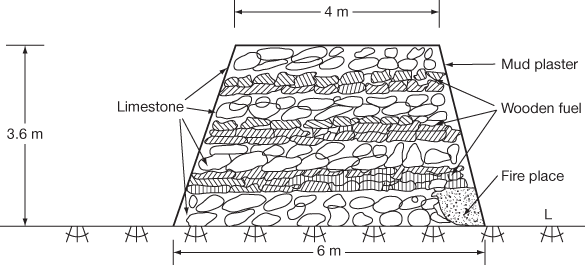
Figure 5.1 Clamp burning
2. Intermittent Kiln Burning
Various kinds of intermittent kilns are in practice, the most prevalent among them being the intermittent flame kiln and the intermittent flare kiln.
The intermittent flame kiln is similar to the clamp kiln. Here the limestone and fuel are arranged in alternate layers between two vertical walls. In some cases vertical flue is also provided. The top of the kiln is covered with unburnt material. The kiln is operated for three days. Then the kiln is cooled and unloaded and the process is repeated.
The intermittent flare kiln is one in which fuel is not allowed to come into contact with limestone. Big pieces of limestone are chosen, and a rough arch is formed over which small pieces of limestone are packed (Fig. 5.2).
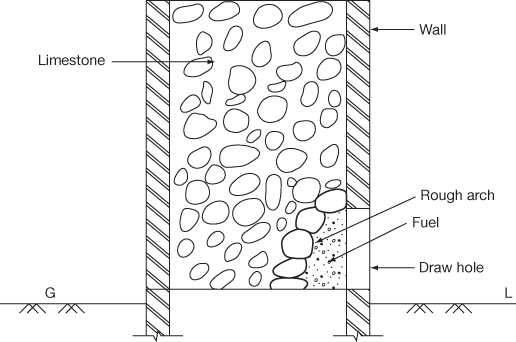
Figure 5.2 Intermittent flare kiln
The fuel is placed below the arch. When it is ignited, only the flame comes into contact with the limestone. After the limestone is adequately burnt, the kiln is cooled and unloaded. This process is then repeated.
This type of kiln is used only for the manufacture of lime on a moderate scale. The main drawback is the wastage of time for every operation.
3. Continuous Kiln Burning
This type of kiln is used when large quantities of lime is needed. In the conventional type, alternate layers of limestone and coal or wood are used. Feeding is done from the top, ignition is done from below, and the lime is collected at the bottom. Such a kiln does not produce high-purity lime as it gets mixed with ash of fuel (Fig. 5.3).
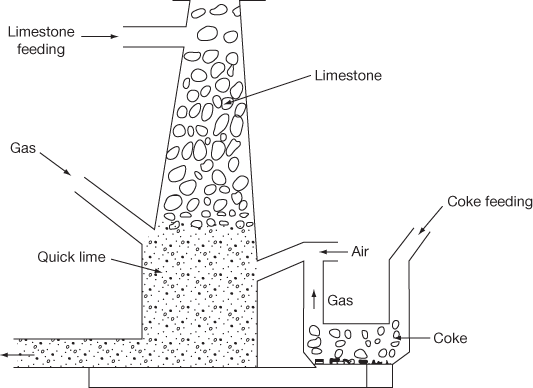
Figure 5.3 Continuous lime kiln
High-purity lime is prepared by using continuous separate feed kilns. The arrangement is shown in Fig. 5.3. Here the limestone is fed from the top and two or four fireplaces are provided by the side of the kiln near the bottom. Coal or wood is used as the fuel, and hot gases of combustion move up the shaft of the kiln. The use of wood as a fuel has an added advantage in that long flames are produced, and the temperature of limestone is not raised too much.
Slaking of Burnt Lime
From quicklime, slaked lime and lime putty are prepared as discussed below:
1. Slaked Lime
Quicklime is heaped on a masonry or wooden platform. Then water is gradually sprinkled over it till the lime is slaked and reduced to a powder form. During the sprinkling of water, the heap is turned over and over again. This process is continued till no more water can be added than that required for the lime to convert into a powder form. The slaked lime is then sieved through an I.S sieve of mesh size 3.35 mm, and the residue if any is rejected. The end product is slaked lime.
2. Lime Putty
Sometimes before using lime in mortar, quicklime is converted into a putty form. For this purpose two large tanks are made, one 50 cm deep and the other 80 cm deep. The first tank is constructed as a pucca masonry at a higher level. The lower level tank is constructed at the ground level. The lower tank is made of dry brick masonry with joints filled with sand.
The upper tank is filled to half of its depth with water. Quicklime is added gradually till it fills half the depth of water. Only lime should be added to water and not otherwise. It is then stirred taking care to ensure that lime at no time is exposed to the air. For about 5 minutes the mixture is stirred till the boiling stops and it thickens. More water is added, if needed, and then the products are allowed to flow to the lower tank.
The mixture is then allowed to stand in the lower tank for 72 hours. As the lower tank is made of dry brick masonry with sand joints, water in the slurry is partly absorbed by the ground and partly through the brick joints. Thus, excess water is removed, and lime putty is obtained as a paste. It can be stored for about two weeks if adequately protected from drying.
Leave a Reply