
Providing Construction Services
An owner wishing to construct a building hopes to achieve a finished project that meets its functional requirements and its expectations for design and quality, at the lowest possible cost, and on a predictable schedule. A contractor offering its construction services hopes to produce quality work, earn a profit, and complete the project in a timely fashion. Yet, the process of building itself is fraught with uncertainty: It is subject to the vagaries of the labor market, commodity prices, and the weather; despite the best planning efforts unanticipated conditions arise, delays occur, and mistakes are made; and the pressures of schedule and cost inevitably minimize the margin for miscalculation. In this high-stakes environment, the relationship between the owner and contractor must be structured to share reasonably between them the potential rewards and risks.
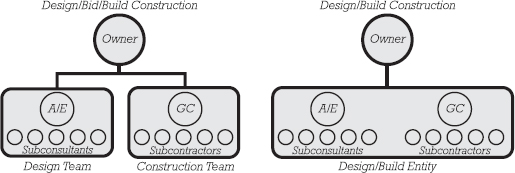
FIGURE 1.8 In design/bid/build project delivery, the owner contracts separately with the architect/engineer (A/E) design team and the construction general contractor (GC). In a design/build project, the owner contracts with a single organizational entity that provides both design and construction services.
Construction Project Delivery Methods
In conventional design/bid/build project delivery (Figure 1.8), the owner first hires a team of architects and engineers to perform design services, leading to the creation of drawings and technical specifications, referred to collectively as the construction documents, that comprehensively describe the facility to be built. Next, construction firms are invited to bid on the project. Each bidding firm reviews the construction documents and proposes a cost to construct the facility. The owner evaluates the submitted proposals and awards the construction contract to the bidder deemed most suitable. This selection may be based on bid price alone, or other factors related to bidders’ qualifications may also be considered. The construction documents then become part of the construction contract, and the selected firm proceeds with the work. On all but small projects, this firm acts as the general contractor, coordinating and overseeing the overall construction process but frequently relying on smaller, more specialized subcontractors to perform significant portions or even all of the construction work. During construction, the design team continues to provide services to the owner, helping to ensure that the facility is built according to the requirements of the documents as well as answering questions related to the design, changes to the work, payments to the contractor, and similar matters. Among the advantages of design/bid/build project delivery are its easy-to-understand organizational structure, well-established legal precedents, and ease of management. The direct relationship between the owner and the design team ensures that the owner retains control over the design and provides a healthy set of checks and balances during the construction process. Also, with design work completed before the project is bid, the owner starts construction with a fixed construction cost and a high degree of confidence regarding the final costs of the project.
In design/bid/build project delivery, the owner contracts with two entities, and design and construction responsibilities remain divided between these two throughout the project. In design/build project delivery, one entity ultimately assumes responsibility for both design and construction (Figure 1.8). A design/build project begins with the owner developing a conceptual design or program that describes the functional or performance requirements of the proposed facility but does not detail its form or how it is to be constructed. Next, using this conceptual information, a design/build organization is selected to complete all remaining aspects of the project. Selection of the designer/builder may be based on a competitive bid process similar to that described above for design/bid/build projects, on negotiation and evaluation of an organization’s qualifications for the proposed work, or on some combination of both. Design/build organizations themselves can take a variety of forms: a single firm encompassing both design and construction expertise, a construction management firm that subcontracts with a separate design firm to provide those services, or a joint venture between two firms, one specializing in construction and the other in design. Regardless of the internal structure of the design/build organization, the owner contracts with this single entity throughout the remainder of the project, which assumes responsibility for all remaining design and construction services. Design/build project delivery gives the owner a single source of accountability for all aspects of the project. It also places the designers and constructors in a collaborative relationship, introducing construction expertise into the design phases of a project and allowing the earliest possible consideration of constructability, cost control, construction scheduling, and similar matters. This delivery method also readily accommodates fast track construction, a scheduling technique for reducing construction time that is described below.
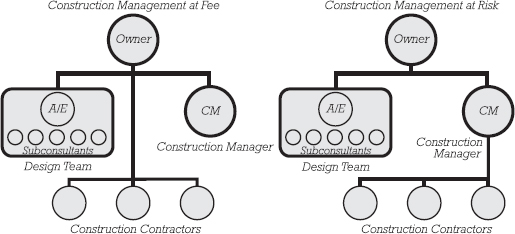
Other delivery methods are possible: An owner may contract separately with a design team and a construction manager. As in design/build construction, the construction manager participates in the project prior to the onset of construction, introducing construction expertise during the design stage. Construction management project delivery can take a variety of forms and is frequently associated with especially large or complex projects (Figure 1.9). In turnkey construction, an owner contracts with a single entity that provides not only design and construction services, but financing for the project as well. Or design and construction can be undertaken by a single-purpose entity, of which the owner, architect, and contractor are all joint members. Aspects of these and other project delivery methods can also be intermixed, allowing many possible organizational schemes for the delivery of design and construction services that are suitable to a variety of owner requirements and project circumstances.
FIGURE 1.9 In its traditional role, a construction manager (CM) at fee provides project management services to the owner and assists the owner in contracting directly for construction services with one or more construction entities. A CM at fee is not directly responsible for the construction work itself. A CM at risk acts more like a general contractor and takes on greater responsibility for construction quality, schedule, and costs. In either case, the A/E design team also contracts separately with the owner.
Paying for Construction Services
With fixed fee or lump sum compensation, the contractor or other construction entity is paid a fixed dollar amount to complete the construction of a project regardless of that entity’s actual costs. With this compensation method the owner begins construction with a known, fixed construction cost and assumes minimal risk for unanticipated increases in cost. On the other hand, the construction contractor assumes most of the risk of unforeseen costs but also stands to gain from potential savings. Fixed fee compensation is most suitable to projects where the scope of the construction work is well defined at the time that the construction fee is set, as is the case, for example, with conventional design/bid/build construction.
As an alternative, compensation may be set on a cost plus a fee basis, where the owner agrees to pay the construction entity for the actual costs of construction—whatever they may turn out to be—plus an additional fee. In this case, the construction contractor is shielded from most cost uncertainty, and it is the owner who assumes most of the risk of added costs and stands to gain the most from potential savings. Cost plus a fee compensation is most often used with projects where the scope of construction work is not fully known at the time that compensation is established, a circumstance most frequently associated with construction management or design/build contracts.
With fixed fee compensation, the builder assumes most of the risk related to unanticipated construction costs; with cost plus a fee compensation, the owner assumes most of this risk. Between these two extremes, many other fee-structuring arrangements can be used to allocate varying degrees of risk between the two parties.
Sequential versus Fast Track Construction
In sequential construction (Figure 1.10), each major phase in the design and construction of a building is completed before the next phase begins. Sequential construction can take place under any of the project delivery methods described previously. It is frequently associated with design/bid/build construction, where the separation of design and construction phases fits naturally with the contractual separation between design and construction service providers.
Phased construction, also called fast track construction, aims to reduce the time required to complete a project by overlapping the design and construction of various project parts (Figure 1.10). By allowing construction to start sooner and by overlapping the work of design and construction, phased construction can reduce the time required to complete a project. However, phased construction also introduces its own risks. Since construction on some parts of the project begins before all design is complete, an overall cost for the project cannot be established until a significant portion of construction is underway. Phased construction also introduces more complexity into the design process and increases the potential for costly design errors (for example, if foundation design does not adequately anticipate the requirements of the not yet fully engineered structure above). Phased construction can be applied to any construction delivery method discussed above. It is frequently associated with design/build and construction management project delivery methods, where the early participation of the construction entity provides resources that are helpful in managing the complex coordination of overlapping design and construction activities.
Construction Scheduling
Constructing a building of any significant size is a complex and costly endeavor, requiring the combined efforts of countless participants and the coordination of myriad tasks. Managing this process requires an in-depth understanding of the work required, of the ways in which different aspects of the work depend upon each other, and of the constraints on the sequence in which the work must be performed.
Figure 1.11 captures one moment in the erection of a tall building. The process is led by the construction of the building’s central, stabilizing core structures (in the photograph, the pair of concrete towerlike structures extending above the highest floor levels). This work is followed by the construction of the surrounding floors, which rely, in part, on the previously completed cores for support. Attachment of the exterior skin can follow only after the floor plates are in place and structurally secure. And as the building skin is installed and floor areas become enclosed and protected from the weather, further operations, such as the roughing in of mechanical and electrical systems, and eventually, the installation of finishes and other elements, can proceed in turn. This simple example illustrates considerations that apply to virtually every aspect of building construction and at every scale from a building’s largest systems to its smallest details: Successful construction requires a detailed understanding of the tasks required and their interdependencies.
The construction project schedule is used to analyze and represent construction tasks, their relationships, and the sequence in which they must be performed. Development of the schedule is a fundamental part of construction project planning, and regular updating of the schedule throughout the life of the project is essential to its successful management. In a Gantt chart, a series of horizontal bars represent the duration of various tasks or groups of tasks that make up the project. Gantt charts provide an easy-to-understand representation of construction tasks and their relationships in time. They can be used to provide an overall picture of a project schedule, with only a project’s major phases represented (Figure 1.10), or they can be expanded to represent a larger number of more narrowly defined tasks at greater levels of project detail (Figure 1.12).
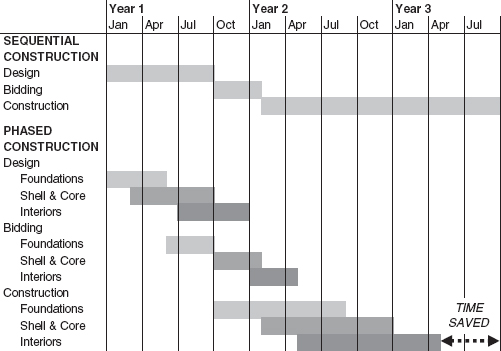
FIGURE 1.10 In sequential construction, construction does not begin until design is complete. In phased construction, design and construction activities overlap, with the goal of reducing the overall time required to complete a project.
The critical path of a project is the sequence of tasks that determines the least amount of time in which a project can be completed. For example, the construction of a building’s primary structural system is commonly on the critical path of a project schedule. If any of the tasks on which the completion of this system depends—such as design, shop drawing production and review, component fabrication, materials delivery, or erection on site—are delayed, then the final completion date of the project will be extended. On the other hand, other systems not on the critical path have more flexibility in their scheduling, and delays (within limits) in their execution will not necessarily impact the overall project schedule.
The critical path method is a technique for analyzing collections of tasks and optimizing the project schedule to minimize the duration and cost of a project. This requires a detailed breakdown of the work involved in a project and the identification of dependencies between the parts (Figure 1.13). This information is combined with considerations of cost and resources available to perform the work, and then analyzed, usually with the assistance of computer software, to identify optimal scheduling scenarios. Once the critical path of a project has been established, the elements on this path are likely to receive a high degree of scrutiny during the life of the project, since delays in any of these steps will directly impact the overall project schedule.
Managing Construction
Once a construction project is underway, the general contractor or construction manager assumes responsibility for day-to-day oversight of the construction site, management of trades and suppliers, and communications between the construction team and other major parties, such as the owner and the designer. On projects of any significant size, this may include responsibility for filing construction permits, securing the project site, providing temporary power and water, setting up office trailers and other support facilities, providing insurance coverage for the work in progress, managing personnel on site, maintaining a safe work environment, stockpiling materials, performing testing and quality control, providing site surveying and engineering, arranging for cranes and other construction machinery, providing temporary structures and weather protection, disposing or recycling of construction waste, soliciting the work of subtrades and coordinating their efforts, submitting product samples and technical information to the design team for review, maintaining accurate records of the construction as it proceeds, monitoring costs and schedules, managing changes to the work, protecting completed work, and more.
FIGURE 1.11 In this photo, the construction sequence of a tall building is readily apparent: A pair of concrete core structures lead the construction, followed by concrete columns and floor plates and, finally, the enclosing curtain wall.
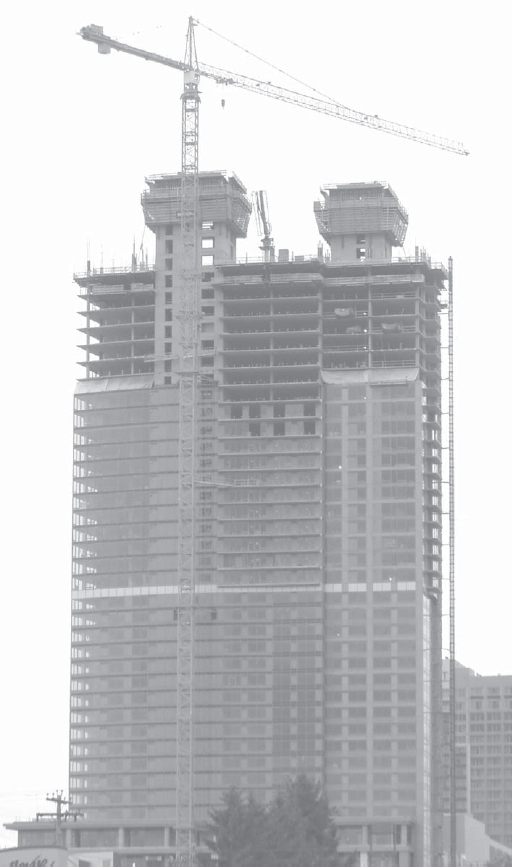
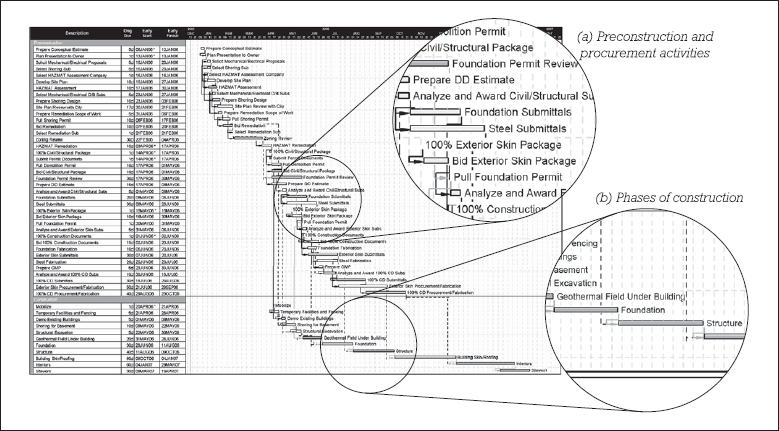
FIGURE 1.12 In a Gantt chart, varying levels of detail can be represented. In this example, roughly the top three-quarters of the chart is devoted to a breakdown of preconstruction and procurement activities such as bidding portions of the work to subtrades, preparing cost estimates, and making submittals to the architect (a). Construction activities, represented more broadly, appear in the bottom portion (b).
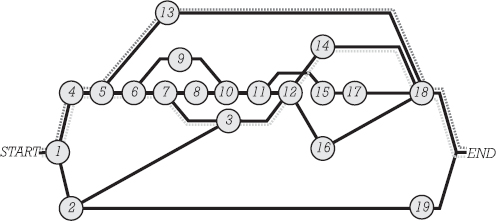
FIGURE 1.13 The critical path method depends on the detailed analysis of work tasks and their relationships to generate an optimal construction schedule. Shown here is a schematic network diagram representing task dependencies. For example, task 6 cannot begin until tasks 1, 4, and 5 are completed, and tasks 7 and 9 cannot begin until task 6 is finished. The dashed lines on the diagram trace two of many possible paths from the start to the end of the diagram. To determine the critical path for this collection of tasks, all such paths must be identified and the time required to complete each one calculated. The path requiring the most time to complete is the critical path, that is, the sequence of activities that determines the least time in which the collection of tasks as a whole can be completed.
Leave a Reply