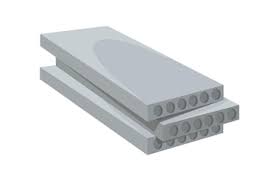
Different types of precast concrete units are discussed below.
9.6.1 Hollow Concrete Blocks
Hollow concrete blocks are manufactured in various shapes and sizes. Blocks of concrete are moulded in a machine. Details of standard size blocks, which are used for different works, are given below:
- Hollow concrete blocks – 39 cm × 19 cm × 30 cm
- Hollow building tiles – 39 cm × 19 cm × 20 cm
- Hollow concrete blocks for partition walls – 39 cm × 19 cm × 10 cm
The face thickness of blocks is maintained as 5 cm or more. Different forms of hollow concrete blocks are shown in Fig. 9.1.

Figure 9.1 Different forms of hollow concrete blocks
Standard hollow blocks are used for the construction of walls and columns. To ensure maximum economy in construction, the overall length and height of walls should be so fixed so as to make maximum use of full and half-length blocks. The availability of the size of hollow blocks should be considered while determining the height of the door and window openings.
Specially shaped blocks are manufactured for corners, sills, lintels and jambs, wall closures, piers between doors and windows, etc., (Fig. 9.2).


Figure 9.2 Special-shaped blocks of hollow concrete blocks
9.6.2 Lintel Units
Prefabricated RCC lintels can be used conveniently over windows, door openings and passage openings. Precast lintels indirectly accelerate the speed of construction as the curing period is eliminated.
Precast RCC lintels are preferred for small spaces up to 2 m (Fig. 9.3) and they are usually cast in wooden moulds and cured well in advance. While laying a precast lintel case care has to be taken to see that the marked face of the lintel is on the top or upper side. All pre-cast lintels are marked with tar or paint at the top so as to distinguish them from the bottom. This is essential, otherwise the position of reinforcement is reversed, which causes structural failure.

Figure 9.3 Cross-section of a precast concrete lintel
9.6.3 Door and Window Frames
Door and window frames can also be prefabricated. Steel bars of about 4–40 mm in diameter run through the frames of the doors or windows. Suitable hard wood blocks are used for fixing hinges, etc., to them. Concrete is vibrated on a table vibrator and then poured into the mould which ensures a durable mix.
9.6.4 Roofing and Flooring Elements
Prefabricated reinforced concrete battens are used instead of wooden battens. For sloping roof, precast reinforced and prestressed concrete trusses may be used. Plain precast concrete tiles can be used for roofing and flooring flat roofs.
9.6.5 Precast Shell Units
Plain or slightly reinforced concrete can be used in the form of precast shell roofing. A suitable frame is made to cast the shell unit. A hessian cloth is spread over it. The cloth is given a sort of sag to maintain the shape of the shell. To regulate the thickness a thin frame of 2.5 cm height is placed. Chicken mesh cut to fit this mould is placed on it. Cement concrete is poured and manually compacted. The frame is made to rest to permit the hessian to sag with wet concrete. Edge beams are also casted. The final positions of the edge beam and the steel are shown in Fig. 9.4. To obtain a level surface the depression is filled with concrete or earth. The shell units may be 1 m × 1 m to about 3 m × 3 m in size.
9.6.6 Sunshade Unit
Sunshades are made 75 mm at the cantilever end and tapered upwards to the depth of the lintel. They come monolithic with lintel. On an average the projection will be 60–90 cm. The main rods of the cantilever of the sunshade can be 8 mm rods at 10 cm centres with 8 mm distributors at 15 cm centres. At least a 20 mm cover is provided. A typical cross-section of a sunshade (Chajja) is shown in Fig. 9.5.

Figure 9.4 Doubly curved precast shell unit used as a roof

Figure 9.5 Sunshade precast concrete unit
Leave a Reply