
After felling trees, the branches are removed and the trunk is cut into logs. Conversion is the process of cutting and sawing logs into suitable sections of timber. In earlier days, it was done manually using saws. Now-a-days, cutting is done by band and circular saws run by machines.
Sawing is done by four methods, viz., ordinary sawing, quarter sawing, tangential sawing, or radial sawing.
Ordinary Sawing
In this method of sawing the log is simply sawed along the diameter. This is the quickest and commonly adopted method. This approach is more economical as wastage of useful timber is minimum. Each cut plank has an outer portion of sapwood and an inner portion of heartwood. But there will be differential shrinkage and warping.
Quarter Sawing
The disadvantage mentioned in ordinary sawing is to some extent avoided in quarter sawing. This method of sawing produces fine timber when the wood has no distinct medullary rays. However, timber cut by this method has a tendency to get bent in the transverse direction (Fig. 10.7(a)).


Figure 10.7 Ordinary and quarter sawing
Tangential Sawing
It is also called plain sawing or flat-grained sawing. This is done tangential to the annular rings. This method produces planks that are susceptible to warping as the medullary rays that give strength to the longitudinal fibres are cut. It is difficult to polish planks evenly (Fig. 10.8).
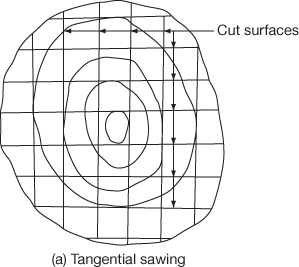
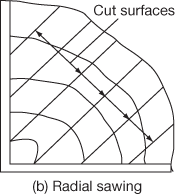
Figure 10.8 Tangential and radial sawing
Radial or Rift Sawing
This is the method adopted for sawing hardwood. This method of sawing produces planks, which do not shrink much. Because of the interplay of grains, it gives a decorative finish. However, maximum wastage occurs by this method of sawing.
Leave a Reply