
In a double-skin façade, the wall system consists of two distinct glass cladding systems separated by an airspace that is wide enough in most cases to allow service personnel to pass between them. Such systems, also variously labeled dual-wall facades or double-skin walls, have long been popular in European building construction and have more recently begun to appear in North American buildings as well. Various configurations of glazing and treatment of the space between the two skins are possible. Most often, one of the two skins is double-glazed, while the other relies on single glass. The interstitial airspace may be ventilated to the interior of the building (when the outer skin is double-glazed) or to the exterior (when the inner skin is double-glazed). Natural ventilation of the building interior through operable openings in both skins is also possible. Ventilation of the interstitial space may be passive, that is, powered by natural convection, or active, accomplished with the aid of fans, and in some cases may be coupled to the building’s HVAC system. Shading devices, such as louvered blinds or roller shades, that may be manually controlled or driven by automatic timers or solar tracking devices, are also frequently integrated into the interstitial space.
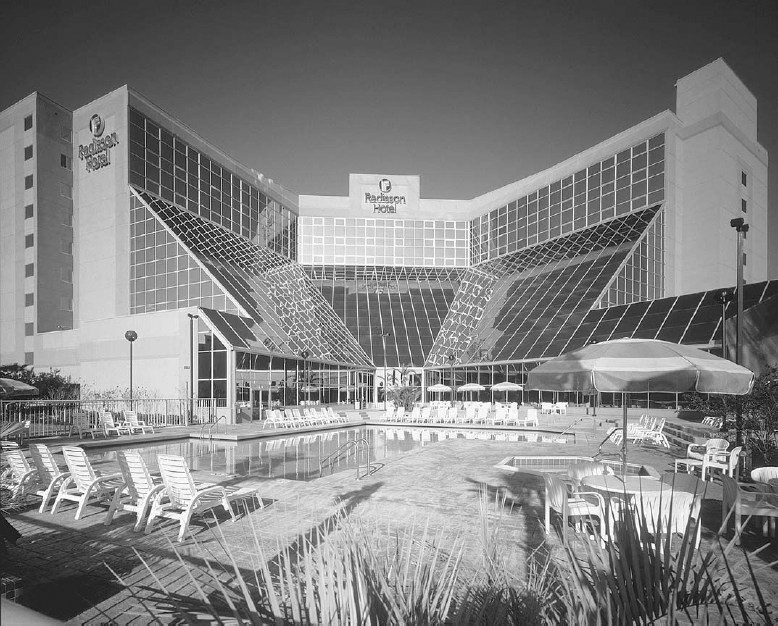
FIGURE 21.27 This hotel in Orlando, Florida, includes massive areas of Kawneer 1600 S.G. sloped glazing. Reflective glass is used to minimize solar overheating of the interior space. (Photo courtesy of Kawneer Company, Inc.)
Double-skin facades can improve the performance of the building enclosure in a variety of ways: They can reduce unwanted solar heat gain, increase daylighting potential, minimize thermal conduction and radiation through the wall system, provide a space for shading elements that is protected from the weather, permit natural ventilation designs in tall buildings, and create a quieter building interior than is possible with conventional glazing systems.
Against the potential benefits of a dual-skin facade system must be weighed its disadvantages: The airspace may subtract as much as 5 to 10 percent of the usable floor area of the building. Though the second skin of the facade may be constructed of less expensive framing and glass than the first skin, this still constitutes a significant increase in construction cost over a traditional curtain wall. And during the life of the building, twice as much glass surface must be washed on a regular basis.
Given these trade-offs, dual-skin facade systems are most appropriate for glass walls that must meet very stringent energy conservation targets, where the building owner’s financial planning allows the higher cost of construction to be amortized over a relatively long time period in which it can be offset by increased energy savings, and where the creation of a high-performance building is an implicit goal of the building program.
Leave a Reply