The ancient Romans built unreinforced concrete vaults and domes as roofs for temples, baths, palaces, and basilicas (Figure 13.2). Impressive spans were constructed, including a dome over the Pantheon in Rome, still standing, that approaches 150 feet (45 m) in diameter. Today, the arch, dome, and vault remain favorite devices for spanning long distances in concrete because of concrete’s suitability to structural forms that work entirely in compression (Figures 14.53–14.55). Through folding or scalloping of vaulted forms, or through the use of warped geometries such as the hyperbolic paraboloid, the required resistance to buckling can be achieved with a surprisingly thin layer of concrete, often proportionally thinner than the shell of an egg (Figure 14.55b).
Long-span beams and trusses are possible in concrete, including posttensioned beams and girders and reinforced deep girders analogous to steel plate girders and rigid frames. Concrete trusses and space frames are not common but are built from time to time. By definition, a truss includes strong tensile forces as well as compressive forces and is heavily dependent on steel reinforcing or prestressing.
Barrel shells and folded plates (Figures 14.54, 14.55c, and 14.56) derive their stiffness and strength from the folding or scalloping of a thin concrete plate to increase its rigidity and structural depth without adding material. Each of these forms depends on reinforcing or posttensioning to resist the tensile forces that it may experience.
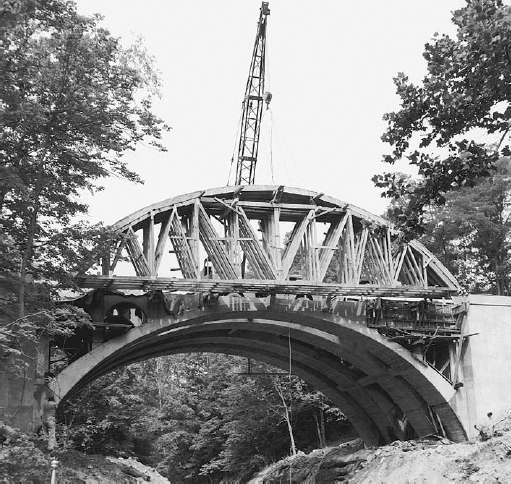
FIGURE 14.53 The same wooden centering was used four times to form this concrete arch bridge. (Courtesy of Gang-Nail Systems, Inc.)
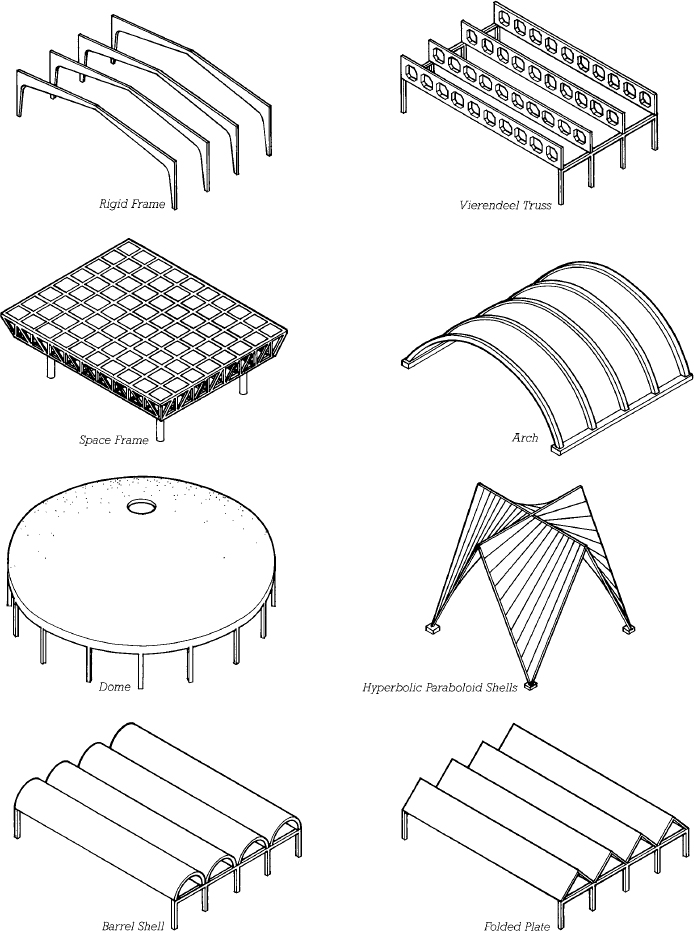
FIGURE 14.54 Examples of eight types of longer-span structures in concrete. Each is a special case of an infinite variety of forms. All can be sitecast, but the rigid frame, space frame, and Vierendeel truss are more likely to be precast for most applications.
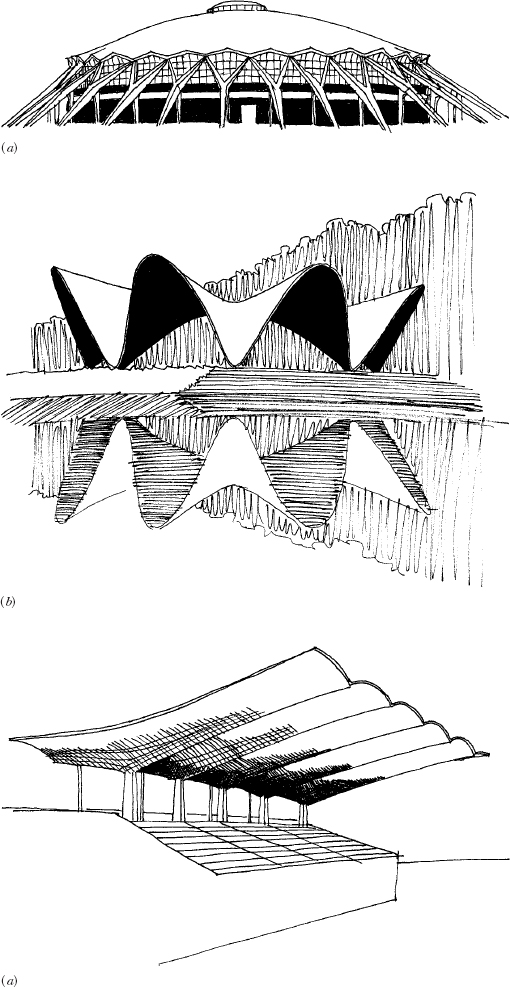
FIGURE 14.55 Three concrete shell structures by 20th-century masters of concrete engineering. (a) A domed sports arena by Pier Luigi Nervi. (b) A lakeside restaurant of hyperbolic paraboloid shells by Felix Candela. (c) A racetrack grandstand roofed with cantilevered concrete barrel shells by Eduardo Torroja. (Drawings by Edward Allen)
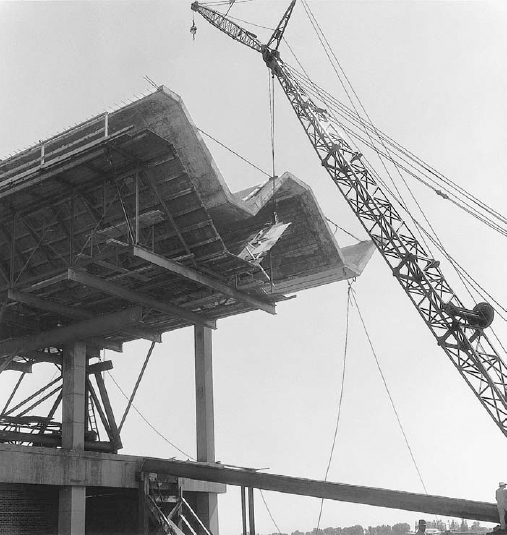
FIGURE 14.56 Flying formwork is removed from a bay of a folded plate concrete roof for an air terminal
Leave a Reply