Posttensioning can be applied to any of the sitecast concrete framing systems. It is used in beams, girders, and slabs, both one-way and two-way, to reduce member sizes, reduce deflection, and extend spanning capability.
Two-way flat plate structures are very commonly posttensioned, especially when spans are long or zoning restrictions on the height of the building require minimal slab depths. The tendon layout, however, is quite different from the conventional reinforcing layout shown in Figure 14.28. Instead of being placed identically in both directions, the draped tendons are evenly distributed in one direction and banded closely together over the line of columns in the other direction (Figures 14.41 and 14.42). This arrangement functions better structurally in posttensioned slabs because it balances the maximum upward force from the banded tendons against the maximum downward force from the distributed tendons. It is also much easier to install than distributed, draped tendons running in both directions. If the structural bay is square, the same number of tendons is used in each direction. The prestressing force from the banded tendons becomes evenly distributed throughout the width of the slab within a short distance of the end anchorages because of corbelling action in the concrete.
As with any prestressed concrete framing system, both short-term and long-term losses of prestressing force must be anticipated. The short-term losses in posttensioning are caused by elastic shortening of the concrete, friction between the tendons and the concrete, and initial movements (set) in the anchorages. The long-term losses are caused by concrete shrinkage, concrete creep, and steel relaxation. The structural engineer calculates the total of these expected losses and specifies an additional amount of initial posttensioning force to compensate for them.
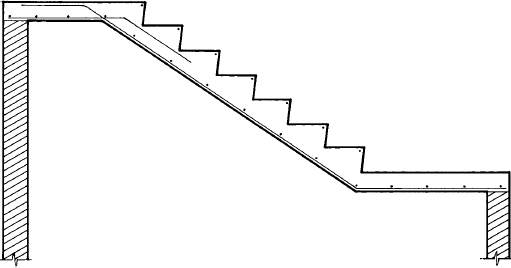
FIGURE 14.40 Section through a simple sitecast concrete stair.
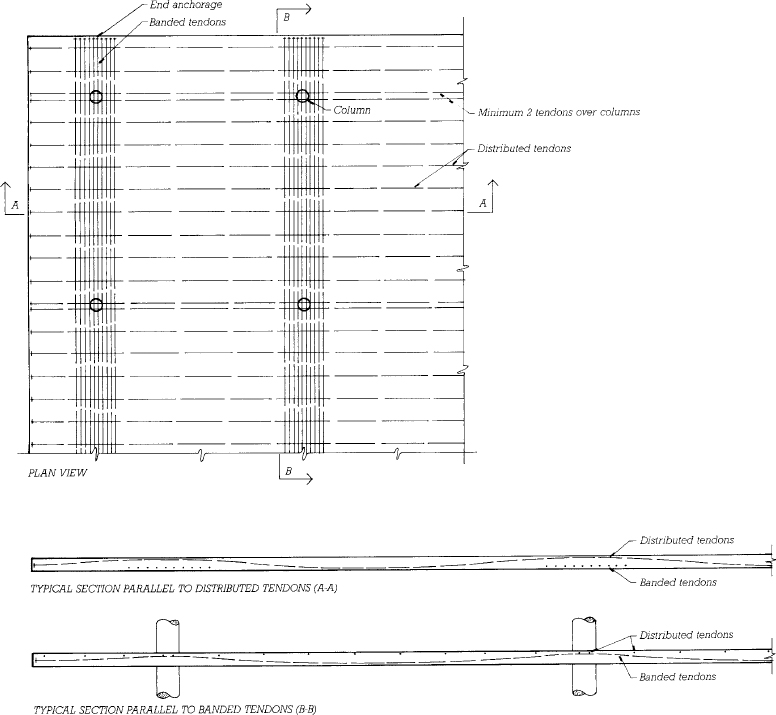
FIGURE 14.41 A plan and two larger-scale sections of the tendon layout in a two-way flat plate floor with banded posttensioning. The number of tendons running in each of the two directions is identical, but those in one direction are concentrated into bands that run over the tops of the columns. The draping of the tendons is evident in the two section drawings. Building codes require that at least two distributed tendons run directly over each column to help reinforce against shear failure of the slab in this region. In addition to the tendons, conventional steel reinforcing is used around the columns and in midspan, but this has been omitted from these drawings for the sake of clarity.
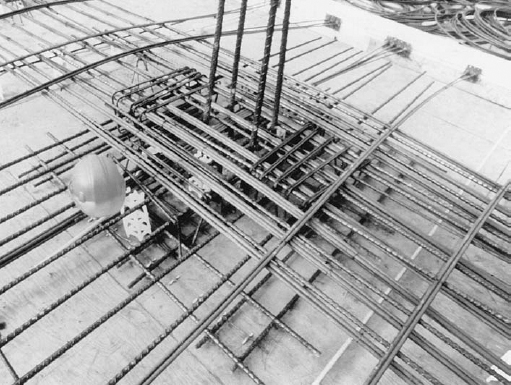
FIGURE 14.42 Banded tendons run directly through the concrete column of this flat plate floor. A substantial amount of conventional reinforcing is used here for shear reinforcing. Notice the end anchorage plates nailed to the vertical surface of the formwork at the upper right; see also Figure 13.40.
Leave a Reply